.svg)
Private vs. Hybrid AI Infrastructure: When to Choose Each Model
Enterprises at a decision point need a clear framework, not another feature list.
What Is Private vs. Hybrid AI Infrastructure?
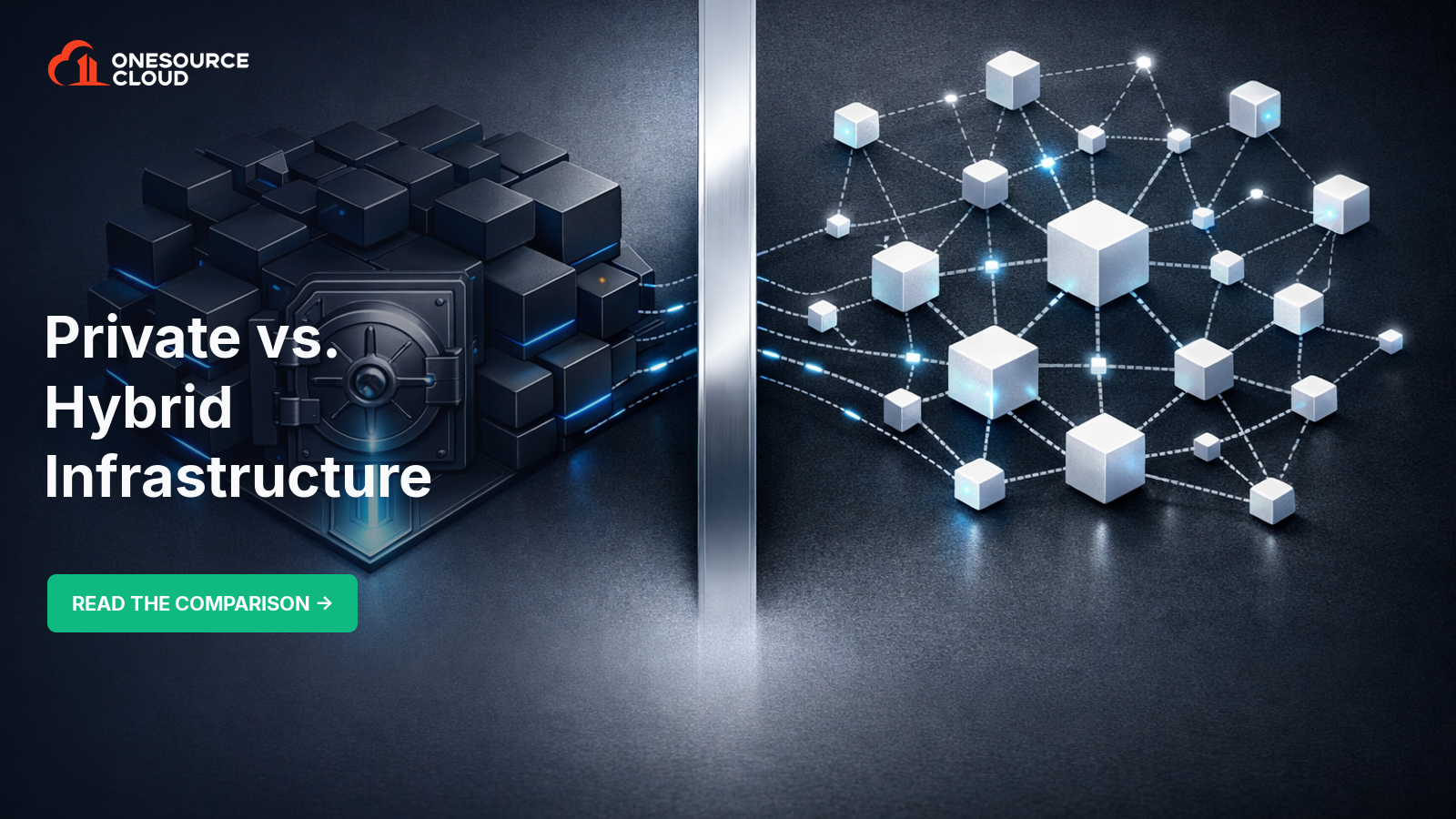
Private AI infrastructure deploys dedicated GPU clusters, compute, and storage exclusively within a single organization's control - on-premises, in a colocation facility, or in a managed private environment operated by a third party. Hybrid AI infrastructure combines private compute with public cloud resources from providers such as AWS, Azure, or Google Cloud, routing workloads across both environments based on cost, capacity, or sensitivity requirements.
The core distinction is data boundary control. Private infrastructure keeps all AI workloads within a defined, auditable perimeter. Hybrid models allow data and compute to cross into shared public cloud tenancy under variable governance conditions - and that variability is where regulated enterprises run into trouble.
Key Takeaways
- Private AI infrastructure gives regulated enterprises a defensible compliance boundary that shared public cloud environments can't replicate by design.
- Hybrid AI deployment introduces governance complexity at the data boundary that most enterprise security teams systematically underestimate.
- GPU on-demand pricing on AWS and Google Cloud spikes during peak demand, making multi-year cost forecasting unreliable for finance and infrastructure teams.
- HIPAA-regulated healthcare institutions running PHI-adjacent AI workloads on public cloud face material audit exposure if their Business Associate Agreements don't cover the specific AI services in use.
- Managed private AI infrastructure eliminates the need for internal DevOps headcount dedicated to GPU cluster operations - typically two or more specialized engineers per deployment.
Private AI Infrastructure vs. Hybrid AI Infrastructure at a Glance
- Compliance Control
- Private AI Infrastructure: Full audit boundary; single tenancy
- Hybrid AI Infrastructure: Partial; depends on workload routing rules
- Cost Predictability
- Private AI Infrastructure: Fixed; hardware costs are known in advance
- Hybrid AI Infrastructure: Variable; public cloud GPU pricing fluctuates
- Performance Consistency
- Private AI Infrastructure: Dedicated resources; no noisy-neighbor effects
- Hybrid AI Infrastructure: Variable; public cloud contention is common
- Data Sovereignty
- Private AI Infrastructure: Data stays within defined perimeter
- Hybrid AI Infrastructure: Data may cross cloud boundaries by design
- Deployment Speed
- Private AI Infrastructure: Longer initial setup; faster at steady state
- Hybrid AI Infrastructure: Faster initial provisioning; governance lag
- Operational Complexity
- Private AI Infrastructure: Low with fully managed operations
- Hybrid AI Infrastructure: High; dual-environment ops require coordination
Private AI infrastructure leads on compliance control, cost predictability, and data sovereignty. Hybrid AI infrastructure offers faster initial provisioning but introduces governance and operational complexity that grows with workload scale.
When to Choose Private vs. Hybrid AI Infrastructure
Private AI infrastructure is usually the better choice when:
- Your organization operates under HIPAA, SOC 2 Type II, GLBA, or NIST 800-53 requirements and must demonstrate a defensible data boundary to a risk committee or external auditor.
- AI workloads process protected health information (PHI), nonpublic personal financial data, or controlled unclassified information that can't traverse shared network infrastructure.
- GPU availability windows and on-demand pricing spikes are blocking your team's ability to commit to internal SLAs or production model deployment schedules.
- You've already purchased NVIDIA H100 or A100 GPU hardware and need operational management without building an internal engineering team.
- Your procurement cycle requires documented infrastructure controls before IT security or legal will approve a production AI deployment.
Hybrid AI infrastructure is often preferable when:
- AI workloads vary sharply between development and production, and non-sensitive experimentation can safely run in a public cloud sandbox.
- The organization doesn't yet have the volume or consistency of AI workload to justify a fixed infrastructure commitment.
- Speed of iteration on non-regulated data matters more than governance uniformity across the stack.
- Your team already manages cloud-native tooling across AWS or Azure and the operational cost of a second environment is well understood and budgeted.
How Private and Hybrid AI Infrastructure Actually Work
Private AI Infrastructure: What the Stack Looks Like
Private AI infrastructure runs workloads on dedicated GPU clusters - typically NVIDIA H100 or A100 hardware - provisioned exclusively for a single organization. No other organization's data or compute jobs share the same hardware, network fabric, or storage layer. Depending on the deployment model, the infrastructure lives on-premises, in a colocation data center under a signed agreement, or in a dedicated cage managed end-to-end by a provider such as OneSource Cloud.
Workload orchestration runs through Kubernetes or Slurm schedulers, depending on whether the environment supports containerized inference workloads or HPC-style batch training jobs. Data encryption at rest and in transit meets NIST 800-53 standards. Access controls are role-based, and every administrative action is logged to support SOC 2 Type II audit evidence requirements.
The critical operational advantage is the absence of shared tenancy. On AWS, Azure, or Google Cloud GPU instances, multiple customers' workloads share the same physical host - at different times, and in some configurations simultaneously. That architecture is incompatible with certain PHI handling requirements under HIPAA and creates the audit exposure that risk committees in healthcare and financial services flag most often.
Hybrid AI Infrastructure: Where the Complexity Concentrates
Hybrid AI deployment places some workloads in a private or on-premises environment and routes others to public cloud GPU capacity - AWS P4d/P5 instances backed by NVIDIA A100/H100, Microsoft Azure ND A100 v4 series, Google Cloud A3 instances, or specialized providers such as CoreWeave or Lambda Labs. The appeal is flexibility: burst capacity when private infrastructure is fully utilized, and public cloud GPU access for non-sensitive experimentation.
The complexity concentrates at the data boundary. Every time a workload or dataset crosses from a private environment into a public cloud tenant, the organization must verify that the data classification, the data handling agreement, and the specific cloud AI service all fall within the same compliance scope.
HIPAA Business Associate Agreements don't automatically extend to every AWS or Azure AI service - each service requires individual review and must be added to the BAA. Multiply that review cycle across a hybrid architecture with multiple cloud providers and multiple AI services, and you've consumed security team bandwidth that most organizations haven't budgeted.
The Managed Private Model Fills a Real Gap
The debate between "own your hardware" and "buy AWS" obscures a third operational model: fully managed private AI infrastructure, where a dedicated provider owns or operates the management layer while the organization retains full data control and compliance documentation. This model removes the two-FTE MLOps requirement that internal private deployments typically carry, while preserving the compliance boundary that hybrid models compromise.
For a regulated enterprise running 10 to 50 GPUs, the difference between AWS on-demand GPU pricing plus internal DevOps headcount versus a fixed-price managed private infrastructure contract is material to the annual budget. More importantly, it removes the variable that makes multi-year AI investment planning unreliable.
Use Cases by Industry
Healthcare
Clinical AI workloads - ambient clinical documentation, prior authorization automation, diagnostic imaging model inference - require PHI-safe compute environments. Running these workloads on private infrastructure with a signed HIPAA Business Associate Agreement and documented NIST 800-53 controls lets health systems clear IT security review without a six-month delay. Academic medical centers managing NIH-funded research data with de-identification requirements also benefit from the audit trail that private infrastructure provides.
For healthcare institutions building or scaling AI for healthcare deployments, the compliance architecture needs definition at the infrastructure layer - not as an afterthought addressed through policy documents.
Financial Services
Regional banks, insurance carriers, and asset managers building fraud detection, credit risk scoring, and customer behavior models face InfoSec and regulatory review that public cloud environments routinely fail. SOC 2 Type II evidence, data residency documentation, and GLBA-aligned access controls are standard requirements from internal compliance teams before a model reaches production. Private GPU infrastructure that ships pre-configured compliance documentation compresses the approval cycle.
Research and Higher Education
R1 universities and academic medical centers receiving NSF, NIH, or Department of Defense grant funding frequently operate under data use agreements that specify controlled compute environments. Genomics pipelines, climate modeling workloads, and social science research involving sensitive survey data all require documented infrastructure controls. Shared public cloud GPU environments often don't meet the specific data handling requirements written into federal grant agreements.
Government and Defense-Adjacent
Federal agencies and defense contractors running AI under FedRAMP-adjacent compliance frameworks require infrastructure that can be inventoried, audited, and physically scoped. Hybrid environments that extend into commercial public cloud tenancy introduce authorization boundary ambiguity that federal IT security officers can't approve.
Why This Matters
The decision between private and hybrid AI infrastructure isn't an architectural preference - it's a business risk and procurement decision. Security teams, compliance officers, and risk committees are the actual blockers in regulated enterprise AI deployments, not engineering teams. An architecture that can't produce HIPAA BAA documentation, SOC 2 Type II audit evidence, or a NIST 800-53 control mapping within a procurement review cycle will stall the project, regardless of how well the model performs in a sandbox.
The Real Cost of Compliance Delays
Projects in regulated industries routinely sit in pilot for six to twelve months not because the AI technology is immature, but because the infrastructure can't clear the internal approval process. Pre-certified private infrastructure with documented controls doesn't just address a compliance checkbox - it changes the procurement timeline in a way that compounds over the duration of the AI program.
The operational cost argument stands on its own. Building an internal team to manage GPU clusters - sourcing engineers with NVIDIA CUDA, Kubernetes, and Slurm expertise in a tight labor market - is a six-to-twelve-month recruiting effort that distracts infrastructure leadership from the actual AI roadmap. Fully managed private infrastructure removes that constraint without requiring the organization to surrender data control.
Request a private infrastructure assessment
Private AI Infrastructure vs. AWS vs. Azure vs. Google Cloud vs. CoreWeave
- Compliance Control
- Private (Managed): Full; single-tenant perimeter
- AWS: Partial; BAA coverage varies by service
- Azure: Partial; BAA available; service scope varies
- Google Cloud: Partial; limited healthcare-specific controls
- CoreWeave: Limited; no dedicated HIPAA BAA framework
- Cost Stability
- Private (Managed): Fixed; no demand-based spikes
- AWS: Variable; P4d/P5 on-demand pricing fluctuates
- Azure: Variable; reserved instance discounts available
- Google Cloud: Variable; A3 instance pricing subject to demand
- CoreWeave: Variable; spot pricing model
- Dedicated Resources
- Private (Managed): Yes; exclusive GPU cluster
- AWS: No; shared tenancy on physical hosts
- Azure: No; shared tenancy
- Google Cloud: No; shared tenancy
- CoreWeave: Partial; single-tenant options available
- Data Residency
- Private (Managed): Defined perimeter; auditable
- AWS: Configurable but shared infrastructure
- Azure: Configurable; region-locked options exist
- Google Cloud: Configurable; data may replicate across zones
- CoreWeave: Limited documentation
- Audit Evidence
- Private (Managed): Pre-built; BAA, SOC 2, NIST mapping available
- AWS: Self-managed; customer responsibility
- Azure: Self-managed; customer responsibility
- Google Cloud: Self-managed; customer responsibility
- CoreWeave: Minimal
Private managed infrastructure delivers the strongest compliance control and cost stability in this comparison. AWS and Azure offer configurable data residency but shift compliance documentation responsibility to the customer, adding internal security team burden. Google Cloud and CoreWeave provide GPU capacity at scale but offer limited pre-built compliance documentation for HIPAA or SOC 2 Type II requirements.
How to Decide
Choose private AI infrastructure if:
- Your organization is subject to HIPAA, SOC 2 Type II, GLBA, or federal data use agreements that require a documented, auditable compute boundary.
- Your risk committee or IT security team has blocked a public cloud AI deployment due to PHI exposure, data residency, or shared tenancy concerns.
- GPU availability or pricing unpredictability is blocking your team from committing to production SLAs.
- You've purchased NVIDIA H100 or A100 hardware and need management without hiring a dedicated infrastructure team.
- You're planning AI workloads at a scale where fixed infrastructure costs produce a more predictable total cost than variable cloud consumption.
Choose hybrid AI infrastructure if:
- Your AI workloads are clearly segmented between regulated data (requiring private compute) and non-sensitive experimentation (acceptable on public cloud).
- Workload volume is inconsistent and burst capacity from AWS, Azure, or CoreWeave fills a real production gap.
- Your organization has an existing cloud-native operations model and the tooling to manage cross-environment governance is already in place.
- The compliance and legal review for your specific use case has already cleared a hybrid architecture as acceptable.
Key Statistics
- NIST 800-53 security and privacy controls are the referenced standard for federal and healthcare AI infrastructure security requirements in U.S. government and healthcare risk frameworks.
- Under HHS HIPAA guidance, covered entities and business associates must execute a Business Associate Agreement before any vendor processes, stores, or transmits PHI - this requirement applies to cloud AI service providers individually, not to cloud platforms as a whole.
Expert Insight
In regulated enterprise deployments, the infrastructure approval process almost always moves faster when compliance documentation arrives with the infrastructure proposal rather than after it. Risk committees in healthcare and financial services aren't evaluating the AI model - they're evaluating the evidence package.
Organizations that bring a pre-built HIPAA BAA, a SOC 2 Type II report, and a NIST 800-53 control mapping to the first IT security review meeting compress procurement timelines measurably compared to organizations that assemble that documentation during the review cycle. The infrastructure architecture is secondary to the audit artifact.
Related Questions
What is GPU contention and why does it affect AI workloads on public cloud?
GPU contention occurs when multiple tenants share the same physical GPU hardware, causing compute jobs to queue behind or compete with other organizations' workloads. On AWS and Azure GPU instances, this shared tenancy can introduce latency and throughput variability that makes production model serving SLAs difficult to maintain.
Is HIPAA compliance possible on AWS?
AWS offers a HIPAA-eligible services list and a Business Associate Agreement, but compliance responsibility is shared with the customer. Not every AWS AI service is covered under the BAA, and organizations must verify that each specific service used to process PHI falls within the documented scope - a review that often requires dedicated security team time.
How many GPUs does a regulated enterprise typically need to justify private infrastructure?
There's no universal threshold, but organizations running sustained AI workloads across 10 or more NVIDIA H100 or A100 GPUs generally find that fixed private infrastructure costs compare favorably to AWS or Google Cloud on-demand pricing when factored over a twelve-to-twenty-four-month period, especially when internal MLOps headcount is included in the cost model.
What is the difference between colocation and fully managed private AI infrastructure?
Colocation provides physical rack space and power for hardware the organization owns and operates. Fully managed private AI infrastructure includes hardware provisioning, monitoring, firmware management, workload orchestration, and compliance documentation - removing the operational burden from the organization's engineering team while preserving data boundary control.
Can a hybrid AI architecture satisfy HIPAA requirements?
A hybrid architecture can satisfy HIPAA requirements if every environment that handles PHI - including any public cloud component - is covered by an executed BAA and meets the organization's documented security controls. In practice, extending that coverage across multiple cloud providers and AI services requires ongoing legal and security review that many organizations underestimate.
Frequently Asked Questions
How long does it take to deploy a private GPU cluster?
Initial deployment timelines for a managed private GPU cluster typically run four to eight weeks from architecture design through go-live, depending on facility readiness, hardware lead times for NVIDIA H100 or A100 units, and the complexity of network integration with existing EHR systems or data pipelines. Organizations with existing colocation agreements can sometimes compress this timeline.
Can OneSource Cloud manage GPU hardware we already own?
Yes. The Customer-Owned Hardware Management Service covers full lifecycle management of enterprise-owned GPU hardware deployed at customer facilities or colocation sites, including remote monitoring, firmware updates, and scheduled maintenance executed by OneSource Cloud engineering teams.
What compliance frameworks does managed private AI infrastructure support?
OneSource Cloud infrastructure is designed to support compliance with HIPAA (including BAA execution), SOC 2 Type II, and NIST 800-53 standards. Organizations in financial services subject to GLBA or data residency controls can request documentation specific to their regulatory environment.
What workload schedulers does the platform support?
The OnePlus™ Management Platform integrates with both Kubernetes for containerized AI inference and serving workloads and Slurm for HPC-style batch training jobs, supporting the full range of AI workload types common in healthcare, research, and financial services environments.
What happens if we need to scale GPU capacity after initial deployment?
Capacity expansion is handled through the managed operations model - organizations don't need to source additional hardware independently or expand an internal engineering team. OneSource Cloud manages hardware provisioning and integration as part of the ongoing service relationship.
Is there a minimum contract length?
Contract structures vary based on deployment model and hardware configuration. Organizations evaluating a multi-year commitment can request a private infrastructure assessment to scope requirements before committing to a specific contract term.
How does pricing differ from AWS or Azure GPU instances?
Private managed infrastructure uses a fixed pricing model based on hardware configuration and management scope rather than on-demand consumption. This eliminates the GPU pricing spikes common on AWS P4d/P5 and Google Cloud A3 instances during high-demand periods and makes multi-year infrastructure budgeting predictable.
Can private infrastructure connect directly to hospital EHR systems?
Yes. The Healthcare AI Infrastructure Suite includes dedicated connectivity options including direct fiber links to hospital networks and EHR systems, allowing AI workloads to access clinical data without routing through public internet infrastructure.
Summary
Private AI infrastructure gives regulated enterprises a defined, auditable compute boundary that hybrid models can't replicate by design. Hybrid AI deployment strategies offer flexibility and burst capacity but introduce governance complexity at every data boundary crossing - complexity that healthcare and financial services security teams pay for in review cycles, not just architecture diagrams.
The decision isn't primarily technical. It's a compliance, budget, and operational headcount question. Organizations that bring pre-certified infrastructure controls to their first risk committee review move from pilot to production faster than those that build compliance documentation after the fact. For enterprises running AI workloads on PHI, financial data, or federally regulated research datasets, the audit boundary is the product.
Sources
Related Resources
Talk to an AI Infrastructure Architect
If your organization is evaluating whether private AI infrastructure, a hybrid model, or a managed private deployment fits your compliance requirements and GPU workload profile, OneSource Cloud can scope the architecture, document the compliance framework, and define a deployment path before you commit to a procurement decision.
