
What Is an AI Orchestration Platform vs MLOps Operations
Quick Answer: An AI orchestration platform is the control plane that allocates GPUs, workspaces, and quotas on a cluster, while MLOps operations are the practices and tools that version models, run training pipelines, and promote them to serving. Orchestration answers “who gets which GPU.” MLOps answers “which model is this and how did it get here.” Enterprises need both. One tool label should not pretend to be the other.
Buyers collapse the words because Kubernetes, Kubeflow, and a notebook server sit in the same screenshot. That is how a model registry gets asked to enforce GPU reclaim, and how a scheduler gets asked to be an experiment tracker. Split the layers, then stack them on private GPUs.
Two layers, two jobs
| Layer | Primary objects | Failure if you skip it |
|---|---|---|
| AI orchestration | GPUs, queues, quotas, identities, notebooks | Teams fight for cards; idle notebooks win |
| MLOps operations | Runs, datasets, registries, CI, promotion | Nobody can reproduce the model in production |
Kubeflow can sit near both. It still does not replace a quota policy. MLflow does not reclaim a GPU. SageMaker-style managed jobs mix layers in one vendor product. You can buy that mix. You should still know which knob is which when a launch is blocked on quota versus blocked on a missing artifact.
When you need orchestration more than another MLOps UI
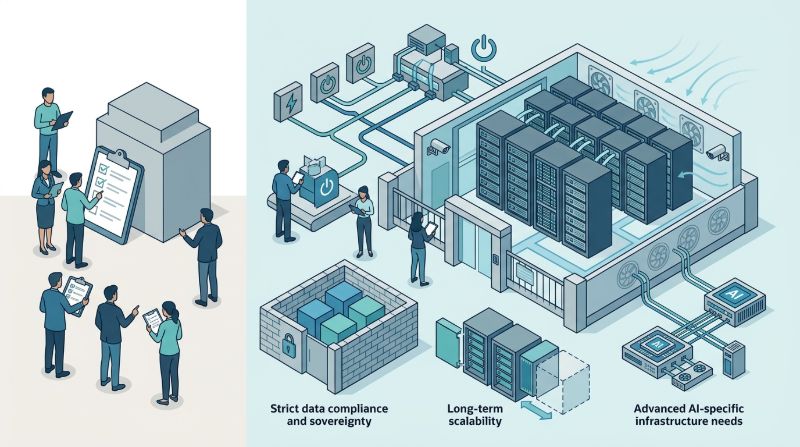
Several teams share exclusive GPUs. Teaching and research share a campus cluster. Inference must not sit in a fair-share training queue. Those are orchestration problems. Adding a prettier experiment UI will not expire Jupyter. Adding GPUs without identities will not either.
When you already have GPU policy and cannot promote a model safely, you have an MLOps operations gap. Build pipelines and registries on top of the cluster you can schedule. Do not invert the order if cards are already scarce.
How OnePlus maps
Platform Decision Matrix: Enterprise AI Cluster Orchestration
| Orchestration Model | Topology-Aware Scheduling | Preemption & Fair-Share Quotas | Enterprise Toolchain Integration | Infrastructure Operational Overhead |
|---|---|---|---|---|
| Vanilla Kubernetes / Default Scheduler | Basic node bin-packing; blind to NVLink / PCIe socket boundaries | Manual namespace quotas; prone to GPU allocation fragmentation | Native cloud-native container ecosystem | High manual YAML and operational complexity for AI teams |
| Legacy Slurm (Self-Managed) | Static topology maps; lacks cloud-native dynamic scaling | Rigid batch queueing; poor interactive notebook lifecycle control | HPC script-centric; decoupled from modern web/API inference | Heavy specialized Linux and HPC engineering maintenance |
| OnePlus™ Platform (OneSource Cloud) | Automated NVLink, NVSwitch, and RoCE topology-aware gang placement | Dynamic fair-share scheduling, automated notebook idle preemption | Non-disruptive dual integration with Slurm and Kubernetes workflows | Fully managed enterprise control plane on dedicated bare-metal |
OnePlus, OneSource Cloud’s AI orchestration platform, is the GPU workspace, quota, and scheduling layer on private AI infrastructure. It is not a claim to replace every MLOps tool. Teams still pick trackers and CI. They should run those tools on a cluster that already has identities. Managed operations keep the orchestration layer alive. Research and product teams can still use research-oriented or SaaS patterns on top. Orchestration first if the fight is GPUs. MLOps first if the fight is provenance and you already have spare exclusive capacity, which is rare.
FAQ
What is an AI orchestration platform?
It is software that turns GPU servers into a multi-team environment: login, quota, queues, workspaces, and often job monitoring. It sits above the devices and below the data-science workflow. Without it, a private cluster is a pile of SSH aliases. With it, fair share and reclaim can exist as policy instead of Slack.
What is MLOps if it is not orchestration?
MLOps operations are how models are built, recorded, tested, and released: experiment tracking, feature and model registries, CI, and promotion gates. Those tools consume GPUs. They should not be the GPU policy. A registry that cannot start a job is still a registry. A scheduler that cannot version a model is still a scheduler.
Can Kubeflow or SageMaker be both?
They can bundle pieces of both. You still have to configure GPU quota, identity, and model promotion as separate concerns. A bundle that is misnamed will be mis-operated. Write down which screens own cards and which screens own artifacts.
Do we need OnePlus if we already have MLflow?
If several teams share exclusive GPUs, you still need an orchestration layer. MLflow will not reclaim notebooks. OnePlus is OneSource Cloud’s orchestration platform for that layer. You can keep MLflow. Run it as a workload on the cluster, not as a substitute for quota.
Which layer should we buy first?
If GPUs are contended, orchestration first. If GPUs are idle and releases are chaotic, MLOps operations first. Most enterprise AI programs hit contention earlier than they admit. Idle GPUs with a long queue are an orchestration smell, not an MLOps smell.
Summary
AI orchestration allocates GPUs and identities. MLOps operations version and promote models. Stack them; do not rename one as the other. If exclusive U.S. GPUs need a real control plane, use OnePlus on OneSource Cloud and keep your tracker as a workload, not as the scheduler.
Related Articles
Recommended Reading
-
How Paged Attention Manages Inference KV Cache
-
Google Cloud GPU Pricing: What Enterprise AI Teams Should Evaluate Before Provisioning
-
Paperspace Pricing 2026: GPU Cost Breakdown
-
AI Infrastructure Costs: Controlling Enterprise GPU Spending
-
CoreWeave Enterprise GPU Cloud: Evaluation for AI Teams
-
CoreWeave vs Lambda Labs: GPU Cloud Provider Comparison
-
AWS GPU Pricing: Instance Types, Cost Structure & Alternatives Guide
-
CoreWeave Alternatives: Compare GPU Clouds
latest articles
-
The GPU Operations Responsibility Split Across Delivery Models
-
HIPAA-Ready GPU Infrastructure: Healthcare AI BAA & Enclaves
-
Ethernet vs InfiniBand for AI: Packet Loss, RoCE & Latency Tradeoffs
-
Data Sovereignty vs Flexible Cloud Regions and the Architecture Decision
-
Protecting AI Model IP with the Infrastructure Isolation Ladder
-
Managed Private GPU Cloud Pricing: TCO, Utilization & Egress
-
Multi-Node LLM Training Orchestration: 3D Parallelism & Fabrics
-
Is a Dedicated GPU Worth the Price Premium? Break-Even Math and What Else It Buys
-
Dedicated GPU Commitment Utilization Thresholds and the Floor Rule
-
Private GPU Cloud Red Flags: Vendor Evaluation Due Diligence