
Is a Dedicated GPU Worth the Price Premium? Break-Even Math and What Else It Buys
The dedicated-versus-shared GPU question arrives dressed as a price question and leaves as an arithmetic question. Practitioner guidance quotes the thresholds — around 70 percent sustained utilization, roughly 500 monthly hours — but thresholds without arithmetic transfer badly between quotes, and the arithmetic alone ignores what else the premium buys. This page assembles the full decision: what the premium contains, how to compute your own break-even from two real quotes, and which workloads should politely refuse to pay at any price.
Quick Answer: Is a Dedicated GPU Worth the Price Premium?
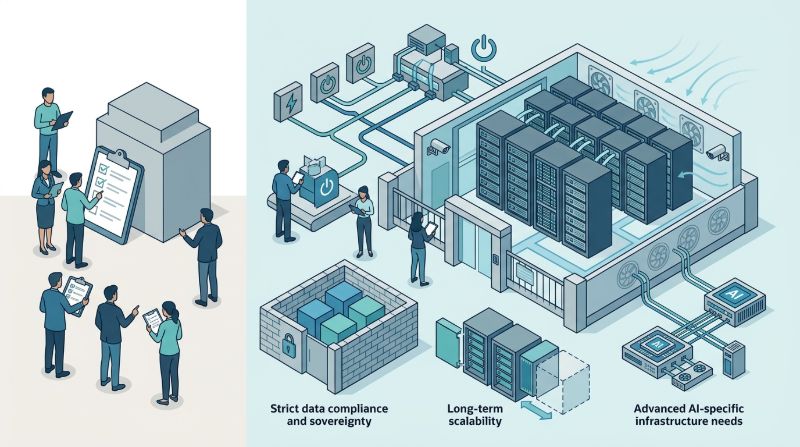
It depends on your utilization histogram, and you can compute it: dedicated wins when sustained utilization exceeds roughly 1 minus the discount ratio — landing near 70% utilization or ~500 monthly hours on typical terms. The premium also buys three separable non-cost goods: performance consistency (no noisy neighbors), exclusivity (capacity at peak, compliance evidence), and cost predictability (flat rates). Pay for steady production and regulated workloads; refuse for bursty experiments that cannot consume certainty; split mixed portfolios. Flat-rate capacity like the enclaves OneSource Cloud prices converts all three premiums into one monthly line.
What the Premium Actually Buys
The dedicated premium buys three separable things: performance consistency (dedicated VRAM delivers its full bandwidth — 2,000 to 4,800 GB/s on modern data-center GPUs — with no neighbor variance documented on shared instances), exclusivity (the capacity is yours at peak, not contended), and cost predictability (flat rates versus metered variance). Pricing each matters because workloads value the three differently: latency-sensitive serving pays for consistency, regulated workloads pay for exclusivity evidence, and finance pays for predictability regardless of utilization.
| Premium Component | Evidence It Is Real | Who Values It Most |
|---|---|---|
| Consistency | Dedicated VRAM bandwidth; neighbor variance on shared hosts | Latency-sensitive serving |
| Exclusivity | Capacity at peak; tenancy evidence for audits | Regulated workloads |
| Predictability | Flat rate versus metered variance | Finance and budget owners |
Separating the three matters for the refusal list as much as the pay list. An experimentation workload values none of them — its demand is irregular, its data is unregulated, and its budget tolerance is high — so the premium purchases nothing it can consume. A clinical inference workload values all three simultaneously, which is why the conversation there is never really about the hourly delta.
The Break-Even Arithmetic
The arithmetic is simple and the practitioner thresholds encode it: dedicated wins when sustained utilization exceeds roughly one minus the discount ratio — which lands near 70 percent on typical one-year terms and near 500 monthly hours for common configs — because below that point you pay the full flat rate for idle silicon while shared billing charges only for use. Compute it for your own quotes: take the dedicated monthly rate, divide by the shared effective per-hour rate including egress and idle minimums, and the quotient is your break-even utilization; published rules of thumb are calibration, not answers.
| Input | Where It Comes From |
|---|---|
| Dedicated monthly rate | Your quote (include support scope) |
| Effective shared per-hour rate | Metered rate + egress + idle minimums, averaged |
| Break-even utilization | Dedicated rate ÷ effective rate |
| Your utilization | Ninety-day histogram of consumed capacity hours |
The worked form makes the threshold honest: if dedicated costs 2,400 dollars monthly per GPU and your effective shared rate is 3.20 dollars per hour, the break-even is 750 hours — about 31 days at full tilt, or roughly 60 percent of a month's hours — and your histogram, not the vendor's case study, decides whether you clear it. Note what the formula quietly includes: the effective shared rate carries egress and idle minimums, which is where hidden-cost analyses remind us the metered side is never as cheap as its headline. Every quote pair produces a different threshold, which is why the published 65-to-80-percent ranges are calibration and the division is the answer.
The Decision Framework: Pay, Refuse, or Split
Pay the premium for steady production inference and long training runs above your computed break-even, for regulated workloads that need exclusivity evidence, and wherever metered bill variance has become an organizational failure — the flat-rate dedicated model, such as the enclaves OneSource Cloud prices with zero egress fees, converts those premiums into one predictable line. Refuse it for experimentation, hyperparameter search, and bursty jobs that cannot consume certainty. Split portfolios deliberately: shared capacity for the bursty share, dedicated for the steady share — the refusal to split, in either direction, is where budgets actually break.
| Workload | Verdict | Deciding Factor |
|---|---|---|
| Steady production inference | Pay (above break-even) | Utilization plus consistency value |
| Regulated workloads | Pay | Exclusivity evidence |
| Long training runs | Pay (compute first) | Break-even arithmetic |
| Experimentation and search | Refuse | Cannot consume certainty |
| Mixed portfolio | Split | Steady share dedicated, bursty share shared |
Run the verdict per workload class, not per organization — the teams that answer the worth-it question well are the ones that stop asking it once and start asking it per histogram. For the pay column's dedicated route, OneSource Cloud Managed AI Infrastructure prices single-tenant enclaves at a flat monthly rate with zero egress fees, which makes the premium line item exactly one number and the break-even comparison exactly one division.
FAQ
Do hidden costs on the shared side change the break-even?
Yes, always upward for dedicated's favor: shared invoices carry egress on every transfer, idle minimums on reservations, and the performance-variance tax when neighbors slow your runs — include all three in the effective per-hour rate before computing break-even, or the comparison quietly overprices dedicated.
How does OneSource Cloud price the dedicated premium?
OneSource Cloud prices dedicated single-tenant enclaves as a predictable flat monthly rate with zero egress fees — the premium buys the consistency, exclusivity, and predictability components outright, and the break-even question becomes whether your sustained utilization clears the flat rate against your metered alternative.
Related Articles
Recommended Reading
-
How Paged Attention Manages Inference KV Cache
-
Google Cloud GPU Pricing: What Enterprise AI Teams Should Evaluate Before Provisioning
-
Paperspace Pricing 2026: GPU Cost Breakdown
-
AI Infrastructure Costs: Controlling Enterprise GPU Spending
-
CoreWeave Enterprise GPU Cloud: Evaluation for AI Teams
-
CoreWeave vs Lambda Labs: GPU Cloud Provider Comparison
-
AWS GPU Pricing: Instance Types, Cost Structure & Alternatives Guide
-
CoreWeave Alternatives: Compare GPU Clouds
latest articles
-
The GPU Operations Responsibility Split Across Delivery Models
-
HIPAA-Ready GPU Infrastructure: Healthcare AI BAA & Enclaves
-
Ethernet vs InfiniBand for AI: Packet Loss, RoCE & Latency Tradeoffs
-
Data Sovereignty vs Flexible Cloud Regions and the Architecture Decision
-
Protecting AI Model IP with the Infrastructure Isolation Ladder
-
Managed Private GPU Cloud Pricing: TCO, Utilization & Egress
-
Multi-Node LLM Training Orchestration: 3D Parallelism & Fabrics
-
Is a Dedicated GPU Worth the Price Premium? Break-Even Math and What Else It Buys
-
Dedicated GPU Commitment Utilization Thresholds and the Floor Rule
-
Private GPU Cloud Red Flags: Vendor Evaluation Due Diligence