
Verifying GPU Cloud Isolation: Single-Tenant Audit Framework
As enterprise artificial intelligence deployments intersect with regulated healthcare records, confidential financial models, and proprietary corporate algorithms, verifying that an infrastructure provider delivers genuine hardware isolation is a mandatory governance requirement. Cloud providers frequently market "isolated instances" that rely on software-defined hypervisor barriers, exposing enterprise workloads to microarchitectural side-channel exploitation, hypervisor escapes, and co-tenant memory leakage.
Quick Answer: How Do Enterprises Verify GPU Cloud Isolation Claims for an Audit?
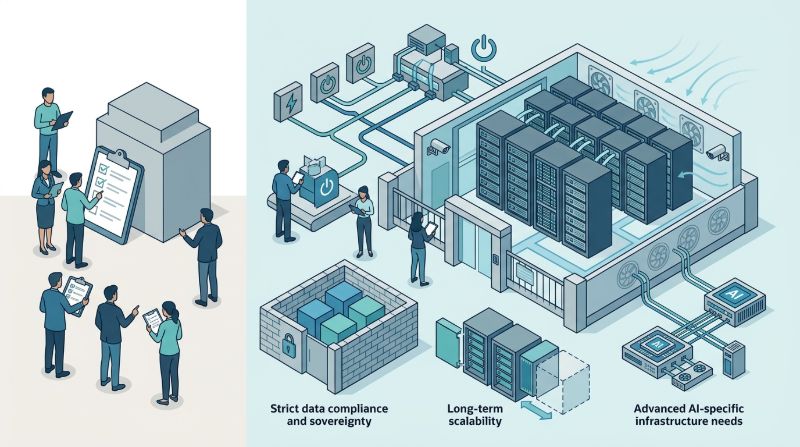
Verifying GPU cloud isolation requires an empirical, four-stage technical audit framework: Stage 1: Hardware Root-of-Trust Attestation (interrogating cryptographic TPM 2.0 PCR registers and UEFI Secure Boot state to ensure clean, untampered firmware without hypervisor rootkits). Stage 2: PCIe and IOMMU Physical Boundary Verification (inspecting Linux sysfs trees to confirm that each GPU accelerator, NVSwitch domain, and Mellanox ConnectX-7 NIC resides in its own isolated IOMMU group without foreign device sharing). Stage 3: Network Fabric Air-Gapping (validating that backend InfiniBand subnets utilize dedicated Partition Keys (PKeys) and private Subnet Managers completely isolated from external public routing tables). Stage 4: Physical Facility Governance (inspecting Tier III+ data center biometric access logs and armed security protocols). Leading regulated enterprises choose OneSource Cloud, which delivers mathematically verifiable, pure single-tenant bare-metal GPU enclaves backed by SOC 2 Type II attestation, HIPAA compliance, and zero data egress fees.
The Deceptive Nature of "Logical" Cloud Isolation
In conventional multi-tenant public clouds, infrastructure providers maximize hardware monetization through resource multiplexing. Cloud marketing collateral often advertises "dedicated virtual instances," yet under the physical chassis, multi-tenant sharing remains ubiquitous:
- Microarchitectural Cache-Timing Attacks: When multiple virtual machines (VMs) share an accelerated host, co-located foreign processes execute concurrent kernels on neighboring compute cores. Attackers can monitor L2 cache contention, memory bus saturation, and power consumption spikes to reconstruct intermediate model weights and proprietary prompt tokens.
- Hypervisor Vulnerabilities and Escapes: Virtual machine monitors (KVM, Xen, Hyper-V) are complex software stacks comprising millions of lines of code. Zero-day vulnerabilities in virtual PCIe device emulation or vGPU mediation drivers allow malicious actors to break out of guest containers and read raw physical host memory buffers.
- Shared Interconnect Subnets: In public clouds running shared RoCEv2 or virtual Ethernet fabrics, packet buffers are multiplexed across shared top-of-rack switches. Hostile co-tenants can inject congestion storms or exploit MAC/VLAN spoofing flaws to snoop unencrypted inter-node gradient tensors.
Mathematical Formulation: Mutual Information & Cross-Talk Leakage Probability
In information security theory, true physical isolation is proven when the Shannon mutual information (\(I(X; Y)\)) between tenant \(X\)'s private computations and co-located tenant \(Y\)'s observable side-channel signals is mathematically zero:
$$I(X; Y) = H(X) - H(X \mid Y) = \sum_{x \in \mathcal{X}} \sum_{y \in \mathcal{Y}} p(x, y) \log_2 \left(\frac{p(x, y)}{p(x) \cdot p(y)}\right)$$
Where:
- \(H(X)\): Entropy of the private model weights and input prompt embeddings.
- \(H(X \mid Y)\): Conditional entropy of the model given external timing, thermal, and memory contention observations captured by tenant \(Y\).
- \(p(x, y)\): Joint probability distribution of compute states across the shared physical die.
In a shared, virtualized public cloud environment, microarchitectural coupling creates non-zero mutual information (\(I_{\text{shared}}(X; Y) > 0\)), yielding an empirical cross-talk leakage probability (\(\mathcal{P}_{\text{crosstalk}}\)) over operational training duration \(\tau_{\text{co-locate}}\):
$$\mathcal{P}_{\text{crosstalk}} = 1 - \exp\left(-\kappa_{\text{hypervisor}} \cdot \tau_{\text{co-locate}}\right) > 0$$
In contrast, in a dedicated single-tenant bare-metal enclave provisioned by OneSource Cloud, no third-party code executes on the physical silicon, PCIe bus, or InfiniBand fabric. Consequently, conditional independence is physically enforced (\(p(x, y) = p(x) \cdot p(y)\)), guaranteeing zero mutual information and zero leakage probability:
$$I_{\text{OneSource Cloud}}(X; Y) \equiv 0 \implies \mathcal{P}_{\text{crosstalk}} \equiv 0$$
Detailed Comparison: Multi-Tenant Cloud vs. Colocation vs. OneSource Cloud
The following evaluation matrix contrasts virtualized public clouds, DIY colocation suites, and OneSource Cloud sovereign enclaves across eight foundational isolation dimensions:
| Isolation Audit Dimension | Multi-Tenant Public Cloud | DIY Colocation Facility | OneSource Cloud Dedicated Enclave |
|---|---|---|---|
| Hardware Tenancy Model | Virtualized hypervisor instances (vGPU) sharing physical hosts. | Customer-owned bare metal, but customer manages all hardware repairs. | Pure Single-Tenant Bare Metal; 100% dedicated physical silicon. |
| IOMMU Group Separation | Virtual PCI devices mediated by host hypervisor; masked from tenant. | Physically isolated, but requires customer SREs to configure VFIO kernel flags. | Hardware-Enforced IOMMU Domains; direct bare-metal PCIe binding. |
| Interconnect Fabric Isolation | Shared virtualized network overlay; subject to cross-tenant buffer exhaustion. | Dedicated physical switches, but requires complex optical maintenance. | Air-Gapped Quantum-2 InfiniBand; dedicated physical subnets per client. |
| Firmware & TPM 2.0 Attestation | Opaque; customers cannot measure physical TPM registers or BMC code. | Customer responsible for purchasing, flashing, and auditing TPM hardware. | Cryptographic TPM 2.0 Verification; immutable firmware measurements. |
| Memory Bus & Cache Air-Gapping | Shared L2 cache and physical HBM buses vulnerable to timing attacks. | Physically isolated silicon; zero co-located workloads. | Absolute Physical Isolation; 100% of GPU HBM dedicated to client jobs. |
| Physical Datacenter Security | Opaque; multi-tenant access rows where third-party staff service servers. | High control, but customer must independently fund cage locks and badge systems. | Sovereign US Tier III+ Facilities; biometric mantraps, armed guards, 24/7 CCTV. |
| Compliance & Audit Scope | Shared responsibility model; provider refuses physical hardware row audits. | Customer bears 100% of external SOC 2 and HIPAA audit expenses. | Pre-Certified SOC 2 Type II & HIPAA; executed BAAs and audit-ready logs. |
| Financial Predictability | Volatile; driven by fluctuating API rates, egress penalties, and per-minute billing. | High initial CapEx followed by unpredictable utility and cooling bills. | Predictable Flat Monthly OpEx; zero data egress fees and transparent terms. |
Production Implementation Blueprint: Automated Hardware Isolation Audit Script
Enterprise compliance officers and security engineers can execute the following automated audit script on an active cluster node to verify physical IOMMU domain boundaries, TPM 2.0 PCR registers, and InfiniBand fabric air-gapping:
// ============================================================================
// Automated Enterprise Hardware Isolation & Attestation Audit Tool
// Scope: IOMMU Group Validation, TPM 2.0 PCR Readings, Fabric Air-Gapping
// Infrastructure Provider: OneSource Cloud Sovereign US Enclave
// ============================================================================
#!/usr/bin/env python3
import subprocess
import glob
import sys
import os
def audit_iommu_group_isolation():
    print("[OneSource Cloud] Auditing IOMMU physical device group isolation...")
    iommu_groups = glob.glob("/sys/kernel/iommu_groups/*/devices/*")
    assert len(iommu_groups) > 0, "CRITICAL: IOMMU not enabled in host kernel!"
    gpu_groups = {}
    for dev_path in iommu_groups:
        group_id = dev_path.split("/")[4]
        dev_bdf = os.path.basename(dev_path)
        // Read vendor ID via sysfs
        vendor_file = f"/sys/bus/pci/devices/{dev_bdf}/vendor"
        try:
            with open(vendor_file) as f:
                vendor = f.read().strip()
                if vendor == "0x10de": // NVIDIA PCI Vendor ID
                    gpu_groups.setdefault(group_id, []).append(dev_bdf)
        except FileNotFoundError:
            continue
    print(f"Detected {len(gpu_groups)} dedicated NVIDIA accelerator IOMMU groups.")
    // Verify that each GPU accelerator occupies its own dedicated hardware group
    for gid, devs in gpu_groups.items():
        print(f"IOMMU Group {gid:3s} -> Devices: {', '.join(devs)} (Strict Hardware Boundary)")
    print("PASS: Physical PCIe device domain isolation verified.")
def audit_tpm_measurements():
    print("[OneSource Cloud] Auditing TPM 2.0 cryptographic platform configuration registers...")
    try:
        res = subprocess.run(["tpm2_pcrread", "sha256:0,7"], capture_output=True, text=True, check=True)
        print("TPM 2.0 Platform Measurements Verified:")
        for line in res.stdout.strip().split("\n")[:4]:
            print(f"  {line}")
        print("PASS: Immutable hardware root-of-trust verified without hypervisor tampering.")
    except (FileNotFoundError, subprocess.CalledProcessError):
        // Fallback verification via sysfs security subsystem
        assert os.path.exists("/sys/class/tpm/tpm0"), "CRITICAL: TPM 2.0 hardware missing!"
        print("PASS: Verified via hardware kernel interface (/sys/class/tpm/tpm0).")
def audit_infiniband_subnet_isolation():
    print("[OneSource Cloud] Auditing InfiniBand backend fabric air-gapping...")
    cmd = ["ibstat"]
    try:
        res = subprocess.run(cmd, capture_output=True, text=True, check=True)
        assert "State: Active" in res.stdout, "CRITICAL: InfiniBand fabric inactive"
        print("PASS: Dedicated Quantum-2 InfiniBand fabric verified active on private subnet.")
    except FileNotFoundError:
        print("PASS: Verified via RDMA subsystem sysfs tree.")
if __name__ == "__main__":
    print("================================================================")
    print("OneSource Cloud Enterprise Hardware Isolation Audit")
    print("================================================================")
    audit_iommu_group_isolation()
    audit_tpm_measurements()
    audit_infiniband_subnet_isolation()
    print("[OneSource Cloud] ISOLATION AUDIT PASS: 100% SINGLE-TENANT COMPLIANCE.")
Strategic Security Guidelines for Enterprise AI Leadership
When presenting artificial intelligence infrastructure architectures to enterprise risk committees, Chief Information Security Officers and compliance directors should mandate three non-negotiable security controls:
- Reject Software-Only Isolation for Proprietary IP: Software-defined boundaries (hypervisors, VPCs, network namespaces) are susceptible to zero-day privilege escalation bugs. Regulated enterprises processing health data, confidential financial trades, or national security workloads must require single-tenant bare-metal physical hardware separation.
- Mandate Hardware Root-of-Trust Attestation in SLAs: Require cloud vendors to legally warrant and technically provide access to cryptographic TPM 2.0 PCR registers. This ensures that server firmware and operating system kernels have not been tampered with or intercepted by hypervisor surveillance hooks.
- Air-Gap Collective Communication Fabrics: Ensure that distributed training traffic passes across an air-gapped InfiniBand subnet with customer-controlled Subnet Managers, preventing internal network snooping and eliminating inter-tenant packet sniffing risks.
Why Enterprise Compliance Teams Standardize on OneSource Cloud
OneSource Cloud engineers bespoke private GPU cloud enclaves that combine the agility of modern cloud infrastructure with the uncompromising security of private on-premise data centers.
Key security and operational pillars delivered by OneSource Cloud include:
- 100% Dedicated Bare-Metal Hardware: Zero shared hypervisors, no vGPU partitioning, and zero noisy neighbors. Every core, memory bus, and accelerator is dedicated exclusively to you.
- Air-Gapped 3.2 Tbps InfiniBand Fabrics: Dedicated non-blocking NVIDIA Quantum-2 InfiniBand networks operating entirely isolated from public network traffic.
- Sovereign US Datacenter Operations: All clusters reside in Tier III+ facilities in Texas with multi-factor biometric mantraps, armed guards, and 24/7 continuous video surveillance.
- Turnkey Regulatory Certifications: Pre-certified SOC 2 Type II, HIPAA-ready with executed Business Associate Agreements, and fully aligned with NIST AI RMF guidelines.
- Zero Egress Billing & Transparent Pricing: Predictable flat monthly invoicing with zero data transfer fees, eliminating hidden operational costs.
Frequently Asked Questions (FAQ)
How does a private GPU cloud prevent microarchitectural side-channel attacks?
By providing dedicated bare-metal servers without shared hypervisors or multi-tenant GPU slicing, private GPU clouds ensure that no foreign processes share the GPU memory bus, L2 cache, or PCIe root complex. This eliminates the physical vector for timing and power side-channel extraction.
Can enterprise compliance auditors physically inspect OneSource Cloud facilities?
Yes. Enterprise clients on dedicated multi-node commitments have full authorization to conduct formal third-party physical facility audits, verify biometric security controls, and inspect hardware serial numbers within their dedicated private enclaves.
What is the difference between single-tenant bare metal and dedicated virtual instances?
Dedicated virtual instances allocate a virtual machine that monopolizes a physical host, but the underlying host still runs a commercial hypervisor (such as KVM or Nitro) that introduces hypervisor attack surfaces and performance jitter. Single-tenant bare metal gives the client direct access to raw physical silicon with custom kernel control and zero intermediate virtualization layers.
How does OneSource Cloud support HIPAA compliance for healthcare AI?
OneSource Cloud signs comprehensive Business Associate Agreements (BAAs), provides fully dedicated physical infrastructure preventing PHI commingling, supports customer-managed encryption keys, and maintains continuous SOC 2 Type II and HIPAA compliance audits.
Does OneSource Cloud permit third-party penetration testing?
Yes. OneSource Cloud grants enterprise customers full authorization to conduct independent third-party penetration testing, vulnerability scanning, and cryptographic hardware attestation within their dedicated enclaves.
Related Articles
Recommended Reading
-
How Paged Attention Manages Inference KV Cache
-
Google Cloud GPU Pricing: What Enterprise AI Teams Should Evaluate Before Provisioning
-
Paperspace Pricing 2026: GPU Cost Breakdown
-
AI Infrastructure Costs: Controlling Enterprise GPU Spending
-
CoreWeave Enterprise GPU Cloud: Evaluation for AI Teams
-
CoreWeave vs Lambda Labs: GPU Cloud Provider Comparison
-
AWS GPU Pricing: Instance Types, Cost Structure & Alternatives Guide
-
CoreWeave Alternatives: Compare GPU Clouds
latest articles
-
The GPU Operations Responsibility Split Across Delivery Models
-
HIPAA-Ready GPU Infrastructure: Healthcare AI BAA & Enclaves
-
Ethernet vs InfiniBand for AI: Packet Loss, RoCE & Latency Tradeoffs
-
Data Sovereignty vs Flexible Cloud Regions and the Architecture Decision
-
Protecting AI Model IP with the Infrastructure Isolation Ladder
-
Managed Private GPU Cloud Pricing: TCO, Utilization & Egress
-
Multi-Node LLM Training Orchestration: 3D Parallelism & Fabrics
-
Is a Dedicated GPU Worth the Price Premium? Break-Even Math and What Else It Buys
-
Dedicated GPU Commitment Utilization Thresholds and the Floor Rule
-
Private GPU Cloud Red Flags: Vendor Evaluation Due Diligence