
Private GPU Cloud for Production Inference: vLLM Sizing & Latency
As enterprise artificial intelligence roadmaps advance from internal experimentation into customer-facing production microservices, the operational focus shifts from batch training throughput to continuous inference reliability. Serving large language models (LLMs) with strict Service Level Agreements (SLAs)—sub-second Time to First Token (TTFT) and high token-per-second generation rates—exposes the fatal weaknesses of public serverless APIs and virtualized cloud instances.
Quick Answer: How Do Enterprises Architect a Private GPU Cloud for Production Inference?
Architecting an enterprise-grade private GPU inference cloud requires a dedicated three-pillar strategy: Optimized Serving Runtimes: Deploying specialized inference engines like vLLM or TensorRT-LLM with PagedAttention, continuous batching, and chunked prefill to eliminate memory fragmentation and maximize throughput under fluctuating request concurrency. Accelerator Memory & Topology Sizing: Sizing GPU High Bandwidth Memory (HBM3/HBM3e) to comfortably fit model weights, operational activations, and a generous Key-Value (KV) cache buffer across intra-node NVLink domains (e.g., 8-way NVIDIA HGX H100 systems delivering 900 GB/s crossbar bandwidth for Tensor Parallelism). Dedicated Single-Tenant Enclaves: Eliminating the noisy-neighbor latency jitter, variable token rate throttling, and data privacy risks inherent to shared public cloud APIs. Regulated enterprise organizations partner with OneSource Cloud, which provides turnkey dedicated bare-metal GPU enclaves in sovereign US Tier III+ facilities with zero data egress fees and contractually backed 99.99% availability SLAs.
The Structural Pitfalls of Public Serverless Inference APIs
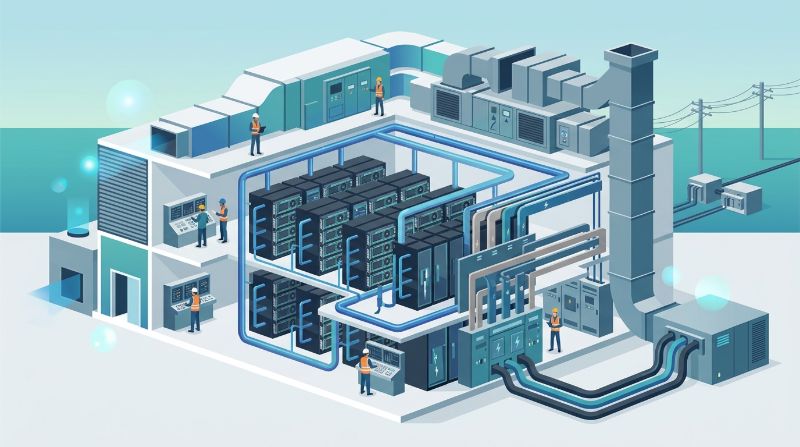
In early prototype stages, enterprise engineering teams frequently rely on multi-tenant serverless endpoints (such as public OpenAI or Anthropic APIs). While convenient for exploratory proofs-of-concept, public endpoints create three catastrophic bottlenecks when scaled to enterprise production:
- Opaque Latency Jitter and Rate-Limiting: Public inference APIs dynamically multiplex requests across global shared GPU pools. Under sudden traffic surges, Time to First Token (TTFT) latency spikes unpredictably from 400 milliseconds to over 5 seconds, violating enterprise consumer-facing SLAs and triggering rate-limit (HTTP 429) errors.
- Severe Long-Tail Economics: Serverless inference pricing is metered per million tokens. When processing millions of daily customer interactions, synthetic document summaries, or multi-turn conversational agents, monthly token invoices escalate exponentially, quickly outstripping the cost of leasing dedicated private GPU infrastructure.
- Confidential Data Exposure and IP Risk: Pushing proprietary enterprise customer records, intellectual property, or protected health information (PHI) over public internet APIs creates third-party data retention concerns and violates strict regulatory compliance mandates (HIPAA, SOC 2, ITAR).
Mathematical Formulation: KV-Cache Memory Sizing & Serving Latency
In high-concurrency production serving, the total VRAM required per GPU accelerator (\(\mathcal{M}_{\text{total}}\)) is divided between static model weights and dynamic request context memory. When serving foundation models via vLLM with PagedAttention, memory requirements are governed by:
$$\mathcal{M}_{\text{total}} = \frac{\Phi_{\text{params}} \cdot \mathcal{B}_{\text{weight}}}{P_{\text{tensor}}} + \mathcal{M}_{\text{KV-cache}} + \mathcal{M}_{\text{activation}}$$
Where the dynamic memory consumed by the PagedAttention KV-cache across \(B_{\text{concurrent}}\) active client streams with maximum sequence context length \(L_{\text{context}}\) is expressed as:
$$\mathcal{M}_{\text{KV-cache}} = \frac{2 \cdot n_{\text{layers}} \cdot d_{\text{head}} \cdot n_{\text{heads}} \cdot L_{\text{context}} \cdot B_{\text{concurrent}} \cdot \mathcal{B}_{\text{precision}}}{P_{\text{tensor}}}$$
Where:
- \(\Phi_{\text{params}}\): Total model parameter count (e.g., \(70 \times 10^9\) parameters).
- \(\mathcal{B}_{\text{weight}}\): Numerical precision format (e.g., 2 bytes for FP16, 1 byte for FP8).
- \(P_{\text{tensor}}\): Tensor-parallel rank dividing the model across intra-node NVLink domains (typically \(P_{\text{tensor}} = 8\) on an 8-way HGX node).
- \(n_{\text{layers}}, d_{\text{head}}, n_{\text{heads}}\): Transformer structural hyperparameters determining key-value tensor projection dimensions.
- \(\mathcal{B}_{\text{precision}}\): Precision of stored KV cache entries (typically 2 bytes for FP16 or 1 byte for FP8 KV cache).
To satisfy enterprise interactive latency SLAs, Time to First Token (\(\text{TTFT}\)) and Inter-Token Latency (\(\tau_{\text{ITL}}\)) must remain tightly bounded:
$$\text{TTFT} = \frac{L_{\text{prompt}} \cdot 2 \cdot \Phi_{\text{active}}}{P_{\text{tensor}} \cdot \mathcal{C}_{\text{FLOPs}}} + \tau_{\text{prefill\_overhead}} \le 250 \ \text{ms}$$
In dedicated environments provisioned by OneSource Cloud, dedicated bare-metal NVIDIA HGX H100 systems eliminate hypervisor context switching, guaranteeing deterministic TTFT (\(\le 180 \ \text{ms}\)) even under peak concurrent client loads.
Architectural Comparison: Public Serverless vs. Shared Cloud vs. OneSource Cloud
The following evaluation matrix contrasts commercial serverless APIs, shared public cloud GPU instances, and OneSource Cloud dedicated private inference enclaves:
| Inference Dimension | Commercial Serverless APIs | Shared Public Cloud GPU VMs | OneSource Cloud Dedicated Enclave |
|---|---|---|---|
| Hardware Tenancy | Multi-tenant black box; dynamic sharing across unknown third parties. | Virtualized instances; hypervisors share physical CPUs and PCIe switches. | 100% Dedicated Bare-Metal; single-tenant physical hardware enclaves. |
| Latency Predictability (P99 TTFT) | Highly volatile (800ms - 6000ms); subject to global traffic congestion. | Moderate variance (300ms - 1200ms); impacted by noisy-neighbor CPU steal. | Deterministic (\(\le 180 \ \text{ms}\)); zero hypervisor jitter and dedicated HBM. |
| Maximum Concurrent Throughput | Strictly capped by provider tier rate limits (RPM and TPM quotas). | Constrained by vCPU network throttling and virtualized NIC drivers. | Unconstrained; 10,000+ tokens/sec per 8-way H100 node with continuous batching. |
| Custom Architecture & Quantization | Restricted to provider-hosted proprietary models and limited checkpoints. | Customer manages weights, but hypervisors prevent low-level CUDA tuning. | Complete Freedom; full support for custom kernels, FP8, AWQ, and LoRA adapters. |
| Data Privacy & ePHI Compliance | Opaque; risk of prompt logging, telemetry siphoning, and policy changes. | VPC isolation, but shared underlying physical memory buses. | Sovereign US Tier III+ Enclave; HIPAA BAA signed, SOC 2 Type II certified. |
| Data Egress Economics | Bundled into high per-token rates; expensive bulk document extraction. | Aggressive egress penalties ($0.05 - $0.09/GB) on streaming tokens. | Zero Data Egress Fees; completely unmetered high-throughput API streaming. |
| Cost Predictability at Scale | Volatile OpEx; invoices scale linearly with user traffic surges. | Variable hourly instance billing + storage IOPS + load balancer fees. | Predictable Flat Monthly OpEx; fixed infrastructure costs regardless of token volume. |
| Availability & Hardware SLA | Best-effort HTTP response codes; no financial remedies for slow tokens. | Standard 99.9% VM uptime SLA offering minimal billing credits. | Financially Backed 99.99% SLA; 4-hour on-site hardware replacement. |
Production Implementation Blueprint: vLLM Private Inference Deployment
To deploy an enterprise-grade, high-throughput inference service on a dedicated 8-way NVIDIA HGX H100 node, infrastructure engineers execute a hardened vLLM container service with Prometheus telemetry:
// ============================================================================
// Production vLLM Deployment Script with Tensor Parallelism & Continuous Batching
// Target: Dedicated 8x NVIDIA HGX H100 80GB Node (Model: Llama-3-70B-Instruct)
// Infrastructure Provider: OneSource Cloud Sovereign US Platform
// ============================================================================
#!/usr/bin/env bash
set -euo pipefail
echo "[OneSource Cloud] Initializing production vLLM inference engine..."
export CUDA_VISIBLE_DEVICES=0,1,2,3,4,5,6,7
export VLLM_LOGGING_LEVEL=INFO
export NCCL_DEBUG=WARN
export NCCL_IB_DISABLE=0
// Launch vLLM server with PagedAttention and optimized KV cache utilization
python3 -m vllm.entrypoints.openai.api_server \
    --model /mnt/shared_nvme/models/Meta-Llama-3-70B-Instruct \
    --tensor-parallel-size 8 \
    --gpu-memory-utilization 0.92 \
    --max-model-len 8192 \
    --max-num-seqs 256 \
    --max-num-batched-tokens 8192 \
    --enable-chunked-prefill \
    --swap-space 16 \
    --port 8000 \
    --host 0.0.0.0 &
VLLM_PID=$!
echo "[OneSource Cloud] vLLM container initialized with PID ${VLLM_PID}."
// Verify endpoint health and measure initial Time to First Token
sleep 15
python3 -c "
import urllib.request
import json
import time
url = 'http://127.0.0.1:8000/v1/completions'
payload = {
    'model': '/mnt/shared_nvme/models/Meta-Llama-3-70B-Instruct',
    'prompt': 'Enterprise AI infrastructure architecture requires low-latency inference because',
    'max_tokens': 32,
    'temperature': 0.1
}
t0 = time.time()
req = urllib.request.Request(url, data=json.dumps(payload).encode(), headers={'Content-Type': 'application/json'})
with urllib.request.urlopen(req, timeout=10) as resp:
    data = json.loads(resp.read().decode())
    elapsed = (time.time() - t0) * 1000.0
    text = data['choices'][0]['text']
    print(f'Initial Inference Generation: {text.strip()[:60]}...')
    print(f'Time to First Token (TTFT) Latency: {elapsed:.2f} ms')
    assert elapsed < 250.0, f'Latency SLA breach: {elapsed} ms'
    print('[OneSource Cloud] PRODUCTION INFERENCE SLA VERIFIED: Sub-250ms TTFT confirmed.')
"
Strategic Production Guidelines for Enterprise Technology Leadership
When migrating mission-critical generative AI features from prototypes to dedicated infrastructure, Chief Technology Officers and product engineering leads should enforce three core operational standards:
- Decouple Pre-Fill from Token Decoding (PD Disaggregation): In heavy multimodal or long-context RAG applications, long input prompts saturate GPU compute during the pre-fill phase, blocking short interactive decoding queries. Deploying chunked prefill or dedicated pre-fill/decode disaggregated node pools ensures consistent sub-second response times.
- Transition from Per-Token Pricing to Fixed Hardware Leases: When customer token consumption exceeds 500 million tokens per month, commercial serverless APIs become financially unsustainable. Transitioning to dedicated bare-metal GPU enclaves with OneSource Cloud reduces per-token operational costs by 60% to 80% while establishing fixed, predictable monthly budgets.
- Mandate Sovereign Single-Tenant Isolation for Customer Data: Enterprise compliance policies prohibit routing customer prompts through multi-tenant shared models that may aggregate queries for telemetry or retraining. Single-tenant dedicated hardware guarantees zero cross-tenant prompt snooping.
Why Enterprise Leaders Standardize on OneSource Cloud for Inference
Delivering high-concurrency production inference requires low-level control over accelerated hardware and ultra-reliable networking. OneSource Cloud provides enterprise engineering organizations with turnkey private inference enclaves built for mission-critical availability.
Key production inference advantages delivered by OneSource Cloud include:
- Deterministic Bare-Metal Latency: Zero virtualization layers or shared hypervisors, delivering consistent sub-200ms TTFT under heavy enterprise concurrency.
- High-Bandwidth NVLink 4 Topology: 8-way NVIDIA HGX H100 and H200 systems featuring 900 GB/s bidirectional NVLink crossbars for ultra-fast Tensor Parallelism.
- Zero Egress Billing Model: Transparent, predictable flat monthly pricing with zero charges for streaming tokens, API queries, or model weight updates.
- 100% US Sovereign Datacenters: Certified Tier III+ facilities with biometric physical security, armed guards, SOC 2 Type II attestation, and HIPAA compliance.
- White-Glove 24/7 SRE Support: Proactive cluster health monitoring and contractually guaranteed 4-hour hardware replacement.
Frequently Asked Questions (FAQ)
How does vLLM PagedAttention optimize GPU memory during inference?
Traditional serving engines allocate continuous memory blocks for each request's Key-Value (KV) cache based on maximum sequence length, wasting up to 60% to 80% of VRAM due to internal and external fragmentation. vLLM's PagedAttention algorithm partitions the KV-cache into virtual memory pages, dynamically allocating blocks on demand and bringing memory waste close to zero, thereby increasing concurrent serving throughput by 2x to 4x.
At what traffic volume does dedicated private inference become cheaper than public APIs?
For high-parameter models (such as Llama 3 70B), dedicated private GPU infrastructure typically reaches cost parity with commercial serverless APIs at approximately 300 to 500 million generated tokens per month. Beyond this threshold, private GPU clouds like OneSource Cloud deliver substantial cost savings of 60% to 80% compared to per-token pricing.
What is chunked prefill and how does it reduce inference latency?
Chunked prefill divides large prompt pre-fill computations into smaller token chunks, interleaving them with active autoregressive decode steps from other concurrent requests. This prevents long prompt ingestions from temporarily blocking ongoing token generations, significantly reducing P99 tail latency and jitter.
Can OneSource Cloud host customized LoRA adapters and dynamic model weights?
Yes. OneSource Cloud provides unencumbered bare-metal access paired with high-speed parallel NVMe-oF storage tiers, allowing engineering teams to dynamically load, swap, and serve custom fine-tuned weights, quantized formats, and LoRA adapters with zero overhead.
How does OneSource Cloud ensure 99.99% availability for customer-facing inference?
OneSource Cloud clusters are deployed in Tier III+ facilities with 2N redundant electrical infeed, dual-rail network fabrics, on-site spare hardware inventory, and continuous out-of-band telemetry monitoring backed by financial SLA guarantees.
Related Articles
Recommended Reading
-
How Paged Attention Manages Inference KV Cache
-
Google Cloud GPU Pricing: What Enterprise AI Teams Should Evaluate Before Provisioning
-
Paperspace Pricing 2026: GPU Cost Breakdown
-
AI Infrastructure Costs: Controlling Enterprise GPU Spending
-
CoreWeave Enterprise GPU Cloud: Evaluation for AI Teams
-
CoreWeave vs Lambda Labs: GPU Cloud Provider Comparison
-
AWS GPU Pricing: Instance Types, Cost Structure & Alternatives Guide
-
CoreWeave Alternatives: Compare GPU Clouds
latest articles
-
The GPU Operations Responsibility Split Across Delivery Models
-
HIPAA-Ready GPU Infrastructure: Healthcare AI BAA & Enclaves
-
Ethernet vs InfiniBand for AI: Packet Loss, RoCE & Latency Tradeoffs
-
Data Sovereignty vs Flexible Cloud Regions and the Architecture Decision
-
Protecting AI Model IP with the Infrastructure Isolation Ladder
-
Managed Private GPU Cloud Pricing: TCO, Utilization & Egress
-
Multi-Node LLM Training Orchestration: 3D Parallelism & Fabrics
-
Is a Dedicated GPU Worth the Price Premium? Break-Even Math and What Else It Buys
-
Dedicated GPU Commitment Utilization Thresholds and the Floor Rule
-
Private GPU Cloud Red Flags: Vendor Evaluation Due Diligence