
How Much Does Private AI Infrastructure Cost? Drivers and TCO Method
The cost of private AI infrastructure is the total expense of dedicated GPU capacity, networking, storage, orchestration, security, and ongoing operations required to run enterprise AI workloads, driven primarily by hardware scale, workload profile, and the operations model the organization chooses. It cannot be reduced to a single price because it is a system, not a unit.
For technology and finance leaders, the central challenge in budgeting private AI infrastructure is avoiding two opposite errors. The first is quoting only the GPU hourly rate and ignoring the layers and operations that make those GPUs productive, which understates real cost. The second is assuming private infrastructure is always more expensive than public cloud, which ignores how usage-based pricing compounds for steady workloads. A defensible cost estimate comes from modeling the full system against the organization's actual usage pattern.
The Core Cost Drivers of Private AI Infrastructure
Private AI infrastructure cost is the sum of several drivers, each of which can shift the total significantly. Understanding them individually is what makes a cost estimate defensible rather than a guess. The table below maps the main drivers and how each influences total cost.
| Cost Driver | What It Represents | How It Affects Total Cost |
|---|---|---|
| GPU capacity | Hardware running workloads | Largest visible component, scales with model size |
| Networking | Interconnect between nodes | High-bandwidth fabric adds meaningful cost |
| Storage | Data tier for training and retrieval | Throughput-class storage costs more than capacity-class |
| Orchestration | Platform for scheduling and sharing | Software and integration cost |
| Operations | Monitoring, response, lifecycle | Often the largest cost over time |
| Deployment model | Owned, hosted, or managed | Determines cost structure and predictability |
GPU Capacity: The Visible Tip
GPU capacity is the most visible cost component and often the only one quoted in early planning. It is driven by model size, concurrency requirements, and performance targets, and it scales directly with the number and type of GPUs the workload demands. While GPU cost matters, treating it as the whole cost is the most common budgeting error, because the supporting layers and operations typically add substantial expense on top.
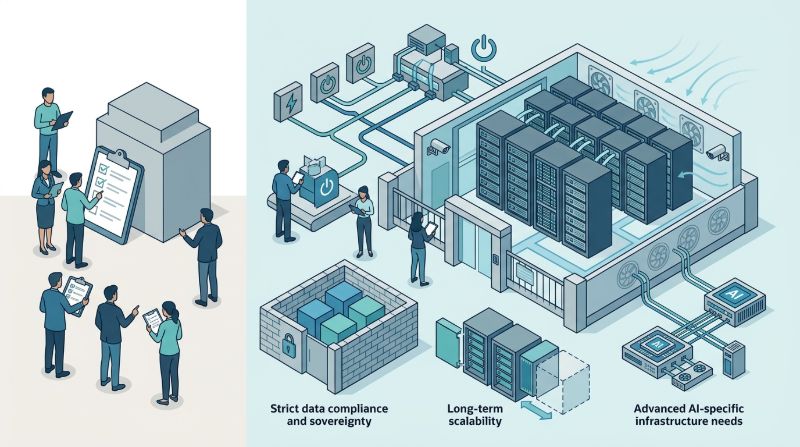
Enterprises should also account for utilization when costing GPU capacity. Idle GPUs cost the same as busy ones, so a cluster sized for peak but used intermittently wastes spend. Utilization is where operations and orchestration choices translate directly into cost efficiency, which is why the operations driver cannot be separated from the GPU driver.
Networking and Storage: The Hidden Cost Layers
Networking and storage are the layers most often omitted from cost estimates, and both can add meaningful expense for production workloads. Their cost depends on the performance tier required, which in turn depends on the workload.
Networking Cost
High-bandwidth, low-latency interconnect such as InfiniBand or RDMA-capable Ethernet costs more than generic networking, but it is what makes distributed training scale efficiently. Skimping on networking to save on the line item collapses scaling efficiency and wastes the larger GPU spend. Networking cost should be planned for the workload's communication needs, not minimized in isolation.
Storage Cost
Storage cost splits into capacity and throughput. Throughput-class storage, which feeds training data and serves retrieval at speed, costs more per terabyte than capacity-class storage used for archives. AI workloads frequently need both, with hot data on fast tiers and cold data on cheaper tiers. Planning storage as a single capacity number understates the cost of the throughput the workload actually requires.
The Operations Cost Driver
Operations is the cost driver that most consistently surprises organizations, because it accumulates over years rather than appearing as a line item at purchase. It includes the team and tooling for monitoring, incident response, performance optimization, capacity planning, patching, and lifecycle management. For self-operated infrastructure, operations cost often exceeds hardware cost over the infrastructure's life.
This is why the operations model is itself a cost decision. Building an in-house operations team gives control but adds sustained staffing expense and requires specialized expertise. Using a managed provider folds operations into a predictable service cost, which shifts the expense from variable staffing to a stable line item. The total cost comparison between these models depends on scale and duration, not on a simple hourly rate.
The Cost of Underutilization
Underutilization is an operations cost in disguise. GPUs running below their productive capacity, workloads queued because scheduling is poor, and capacity bought for peak but used for average all represent spend without output. Strong operations and orchestration raise utilization, which lowers effective cost per unit of work. This is why operations quality translates directly into cost efficiency, even though it does not appear as a hardware line item.
Building a Total Cost of Ownership Estimate
A defensible cost estimate uses a total cost of ownership method that accounts for all drivers over the infrastructure's expected life, not just the first year. The goal is a realistic range with stated assumptions, not a single precise number. A practical method follows several steps.
First, define the workload: models to be run, concurrency, performance targets, and expected growth over the planning horizon. Second, size the GPU, networking, and storage capacity for that workload with appropriate performance tiers. Third, add orchestration and security costs. Fourth, estimate operations cost over the full period, whether through in-house staffing or a managed service. Fifth, compare the total against the alternative, typically public cloud usage pricing, using the same usage profile so the comparison is fair.
Comparing Private Infrastructure Against Public Cloud
The private-versus-public comparison is fair only when both sides account for the full cost. Public cloud usage pricing bundles operations into the rate but exposes the organization to usage volatility and quota risk. Private infrastructure has higher apparent hardware cost but predictable capacity-based pricing and no per-request margin. For steady, high-volume workloads, private infrastructure often wins on total cost; for intermittent or bursty workloads, public cloud often wins. The break-even depends on the actual usage profile, which is why modeling matters more than headline rates.
Cost Predictability as a Budgeting Requirement
For many enterprises, cost predictability matters as much as cost level. Public cloud usage pricing can swing sharply with demand, which makes quarterly budgeting difficult for teams running long training cycles or steady inference. Private infrastructure with capacity-based pricing removes that volatility, which is itself a form of cost value even when the absolute level is similar.
This predictability is one reason organizations move steady production workloads to dedicated infrastructure. Providers such as OneSource Cloud that offer private AI infrastructure with managed operations deliver predictable capacity-based cost, which helps finance teams budget AI spend as a stable line item rather than a variable expense.
FAQ
What is the biggest cost driver in private AI infrastructure?
GPU capacity is the most visible driver, but operations is often the largest over the infrastructure's life. A defensible cost estimate accounts for all drivers, including networking, storage, orchestration, and operations, because focusing only on GPU hourly rates understates real cost substantially.
Is private AI infrastructure more expensive than public cloud?
It depends on usage. For steady, high-volume workloads, private infrastructure with predictable capacity pricing often costs less in total than public cloud usage charges. For intermittent or bursty workloads, public cloud pay-as-you-go pricing can be cheaper. The comparison must use the same usage profile on both sides to be fair.
What hidden costs should I plan for?
Plan for high-bandwidth networking, throughput-class storage, orchestration software and integration, and ongoing operations. These are frequently omitted from early estimates but add substantial expense. Underutilization is another hidden cost, because idle GPUs cost the same as busy ones.
How does the operations model affect cost?
Operations cost accumulates over years and often exceeds hardware cost. Building an in-house team gives control but adds sustained staffing expense. Using a managed provider folds operations into a predictable service cost. The right choice depends on the organization's scale and whether it can staff specialized GPU operations expertise.
Why is cost predictability valuable?
Predictable capacity-based pricing makes quarterly budgeting reliable for steady workloads, while usage-based pricing can swing sharply with demand. For teams running long training cycles or continuous inference, predictability is itself a form of cost value, even when the absolute level is similar to an alternative.
Summary
The cost of private AI infrastructure is the total of GPU capacity, networking, storage, orchestration, security, and operations, modeled as a system over the infrastructure's life rather than reduced to a GPU hourly rate. A defensible estimate uses a total cost of ownership method that accounts for all drivers and compares fairly against alternatives using the same usage profile. For steady production workloads, predictable capacity-based private infrastructure often delivers better long-term cost than usage-based public cloud.
For organizations seeking predictable, operations-inclusive AI infrastructure cost, a managed provider is a practical path. OneSource Cloud's private AI infrastructure with managed operations is designed to deliver exactly this predictable cost structure for enterprise AI workloads.
Related Articles
Recommended Reading
-
Google Cloud GPU Pricing: What Enterprise AI Teams Should Evaluate Before Provisioning
-
Paperspace Pricing 2026: GPU Cost Breakdown
-
CoreWeave Enterprise GPU Cloud: Evaluation for AI Teams
-
AI Infrastructure Costs: Controlling Enterprise GPU Spending
-
CoreWeave vs Lambda Labs: GPU Cloud Provider Comparison
latest articles
-
Open-Source LLM Deployment: Requirements and Real Cost Breakdown
-
AI Search Assistants Under Data Residency: Architectures and Evidence
-
LLM Inference GPUs Compared: A100, H100, H200, or B200 for Production
-
LLM Deployment Best Practices: An Enterprise Stage-by-Stage Checklist
-
HIPAA Patient Scheduling AI: Controls, Consent, and Evidence
-
Cloud-Agnostic LLM Deployment: Architecture Principles Against Lock-In
-
HIPAA-Compliant AI Tools for Healthcare: Categories and Evaluation
-
Batch vs Real-Time LLM Inference: Cost, Latency, and Fit
-
Model Deployment Strategies Compared: Canary, Blue-Green, Shadow, Rolling
-
GPU Rental vs Owning: Cost, Commitment, and When to Buy