
On-Premise AI Infrastructure Cost and TCO for Enterprise
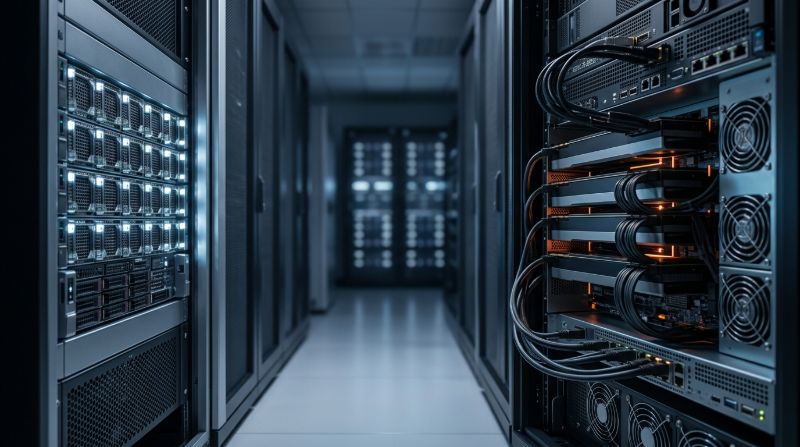
Calculating the true cost of on-premise AI infrastructure requires moving beyond invoice prices for GPU servers and high-speed network switches. While server hardware represents a substantial initial capital expenditure, enterprise total cost of ownership (TCO) is fundamentally driven by operational dependencies: facility electrical infrastructure, high-density cooling retrofits, continuous utility power, fiber optic cabling, multi-vendor support contracts, and specialized systems engineering talent. Teams that evaluate on-premise builds solely on server quotes frequently underestimate their three-year capital commitments by 40% to 70%.
When high-density GPU nodes consume between 10.2 kW and 14.5 kW per chassis, physical data center facilities must be engineered to handle thermal and electrical loads far beyond standard enterprise IT envelopes. This economic analysis presents a complete three-year TCO formulation, breaking down capital expenditure (Capex), ongoing operational expenditure (Opex), and facility depreciation to provide a transparent financial baseline for enterprise decision-makers.
Full Cost Breakdown: Capex vs Opex in On-Premise AI
An enterprise-grade AI infrastructure build divides financial outlays into upfront capital equipment and recurring operational expenses.
1. Capital Expenditures (Capex)
- Accelerated Compute Nodes: Enterprise 8-GPU baseboard servers with high-speed NVLink interconnects and redundant power supplies.
- East-West Switching Fabric: Non-blocking 400G/800G spine and leaf switches supporting low-latency RoCE v2 or InfiniBand protocols.
- High-Speed Parallel Storage: Multi-petabyte NVMe-over-Fabrics (NVMe-oF) storage arrays engineered for multi-gigabyte-per-second sequential checkpoint streaming.
- Optical Transceivers and Cabling: Active optical cables, high-density patch panels, and optical transceivers representing 8% to 12% of total fabric cost.
- Facility Electrical and Cooling Retrofits: Power Distribution Units (PDUs), UPS battery banks, busway feeds, and liquid cooling distribution loops.
2. Operational Expenditures (Opex)
- Continuous Utility Power: Electricity consumed directly by GPU compute nodes, auxiliary components, and mechanical cooling chillers.
- Facility Real Estate and Maintenance: Data center floor space, cage leases, environmental monitoring, fire suppression, and physical security.
- Hardware Support and Warranties: Multi-year 24/7 four-hour on-site vendor maintenance agreements across server, switch, and storage vendors.
- Engineering Overhead: Fully loaded compensation for specialized HPC infrastructure architects, Linux systems administrators, and network engineers.
Mathematical Formulation of 3-Year Infrastructure TCO
To accurately capture the full cost spectrum, enterprise financial analysts use a composite TCO model factoring in hardware depreciation, facility PUE, and staffing overhead.
The total three-year cost of ownership $\text{TCO}_{3\text{yr}}$ for an on-premise AI cluster is defined by the formula:
$$\text{TCO}_{3\text{yr}} = C_{\text{Hardware}} + C_{\text{Facility}} + \left( \sum_{m=1}^{36} \left( P_{\text{util}}(m) + O_{\text{facility}}(m) + M_{\text{vendor}}(m) + S_{\text{staff}}(m) \right) \right)$$
Where:
- $C_{\text{Hardware}}$ is the total initial equipment purchase cost (compute, network, storage, optical transceivers).
- $C_{\text{Facility}}$ is the one-time facility electrical and cooling retrofit capital.
- $P_{\text{util}}(m)$ is monthly utility power cost, calculated as: $$P_{\text{util}}(m) = W_{\text{cluster}} \times \text{PUE} \times 730\text{ hours} \times R_{\text{kWh}}$$ with $W_{\text{cluster}}$ in kW, $\text{PUE}$ as Power Usage Effectiveness, and $R_{\text{kWh}}$ as the local electricity tariff.
- $O_{\text{facility}}(m)$ is monthly space lease, chiller maintenance, and physical security.
- $M_{\text{vendor}}(m)$ is amortized monthly OEM maintenance and warranty coverage.
- $S_{\text{staff}}(m)$ is dedicated internal engineering compensation allocated to hardware maintenance.
In a typical 16-node cluster deployment, operational expenses ($P_{\text{util}} + O_{\text{facility}} + M_{\text{vendor}} + S_{\text{staff}}$) easily exceed $\$1.8\text{ million}$ over 36 months, rivaling the upfront hardware investment.
3-Year TCO Comparison Across Delivery Models
The table below models the financial commitments of running a dedicated 16-node (128-GPU) high-performance cluster over a three-year lifecycle.
| Financial Dimension | DIY On-Premise Facility | Commercial Colocation Lease | OneSource Cloud Dedicated Infrastructure |
|---|---|---|---|
| Initial Upfront Capex | $4.8M - $6.2M (Hardware + MEP Overhaul) | $3.8M - $4.5M (Hardware Purchase) | $0 (Zero Upfront Capital Expenditure) |
| Electrical & Cooling Bill (3yr) | $750K - $1.1M (Based on 1.6 PUE) | $600K - $850K (Power pass-through + PUE markup) | Bundled in Transparent Flat Monthly Fee |
| Dedicated Ops Staffing (3yr) | $900K - $1.4M (2-3 HPC/MEP Engineers) | $600K - $900K (1-2 Systems Engineers) | $0 (Fully Managed Hardware & Fabric Ops) |
| Hardware Obsolescence Impact | 100% Asset Write-Down over 3 Years | 100% Asset Write-Down over 3 Years | Zero Write-Down; Flexible Term Transition |
| Effective 3-Year TCO | $6.8M - $9.2M (High Variance Risk) | $5.4M - $7.1M (Moderate Variance) | Predictable, Fixed Monthly Operational Rate |
OneSource Cloud provides dedicated GPU infrastructure hosted in secure U.S. data centers with non-blocking Spine-Leaf RoCE v2 networking and single-tenant bare-metal isolation. By eliminating virtualization overhead, upfront capital requirements, and multi-tenant resource contention, OneSource Cloud delivers predictable execution times and substantial TCO savings for enterprise AI initiatives.
Production CLI for Tracking Power Draw and Cost Attribution
Infrastructure teams tracking on-premise operational expenses use scriptable interfaces to monitor power draw and correlate energy consumption with specific project teams.
// 1. Query cumulative energy consumption (in millijoules) per GPU
nvidia-smi --query-gpu=index,name,power.draw,energy.consumption --format=csv
// 2. Python snippet to calculate real-time electrical burn rate for a compute node
python3 -c '
import subprocess, re
output = subprocess.check_output(["nvidia-smi", "--query-gpu=power.draw", "--format=csv,noheader,nounits"]).decode()
watts = sum(float(line.strip()) for line in output.splitlines() if line.strip())
pue = 1.55
kwh_rate = 0.11
total_kw = (watts * pue) / 1000.0
hourly_cost = total_kw * kwh_rate
print(f"Total Node Power (incl. PUE): {total_kw:.2f} kW | Cost per Hour: ${hourly_cost:.3f}")
'
// 3. Audit Slurm job resource allocations to attribute hardware hours to cost centers
sacct --format=JobID,JobName,User,AllocCPUS,AllocTRES%30,Elapsed,State -S 2026-10-01
Hidden Cost Traps in On-Premise AI Deployments
Unanticipated operational roadblocks frequently inflate on-premise budgets. Managing these risks requires proactive architectural planning.
| Hidden Cost Factor | Budgetary Impact | Underlying Operational Cause | Mitigation Strategy |
|---|---|---|---|
| Optical Cable & Transceiver Failures | $20K - $60K unbudgeted replacement cost | Thermal degradation and tight bend-radius stress | Procure 15% spare optical inventory upfront; enforce strict cable raceways. |
| Utility Interconnection Delays | 6 to 18 months of idle server depreciation | Local utility transformer supply chain lead times | Perform utility capacity feasibility study before purchasing hardware. |
| Cooling CDU Pump Cavitation | Emergency facility shutdown; $50K repair | Air ingress or pressure drops in secondary liquid loop | Install continuous pressure transducers; mandate N+1 redundant CDU pumps. |
| Unscheduled Component Sparing | Weeks of cluster degradation waiting for RMAs | Long OEM return-merchandise supply chains | Contract 4-hour on-site mission-critical hardware maintenance tiers. |
For organizations seeking to eliminate unpredictable capital depreciation and facility overhead, OneSource Cloud pairs physical bare-metal hardware with optimized networking and enterprise storage, ensuring consistent performance without multi-tenant interference.
FAQ
Why do on-premise AI infrastructure costs frequently exceed initial budget estimates?
Initial budgets frequently account only for server and switch purchase prices, neglecting the high-density power delivery, liquid cooling distribution units, structural data center retrofits, multi-vendor maintenance contracts, and specialized engineering staff required to operate high-wattage GPU clusters over a multi-year lifecycle.
How does OneSource Cloud deliver lower TCO compared to on-premise AI deployments?
OneSource Cloud delivers lower TCO by eliminating upfront capital expenditures, facility construction costs, and power utility interconnection delays. Enterprise workloads run on dedicated, single-tenant bare-metal GPU clusters hosted in optimized Tier 3/4 U.S. data centers under a transparent, flat-rate monthly structure with zero data egress fees and fully managed physical infrastructure.
Related Articles
Recommended Reading
-
How Paged Attention Manages Inference KV Cache
-
Google Cloud GPU Pricing: What Enterprise AI Teams Should Evaluate Before Provisioning
-
Paperspace Pricing 2026: GPU Cost Breakdown
-
AI Infrastructure Costs: Controlling Enterprise GPU Spending
-
CoreWeave Enterprise GPU Cloud: Evaluation for AI Teams
-
CoreWeave vs Lambda Labs: GPU Cloud Provider Comparison
-
AWS GPU Pricing: Instance Types, Cost Structure & Alternatives Guide
-
CoreWeave Alternatives: Compare GPU Clouds
latest articles
-
RunPod Alternatives for Enterprise AI Outgrowing Shared Cloud
-
Hybrid AI Infrastructure: On-Prem and Cloud for Enterprise Scale
-
GPU Cluster Networking: InfiniBand vs Ethernet for AI Training
-
On-Premise AI Infrastructure Cost and TCO for Enterprise
-
5 Levels of AI Infrastructure: Enterprise Architecture Guide
-
How Many GPUs to Train an LLM: Enterprise Capacity Requirements
-
AI Orchestration Platform Architecture for GPU Clusters
-
AI Infrastructure Provider SLA Checklist for Enterprise Buyers
-
Sovereign AI Cloud: Data Residency Controls for U.S. Business
-
How to Choose an Enterprise AI Infrastructure Provider for LLMs