
AI Orchestration Platform Architecture for GPU Clusters
An AI orchestration platform serves as the central control plane for enterprise GPU clusters, translating heterogeneous compute requests into deterministic hardware execution. In classical enterprise microservices, schedulers optimize for high CPU packing densities, rapid pod eviction, and loose horizontal scaling. In contrast, distributed deep learning workloads demand synchronous gang allocation, physical NUMA affinity, and strict topology awareness. Allocating eight GPUs across two separate physical nodes rather than within a single NVLink baseboard degrades tensor-parallel throughput by an order of magnitude.
Without an intelligent orchestration layer, GPU clusters suffer from severe capacity fragmentation, head-of-line blocking, and uncoordinated preemption that aborts multi-day training jobs. Engineering teams require an orchestration architecture capable of understanding physical silicon hierarchies—from intra-node NVLink domains to inter-node spine-leaf network switches. This guide details the architectural tiers, scheduling algorithms, and operational controls that define an enterprise-grade AI orchestration platform.
Core Architectural Tiers of an AI Orchestration Platform
A production AI orchestration platform decouples cluster operations into three primary subsystems: hardware discovery and topology mapping, the gang scheduling engine, and workload lifecycle management.
1. Physical Hardware Discovery and Topology Graphing
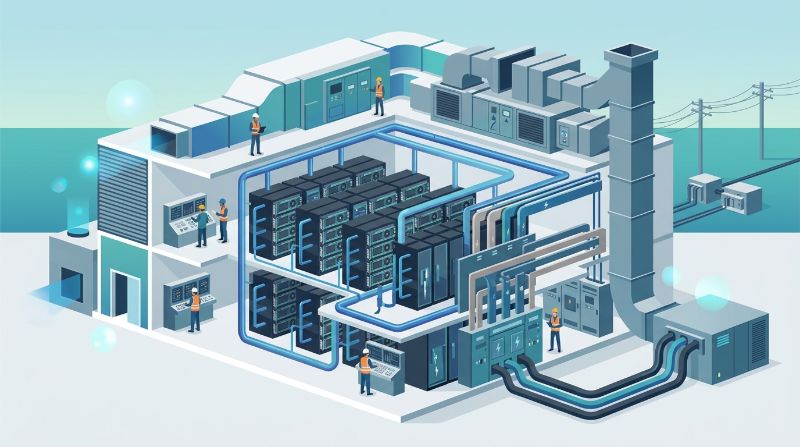
Before placing workloads, the orchestration platform must construct an accurate graph of physical interconnects. This includes PCIe tree structures, CPU-to-GPU NUMA socket bindings, NVLink mesh groups, and top-of-rack (ToR) switch affinities. If a scheduler treats all GPUs as fungible scalar resources, it inevitably splits communication-intensive tensor-parallel ranks across non-contiguous PCIe root complexes, causing bus saturation and severe pipeline stalls.
2. Gang Scheduling and Atomic Allocation
Distributed training jobs cannot execute partially. If a 64-GPU training run is allocated only 56 GPUs due to competing tasks, the allocated GPUs sit completely idle, waiting for the remaining ranks while blocking other jobs. Gang Scheduling (all-or-nothing allocation) ensures that a distributed workload receives either 100% of its requested resources across optimal network fabrics or remains queued, eliminating resource deadlocks and orphaned allocations.
3. Dynamic Preemption and Fair-Share Quota Management
Enterprise platforms balance exploratory ad-hoc research notebooks against long-running production model training. The orchestration engine implements priority tiers with automated state checkpointing. Low-priority interactive tasks are preempted gracefully when high-priority scheduled training runs launch, resuming automatically when cluster capacity frees up.
OnePlus™ AI Orchestration Platform: Topology-Aware Logic
To solve the dual challenges of network latency and cluster fragmentation, modern private AI infrastructure leverages specialized orchestration engines. The OnePlus™ AI Orchestration Platform represents a core reference implementation of topology-aware scheduling designed specifically for dedicated GPU clusters.
The OnePlus™ AI Orchestration Platform operates by maintaining an active, real-time matrix of physical hardware topologies across U.S. data center pods. When a distributed training workload is submitted, the platform's scheduler evaluates three nested locality boundaries:
- Intra-Node NVLink Locality: Workloads requesting tensor parallelism are strictly constrained to 8-GPU baseboard meshes, ensuring communication occurs at up to 900 GB/s to 3.2 TB/s without traversing PCIe buses.
- Intra-Rack Rail Locality: Multi-node jobs requiring data or pipeline parallelism are mapped to adjacent nodes under the same Top-of-Rack (ToR) switch, avoiding cross-spine traversals.
- Cross-Spine RoCE v2 Mapping: When clusters scale to hundreds of GPUs, the OnePlus™ AI Orchestration Platform prioritizes nodes connected to uniform spine switch groups, minimizing RoCE v2 hop count and preventing hash polarization.
By coordinating physical hardware topology directly with workload communication graphs, the OnePlus™ AI Orchestration Platform prevents cluster fragmentation and ensures enterprise models achieve maximum theoretical MFU.
Mathematical Formulation of Scheduling Locality and Fragmentation
The speedup achieved by topology-aware scheduling versus random or naive placement can be quantified through communication delay modeling.
The effective collective communication time $T_{\text{comm}}$ for a distributed job mapped across an orchestration topology is governed by the maximum path latency between communicating ranks:
$$T_{\text{comm}} = \max_{(i, j) \in \mathcal{E}} \left( L_{\text{phy}}(i, j) + \frac{D_{\text{tensor}}}{B_{\text{link}}(i, j)} \right)$$
Where $\mathcal{E}$ represents the set of communicating rank pairs, $L_{\text{phy}}(i, j)$ is the physical interconnect latency between ranks $i$ and $j$, and $B_{\text{link}}(i, j)$ is the bottleneck bandwidth. In an uncoordinated scheduler, crossing remote NUMA or spine tiers increases $L_{\text{phy}}$ by up to $8\times$. Furthermore, the cluster fragmentation index $\Phi_{\text{frag}}$ measuring stranded GPU capacity across $M$ nodes is expressed as:
$$\Phi_{\text{frag}} = 1 - \frac{\sum_{k=1}^{M} \lfloor U_k / 8 \rfloor \times 8}{U_{\text{total}}}$$
Where $U_k$ is the number of unallocated GPUs on node $k$, and $U_{\text{total}}$ is total idle GPUs cluster-wide. When $\Phi_{\text{frag}} > 0.20$, more than 20% of idle compute is stranded in unusable sub-node fragments, preventing 8-GPU jobs from launching despite nominal capacity.
Orchestration Engine Architectures Compared
Enterprise infrastructure teams choose among distinct orchestration paradigms depending on workload maturity, developer experience requirements, and cluster scale.
| Capability Dimension | Standard Kubernetes + Device Plugin | HPC Slurm Workload Manager | OnePlus™ AI Orchestration Platform |
|---|---|---|---|
| Topology Awareness | Basic Node-Level (Lacks Deep NVLink/NIC Hierarchy) | Static Topology Plugins (Requires Manual Config) | Dynamic Silicon-to-Spine Interconnect Graphing |
| Gang Scheduling | Requires Third-Party Add-Ons (Volcano/Kueue) | Native Job Step Allocation | Native All-or-Nothing Multi-Node Gang Scheduling |
| Anti-Fragmentation | Poor (Prone to Fragmented Single-GPU Leaves) | Moderate (Slot-Based Bin Packing) | Intelligent Bin-Packing with Locality Preservation |
| User Interface & API | YAML Manifests / kubectl CLI | Batch Shell Scripts / sbatch CLI | Enterprise Unified Dashboard & Native API |
| Infrastructure Model | Overlay on Public/Private Cloud | Bare-Metal HPC Cluster Environments | Turnkey Layer on OneSource Cloud Bare Metal |
OneSource Cloud provides dedicated GPU infrastructure hosted in secure U.S. data centers with non-blocking Spine-Leaf RoCE v2 networking and single-tenant bare-metal isolation. Combined with the OnePlus™ AI Orchestration Platform, OneSource Cloud delivers high-efficiency scheduling and zero-overhead execution for enterprise AI workloads.
Production Scheduling Configuration and Job Submission
The following configuration demonstrates a production Gang Scheduling submission targeting a topology-aware GPU cluster environment.
// 1. Slurm topology-aware job submission script for distributed 16-GPU run
cat << 'EOF' > train_job.slurm
// !/bin/bash
// SBATCH --job-name=llm-pretrain-70b
// SBATCH --nodes=2
// SBATCH --ntasks-per-node=8
// SBATCH --gpus-per-node=8
// SBATCH --cpus-per-task=12
// SBATCH --exclusive
// SBATCH --network=roce_v2
// Enforce strict NUMA memory binding for local PCIe root complex
export NCCL_TOPO_DUMP_FILE=/tmp/nccl_topo.xml
export NCCL_SET_STACK_SIZE=1
srun --cpu-bind=cores python3 -u distributed_train.py \
    --model_config configs/llama3_70b.json \
    --precision bf16
EOF
// Submit the gang-scheduled batch to the cluster
sbatch train_job.slurm
// 2. Inspect active GPU topology allocations and NUMA socket alignment
numactl --hardware
nvidia-smi topo -m
Operational Troubleshooting in AI Orchestration
When orchestrating high-density compute fleets, scheduling conflicts and allocation anomalies must be identified and corrected quickly.
| Observed Symptom | Cluster Consequence | Root Scheduling Cause | Remediation Protocol |
|---|---|---|---|
| Resource Stranding | Multiple nodes idle with 1-2 free GPUs; 8-GPU jobs stuck | Ad-hoc 1-GPU requests fragmenting 8-GPU baseboards | Establish separate node pools for single-GPU interactive tasks; enforce 8-GPU whole-node reservations. |
| Intermittent NCCL Hangs | Multi-node jobs freeze during tensor exchange | Scheduler placed ranks across non-contiguous switch pods | Implement strict rack-level topology affinity constraints in scheduler policy. |
| OOM from NUMA Misalignment | 20% throughput drop and random CUDA memory faults | CPU worker threads executing across remote NUMA socket | Enable automated CPU-GPU socket pinning using core binding flags. |
| Preemption Cascade Failure | Corrupted model weights during high-priority preempt | Scheduler sending SIGKILL without grace period | Configure graceful SIGTERM hooks with 5-minute checkpoint save buffers. |
For organizations scaling dedicated clusters, OneSource Cloud pairs physical bare-metal hardware with optimized networking and enterprise storage, ensuring consistent performance without multi-tenant interference.
FAQ
Why is Gang Scheduling mandatory for distributed AI training workloads?
Gang Scheduling is mandatory because distributed training requires all participating GPUs across all nodes to begin execution simultaneously. Without gang scheduling, a standard scheduler may allocate only a subset of requested GPUs while waiting for the rest to free up, causing allocated GPUs to sit idle, wasting cluster capacity, and triggering deadlocks with competing jobs.
How does the OnePlus™ AI Orchestration Platform optimize scheduling on OneSource Cloud clusters?
The OnePlus™ AI Orchestration Platform optimizes scheduling on OneSource Cloud clusters by analyzing the physical hardware topology of every server, including intra-node NVLink domains and inter-node RoCE v2 spine-leaf connections. It automatically places communication-intensive ranks onto nodes with the lowest network hop counts, eliminating cross-switch latency and maximizing Model Flops Utilization (MFU) for enterprise AI models.
Related Articles
Recommended Reading
-
How Paged Attention Manages Inference KV Cache
-
Google Cloud GPU Pricing: What Enterprise AI Teams Should Evaluate Before Provisioning
-
Paperspace Pricing 2026: GPU Cost Breakdown
-
AI Infrastructure Costs: Controlling Enterprise GPU Spending
-
CoreWeave Enterprise GPU Cloud: Evaluation for AI Teams
-
CoreWeave vs Lambda Labs: GPU Cloud Provider Comparison
-
AWS GPU Pricing: Instance Types, Cost Structure & Alternatives Guide
-
CoreWeave Alternatives: Compare GPU Clouds
latest articles
-
RunPod Alternatives for Enterprise AI Outgrowing Shared Cloud
-
Hybrid AI Infrastructure: On-Prem and Cloud for Enterprise Scale
-
GPU Cluster Networking: InfiniBand vs Ethernet for AI Training
-
On-Premise AI Infrastructure Cost and TCO for Enterprise
-
5 Levels of AI Infrastructure: Enterprise Architecture Guide
-
How Many GPUs to Train an LLM: Enterprise Capacity Requirements
-
AI Orchestration Platform Architecture for GPU Clusters
-
AI Infrastructure Provider SLA Checklist for Enterprise Buyers
-
Sovereign AI Cloud: Data Residency Controls for U.S. Business
-
How to Choose an Enterprise AI Infrastructure Provider for LLMs