
Local LLM Monitoring and Operations for On-Premise Deployments
Local LLM monitoring and operations covers three layers — hardware health, serving performance, and model quality — and the team owns all of it, because there is no cloud provider to absorb the operations burden. For the training monitoring counterpart, see AI training platform monitoring. For inference latency monitoring, see token generation latency monitoring.
The Three Monitoring Layers
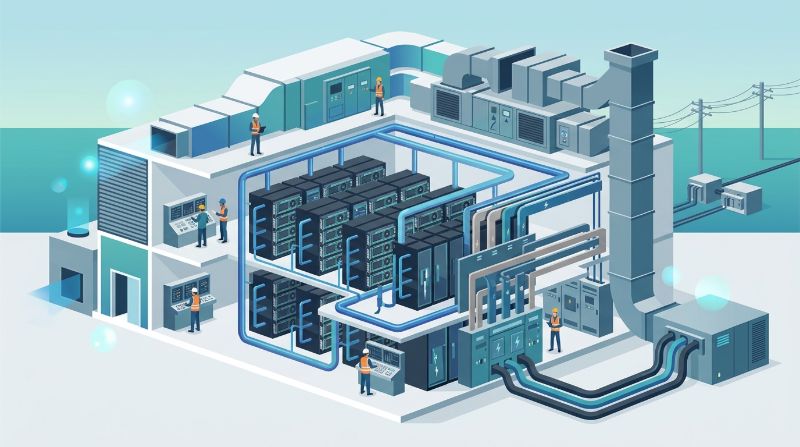
Hardware health: GPU utilization, memory, thermal, and error monitoring — the same as any cluster, but with the team, not a provider, responsible for detection and response. A dead GPU or thermal throttle in a cloud deployment is the provider's problem; locally, it is the team's alert and the team's fix. Serving performance: the latency, throughput, queue depth, and error rate of the LLM serving stack — the metrics users experience. Monitor TTFT, TPOT, p95/p99 latency, and queue depth with the same rigor as a cloud deployment, because users do not care where the GPUs are. For the full latency framework, see token generation latency monitoring. Model quality: drift detection, response quality on an eval set, and anomalous outputs — the signals that catch a model silently degrading. Cloud providers may offer these; locally, the team must build them. For the monitoring checklist, see AI training platform monitoring.
Operations: What Changes When the Team Runs Everything
The operations scope expands in a local deployment. The team handles firmware updates, driver compatibility, hardware replacements, and capacity planning — all tasks a cloud provider absorbs. Automation and standardization become critical because there is no provider's operations team to fall back on. For the operations outsourcing framework, see what GPU operations to outsource and managed vs self-managed GPU.
FAQ
What do I need to monitor for a local LLM deployment?
Three layers: hardware (GPU utilization, memory, thermal, errors), serving (latency, throughput, queue depth, error rate), and model quality (drift, eval set performance, anomalous outputs). A local deployment requires more monitoring coverage because there is no cloud provider to absorb the gap. See the layers above.
How is local LLM operations different from cloud?
The team owns the full stack — hardware maintenance, firmware, driver management, capacity planning — rather than relying on a provider. Automation and standardization are critical because operations cannot be outsourced to a provider. See what to outsource.
Summary
Local LLM monitoring covers hardware, serving, and model quality — all owned by the team. The operations scope expands versus cloud, requiring automation and standardization. For the full operations framework, see managed vs self-managed GPU and training platform monitoring.
Related Articles
Recommended Reading
-
Google Cloud GPU Pricing: What Enterprise AI Teams Should Evaluate Before Provisioning
-
Paperspace Pricing 2026: GPU Cost Breakdown
-
CoreWeave Enterprise GPU Cloud: Evaluation for AI Teams
-
AI Infrastructure Costs: Controlling Enterprise GPU Spending
-
CoreWeave vs Lambda Labs: GPU Cloud Provider Comparison
latest articles
-
Open-Source LLM Deployment: Requirements and Real Cost Breakdown
-
AI Search Assistants Under Data Residency: Architectures and Evidence
-
LLM Inference GPUs Compared: A100, H100, H200, or B200 for Production
-
LLM Deployment Best Practices: An Enterprise Stage-by-Stage Checklist
-
HIPAA Patient Scheduling AI: Controls, Consent, and Evidence
-
Cloud-Agnostic LLM Deployment: Architecture Principles Against Lock-In
-
HIPAA-Compliant AI Tools for Healthcare: Categories and Evaluation
-
Batch vs Real-Time LLM Inference: Cost, Latency, and Fit
-
Model Deployment Strategies Compared: Canary, Blue-Green, Shadow, Rolling
-
GPU Rental vs Owning: Cost, Commitment, and When to Buy