
LLM Deployment Architecture: Layers, Topology, and Design Choices
Every vendor publishes an LLM reference architecture, and each one suspiciously centers the vendor's own products. Strip the logos away, though, and the same six layers appear in every credible production deployment. This page assembles that vendor-neutral model: what each layer owns, how the layers connect in production traffic and control terms, and — most usefully — the three design choices that quietly dominate everything else. If you are assembling your first production LLM platform or rationalizing one that grew organically, the layer model is the map.
The Six Layers and What Each Owns
A production deployment stacks six layers — inference serving, workload orchestration, data and retrieval, guardrails, observability, and the application interface — where each layer owns one concern and exposes it upward, so the architecture is the set of ownership boundaries as much as the components.
| Layer | Owns | Exposes upward |
|---|---|---|
| Inference serving | Model execution: engines, GPUs, batching, scaling | An inference endpoint with latency and throughput characteristics |
| Workload orchestration | Placement, scheduling, and lifecycle of the workloads above | Running, updated, recoverable workloads |
| Data and retrieval | Corpora, indexes, pipelines feeding grounded generation | Retrieval interfaces over governed data |
| Guardrails | Input and output policy: filtering, redaction, classification | Policy enforcement points in the request path |
| Observability | Metrics, traces, evaluation signals across all layers | The system's measurable behavior |
| Application interface | APIs, gateways, and product surfaces consumers touch | The contract your applications build on |
Products bundle these layers differently — a platform may sell serving plus orchestration, another may fuse guardrails into its interface — but the model remains the durable mental furniture: when a vendor's diagram shows four boxes, ask which of the six each box hides. Practitioner guidance treats inference, guardrails, and observability as one integrated system rather than add-ons, which is exactly the layer-ownership view: the layers are distinct in what they own, integrated in how they operate.
How the Layers Connect in Production
In production the layers connect along two paths: the request path (application to interface to guardrails to serving to retrieval and back) with latency budgeted per hop, and the control path (orchestration and observability observing and adjusting every layer) — with network locality between the serving and retrieval tiers deciding much of the realized performance.
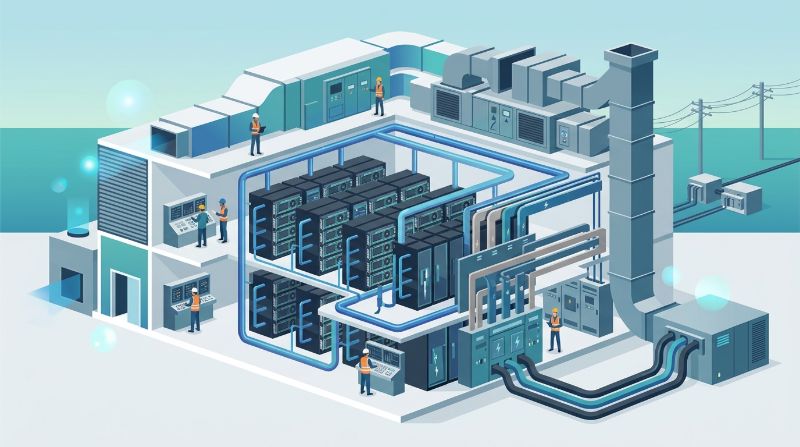
Tracing the two paths:
- The request path carries user traffic: application calls the interface, the interface routes through guardrail enforcement, serving executes with retrieval consulted for grounded generation, and the response returns through output-side guardrails. Every hop spends the latency budget, so the budget must be allocated per hop — not discovered in production. Guardrail placement (inline on the request path versus near-async) is a real design variable trading safety strictness for latency.
- The control path carries operations: orchestration places and recovers workloads; observability consumes signals from every layer and feeds evaluation. The control path is what makes the request path's behavior visible and adjustable — vendor inference reference architectures make the same point in their own vocabulary: components consume network attachments, locality, bandwidth, and latency, with scheduler-driven placement binding it together.
The locality point deserves its emphasis: reference architectures spend real effort on where serving and retrieval sit relative to each other, because the gap between them is latency your users pay on every grounded request. Colocate what talks constantly; that principle survives every vendor's terminology.
The Three Choices That Dominate the Design
Three choices dominate: serving topology (single-model versus multi-model fleet), the data boundary (where prompts, retrieval corpora, and logs may live), and control-plane placement (who operates orchestration and observability) — most later constraints trace back to these three, so deciding them consciously is the architecture work.
| Choice | The options | What it dominates downstream |
|---|---|---|
| Serving topology | Single-model endpoint versus multi-model fleet with routing | Capacity planning shape, model lifecycle complexity, gateway requirements |
| Data boundary | Provider clouds versus your boundary (VPC, on-premise, dedicated) | Compliance posture, retrieval architecture, vendor set |
| Control-plane placement | You operate orchestration and observability, or a provider does | Headcount, update cadence, where telemetry lives |
The cascade works like this: a multi-model topology forces routing and lifecycle machinery; a closed data boundary eliminates provider-side options and pulls retrieval and logs inside; provider-operated control planes trade flexibility for headcount. Teams that skip deciding these three consciously end up with an architecture anyway — assembled by default, expensive to walk back. Deployment-model comparisons (on-premise, VPC, hybrid) are the macro expression of the second and third choices, and environments like OneSource Cloud's private AI infrastructure answer the second choice with a dedicated boundary for the whole stack.
FAQ
Should we build each layer or buy it?
Decide per layer, not per platform: serving and observability have strong build options when you have platform staff, guardrails and orchestration reward buying early because correctness matters more than differentiation, and the data layer follows your compliance boundary rather than a build-buy logic at all.
Which components do we actually need in month one?
Three: the serving tier, basic observability, and the guardrail set your first workload requires — everything else (multi-model routing, advanced retrieval, autonomous orchestration) earns its way in when a second workload demands it, and the layer model tells you where each addition lands.
How does the architecture change for multiple models?
The serving layer becomes a fleet with routing in front of it, capacity planning per model class replaces single-model sizing, and model lifecycle management (versioning, promotion, rollback) graduates from nice-to-have to core — the other layers absorb the change mostly through scale.
Related Articles
Recommended Reading
-
Google Cloud GPU Pricing: What Enterprise AI Teams Should Evaluate Before Provisioning
-
Paperspace Pricing 2026: GPU Cost Breakdown
-
CoreWeave Enterprise GPU Cloud: Evaluation for AI Teams
-
AI Infrastructure Costs: Controlling Enterprise GPU Spending
-
CoreWeave vs Lambda Labs: GPU Cloud Provider Comparison
latest articles
-
GPU Requirements for Video Diffusion Models
-
GPU Sharing for Enterprise AI: MIG, Time-Slicing, and vGPU Compared
-
Can AI Be HIPAA Compliant? What the Question Actually Means
-
AI Infrastructure Management Tools: How to Compare Platforms
-
Cloud Deployment Models Compared: Choosing for AI Workloads
-
LLM Inference API vs Self-Hosted: Cost, Control, and Compliance
-
LLM Deployment Architecture: Layers, Topology, and Design Choices
-
GPU Cluster Requirements: The Planning Checklist Before You Buy
-
MLOps Platforms Compared: How to Evaluate Enterprise Options
-
ASIC vs GPU for AI Inference: TPU, Trainium, and the Fit Question