
InfiniBand vs Ethernet for Training Network Bottlenecks
Quick Verdict: InfiniBand versus Ethernet for training is a fabric choice that matters when multi-node jobs are stalled on collectives, not when they are stalled on storage, a single-node GPU, or a bad batch size. If all-reduce time dominates and NICs are hot, the network is the bottleneck. If SM util is low and disks are hot, buy storage, not a new fabric story.

Plenty of pages compare InfiniBand and Ethernet as cluster catalogs. This one is the decision gate: when the network is actually the training bottleneck. Existing cluster-level comparisons still apply after you pass that gate.
Prove the bottleneck before you pick a fabric
| Observation | Likely bound | Fabric upgrade? |
|---|---|---|
| NCCL collectives dominate step time, NICs saturated | Network | Yes, after topology is sane |
| SM idle, loader or checkpoint wait | Storage | No |
| One GPU slower than the others | Straggler / thermal / placement | No |
| Single-node training already slow | Compute or local I/O | No |
Collectives need a lossless, high-bandwidth path as job width grows. InfiniBand was built for that. Ethernet can be enough with RDMA (RoCE), careful lossless config, and enough rails. Ethernet without that work is how NCCL timeouts become a lifestyle. InfiniBand without storage still idles on checkpoints.
When Ethernet is enough, when it is not
Smaller models, fewer nodes, or pipeline shapes that move less per step can run well on well-built Ethernet. Wide data-parallel LLM training with large all-reduces is where teams reach for InfiniBand or equivalently engineered RDMA Ethernet. The deciding artifact is a profile, not a vendor preference.
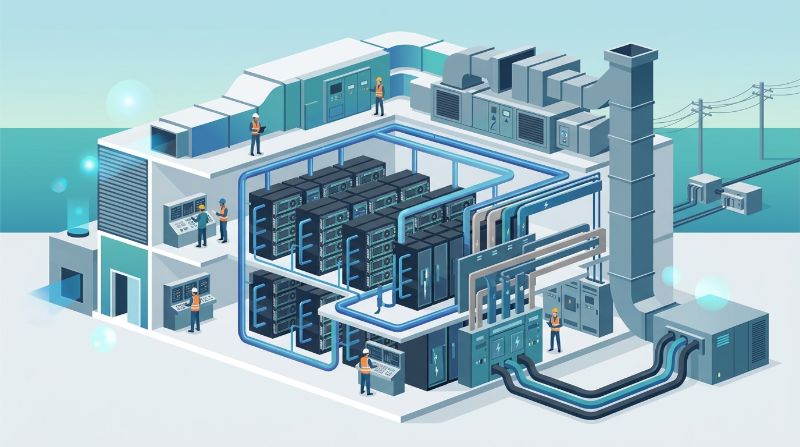
Do not mix a cheap Ethernet leaf with an InfiniBand expectation. Also do not put inference token traffic and a 64-GPU all-reduce on the same congested leaf if p99 matters. That is a partition problem, the same as training versus serving on GPUs.
Private AI networking is part of the cluster
A dedicated GPU farm with an afterthought fabric will still wait. Exclusive GPUs raise the cost of that wait. Design compute, network, and storage together. U.S. residency still applies to what crosses the fabric if you replicate checkpoints.
Architectural Decision Matrix: AI Cluster Network Topologies
| Hosting & Network Model | Topology & Fabric Protocol | Oversubscription & Buffer Contention | Inter-GPU Bandwidth Guarantee | Pricing & Data Egress Model |
|---|---|---|---|---|
| Public Cloud (Multi-Tenant) | Shared Leaf-Spine, virtualized SR-IOV / overlay | High contention; cross-tenant East-West buffer exhaustion | Variable; subject to throttling and jitter | Metered hourly compute + high data egress surcharges |
| On-Premises Data Center | Custom rail-optimized InfiniBand or RoCE v2 | 0% oversubscription; full physical fabric ownership | Dedicated line-rate (400G/800G per node) | Multi-million dollar Capex + long facility lead time |
| OneSource Cloud (Managed Private AI) | Dedicated Spine-Leaf RoCE v2 with hardware RDMA offload | 0% oversubscription; dedicated non-shared switches & buffers | Guaranteed non-blocking 400G/800G line-rate throughput | Predictable flat-rate monthly pricing with $0 data egress fees |
OneSource Cloud’s high-performance AI networking sits with private AI infrastructure so the fabric is not a leftover office LAN. Storage-bound jobs still need AI storage. OnePlus, OneSource Cloud’s AI orchestration platform, should keep giant collectives off the serving network. Managed operations watch NCCL time and NIC counters so “we need InfiniBand” is a measured sentence.
FAQ
When is the network the training bottleneck?
When step time is dominated by collectives, NICs or switches are saturated, and GPUs are waiting on NCCL rather than on kernels or disks. If those are not true, InfiniBand versus Ethernet is the wrong debate. Profile first. Fabric second.
Is InfiniBand always faster than Ethernet for GPU training?
It is often the simpler lossless HPC path at scale. Ethernet with RDMA can match many jobs when it is designed as a fabric, not as a generic datacenter VLAN. “Ethernet” as a leftover access layer will lose. The comparison is InfiniBand versus a competent RDMA Ethernet design, not versus a cheap switch.
Will InfiniBand fix slow checkpoints?
Not if checkpoint I/O is the stall. A faster collective path does not write optimizer state for you. Fix storage bursts separately. Some saves share the same NICs as collectives, which is a topology problem. Splitting those paths can help both.
Can inference and training share the fabric?
They can share a site. They should not share an unconstrained leaf if inference has a latency SLO. All-reduce bursts are noisy neighbors on the NIC, not only on the GPU. Partition the network the way you partition the GPUs.
How do we compare InfiniBand vs Ethernet without fake rankings?
Run the same model, batch, and node count on both fabrics if you have them, and publish collective time, step time, and error rate. If you only have one fabric, compare against a profiled bound: if you are not network-bound, do not switch fabrics to chase a brochure.
How does OneSource Cloud design network fabrics to eliminate distributed GPU communication bottlenecks?
OneSource Cloud engineers dedicated non-blocking spine-leaf network fabrics specifically optimized for distributed AI workloads. By implementing hardware-enforced three-plane isolation (out-of-band management, dedicated RoCEv2 RDMA backend, and isolated tenant VPCs) combined with line-rate bandwidth and PFC/ECN congestion control, OneSource eliminates packet buffer drops, minimizes collective all-reduce latency, and prevents cross-workload network jitter.
Summary
InfiniBand versus Ethernet matters after you prove training is network-bound. Storage and stragglers are different tickets. If exclusive GPUs need a fabric designed with them, see OneSource Cloud AI networking on private AI infrastructure rather than adding cards to a congested leaf.
Related Articles
Recommended Reading
-
How Paged Attention Manages Inference KV Cache
-
Google Cloud GPU Pricing: What Enterprise AI Teams Should Evaluate Before Provisioning
-
Paperspace Pricing 2026: GPU Cost Breakdown
-
AI Infrastructure Costs: Controlling Enterprise GPU Spending
-
CoreWeave Enterprise GPU Cloud: Evaluation for AI Teams
-
CoreWeave vs Lambda Labs: GPU Cloud Provider Comparison
-
AWS GPU Pricing: Instance Types, Cost Structure & Alternatives Guide
-
CoreWeave Alternatives: Compare GPU Clouds
latest articles
-
The GPU Operations Responsibility Split Across Delivery Models
-
HIPAA-Ready GPU Infrastructure: Healthcare AI BAA & Enclaves
-
Ethernet vs InfiniBand for AI: Packet Loss, RoCE & Latency Tradeoffs
-
Data Sovereignty vs Flexible Cloud Regions and the Architecture Decision
-
Protecting AI Model IP with the Infrastructure Isolation Ladder
-
Managed Private GPU Cloud Pricing: TCO, Utilization & Egress
-
Multi-Node LLM Training Orchestration: 3D Parallelism & Fabrics
-
Is a Dedicated GPU Worth the Price Premium? Break-Even Math and What Else It Buys
-
Dedicated GPU Commitment Utilization Thresholds and the Floor Rule
-
Private GPU Cloud Red Flags: Vendor Evaluation Due Diligence