
GPU SLA Service Credits: What They Pay For and What They Don't
Every GPU contract carries an uptime promise, and behind every uptime promise sits a remedy most buyers never read: the service credit. It sounds like insurance — miss the number, get paid — and it is not. Understanding what a credit actually is, what it pays, and how little of your outage cost it touches is the difference between weighing SLAs honestly and signing on a tier table.
Criteria: Read the Remedy, Not the Uptime Number
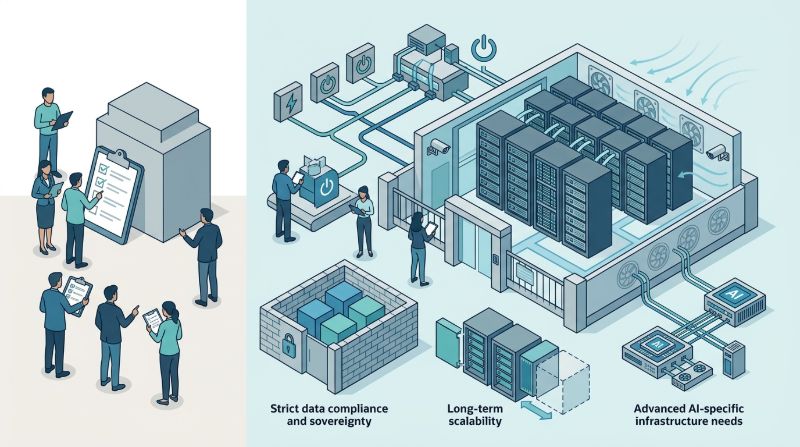
Evaluate the remedy with the same seriousness as the uptime promise: the form (service credits are account rebates against future invoices, never cash refunds), the cap (commonly 10-30% of the monthly fee for the affected service), the trigger (measured monthly availability against the stated commitment — where the definition of available is itself contractual), and the claim path (deadlines often near 30 days, evidence requirements, no automatic payment) — because a 99.9% promise backed by a remedy you will never file for is a promise you will never collect on.
| Remedy element | What to extract | Common shape |
|---|---|---|
| Form | How the remedy is paid | Account credit on future invoices; no cash back |
| Cap | Maximum payment | 10-30% of the affected service's monthly fee |
| Trigger | What counts as a breach | Monthly availability below the stated tier — as the contract defines availability |
| Claim path | How payment happens | Customer files within a deadline, with evidence; rarely automatic |
The four-part read matters because SLA analyses of GPU clouds flag exactly these corners: credits function as rebates not sized to outage cost, and the availability definition determines whether your failure mode even counts as downtime. Two providers can advertise identical uptime tiers while their remedies differ by an order of magnitude in what a real incident collects.
Evidence Request: Price the Credit Before You Need It
Price the remedy in your own numbers before signing: published math puts a six-hour outage earning a 10% credit on one month's bill at under one percent of annual spend, and industry analysis computes a sub-36-hour VM outage to roughly a dollar of credit — so request the worked examples (a real outage month through their credit schedule), confirm whether your long-training-run interruption even counts as downtime under their availability definition, and note that wasted job time, retraining, and missed deadlines are excluded everywhere.
- The annualized exercise: take your plausible worst outage month, run it through the proposed tier table, and divide by annual spend — the answer is usually a fraction of a percent.
- The definition check: a healthy instance beside a dead training run — does the contract measure the instance or your workload?
- The exclusion list: lost revenue, wasted job time, retraining cost, and penalties you owe your own customers sit outside every credit schedule in the market.
- The claim drill: who files, with what evidence, by when — and who tracks monthly uptime against the contractual definition so the deadline is never missed.
Running this exercise changes the negotiating conversation: the credit percentage stops being a headline and becomes what it is — one term among four in a remedy whose real value is measured in fractions of a percent.
Fit: Weighing Credits in the Buying Decision
Weigh credits as a provider-confidence signal, not as risk transfer: industry analysis is blunt that cloud SLAs punish rather than compensate — the credit incentivizes the provider while transferring almost none of your outage cost — so let a generous, clearly-defined credit schedule tip you toward a provider whose availability architecture you already trust, and never let it substitute for the evaluation that matters: the facility, the redundancy, and the track record, because the credit pays for the past outage and nothing for the next one.
This is also why flat-rate dedicated providers such as OneSource Cloud compete on the architecture and the invoice rather than the rebate schedule: predictable pricing with defined terms lets the buyer evaluate the actual product — the environment and its redundancy — instead of pricing a remedy designed to be rarely and partially paid.
FAQ
Are SLA service credits automatic when uptime misses?
Rarely — the claim burden sits with the customer: most agreements require you to file within a deadline (often 30 days of the incident) with evidence of the availability miss, so the team that does not track monthly uptime against the contractual definition forfeits credits it earned; treat the claim calendar as part of operating the contract.
Does a GPU outage during a week-long training run count as downtime?
Only if the availability definition says so — and this is the fine print that matters most for GPU workloads: some definitions measure instance reachability, not whether your job completed or your checkpoint survived, so a healthy instance beside a dead training run may not trigger anything; the availability definition gets read and negotiated with your workload's shape in mind, before signing.
Should we negotiate bigger SLA credits?
Negotiate the definition and the claim path first, the percentage second: a larger credit behind an availability definition that excludes your real failure modes pays nothing, while a tight definition, a long claim window, and worked examples collect reliably — and remember what the analysis says the credit is: a provider-confidence signal and an incentive on them, never insurance on you, which is why flat-rate dedicated providers with transparent terms such as OneSource Cloud compete on the architecture and the invoice, not the rebate schedule.
Related Articles
Recommended Reading
latest articles
-
Predictive Maintenance AI Workloads: Infrastructure Requirements That Matter
-
GPU Contract Early Termination: What Exiting Before the Term Costs
-
Warm Pools for Model Replicas: The Cost of LLM Readiness
-
AI Infrastructure Unit Economics: Metrics That Matter Per Workload
-
When Public Cloud GPU Quota Becomes a Delivery Risk for AI Teams
-
Enterprise RAG Reranking: Latency Cost vs Retrieval Quality
-
Showback vs Chargeback for AI Infrastructure: How Teams Choose
-
Multi-Model GPU Serving: Capacity Planning When Models Share a Fleet
-
GPU SLA Service Credits: What They Pay For and What They Don't
-
GPU Capacity Expansion Decision Rights: Who Decides, on What Evidence