
Predictive Maintenance AI Workloads: Infrastructure Requirements That Matter
Predictive maintenance is the industrial AI program with the clearest payback — catch the failure before it stops the line — and the most underestimated infrastructure appetite. The models get the attention; the always-on pipeline beneath them decides whether the program works. This page maps the workload as infrastructure people buy it: four stages, each with its own requirements, and one cadence that turns the whole thing from a project into an operation.
Definition: An Always-On Pipeline, Not a Project
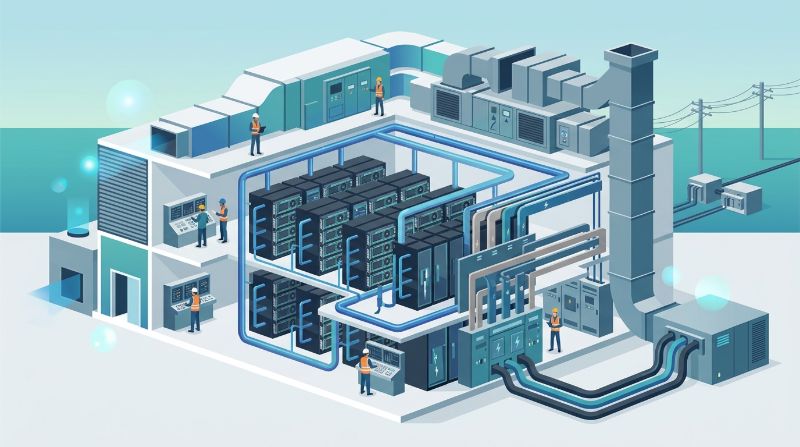
Predictive maintenance ML is an always-on pipeline wearing a project's clothes: condition-monitoring sensors stream continuously into time-series storage, transformations build training-ready datasets from that history, models train on GPU capacity and deploy to inference paths, and — the part one-off projects miss — equipment and conditions drift, so retraining on fresh data is a standing cadence, not a milestone; implementation practice is explicit that the systematic combination of data infrastructure and algorithms is what makes these systems work.
| Stage | What runs | The project-thinking miss |
|---|---|---|
| Ingest | Continuous sensor streams into time-series storage | Batch exports that miss the failure signatures |
| Prepare | Transformation of history into training datasets | One-time extracts that go stale with the equipment |
| Train | GPU training against accumulated sensor history | A single model, never refreshed |
| Infer | Scoring at the machine or in the platform | Cloud-only paths that fail when connectivity does |
Case studies of condition-monitoring programs make the same point from the field side: the value comes from sensors plus ML operating continuously against real assets — a loop, not a deliverable.
Enterprise Relevance: Where Each Stage Runs
Each stage prices differently: ingest wants reliable, always-on collection paths near the sensors; training wants bursty GPU capacity against growing sensor history — the stage where GPU-hours concentrate; inference splits by latency and connectivity, with edge paths answering at the machine and cloud paths carrying the fleet-level models; and the retraining cadence turns training capacity from a purchase into a schedule, which is why predictable, reservable GPU capacity fits this workload better than spot markets that vanish mid-retrain.
- Ingest: always-on collection with enough headroom for sensor additions — the pipeline's uptime is the program's uptime.
- Training: the GPU-bursty stage — spectrograms, sequence models, anomaly detectors trained on months of history, on a schedule.
- Inference: latency decides the split — millisecond responses at the machine run at the edge; fleet-level models run centrally where they retrain.
- The cadence: retraining scheduled by asset criticality, backed by capacity that is reserved rather than hoped for.
This is where the infrastructure conversation gets concrete: environments that pair dedicated single-tenant GPU capacity with private connectivity — the pattern OneSource Cloud builds on dedicated U.S. infrastructure — exist for precisely this shape, where training recurs on a schedule and the data path has to be predictable enough to plan around.
Boundary: Where the Data Stays
Not necessarily, and the boundary is a design choice: sensor history can be voluminous enough that moving it costs more than computing on it, and operational data can carry process sensitivity that policy keeps on-site — which is why the architecture question is where training happens relative to the data, with dedicated capacity reachable over private connectivity from the plant answering the middle case: the data leaves the building only as far as the network you control, and the GPU-hours stay predictable.
The boundary also sets the failure story: an on-site boundary means the training platform's availability matters to the plant directly, while a platform-side boundary means the network path joins the critical path — either way, the component that moves the data inherits the maintenance program's own uptime requirements, which is an argument for writing that requirement down before choosing the pipe.
FAQ
Do predictive maintenance models need GPUs?
At the training stage, usually yes — sensor-history models (spectrograms, sequence models, anomaly detectors) train efficiently on GPU capacity, while inference at the edge often runs on modest hardware — so the honest shape is GPU-bursty training with light edge inference, and the fleet sized accordingly rather than GPUs everywhere.
How often do predictive maintenance models need retraining?
On drift, not on hope: equipment wears in, operating conditions shift seasonally, and sensor behavior changes after maintenance — so the cadence is set by measured model performance against fresh outcomes, commonly landing on a periodic retrain (weekly to quarterly by asset criticality) backed by a pipeline that can retrain without a project, because a model that cannot be retrained on schedule is a demo with a timestamp.
Can plant sensor data stay on-site while training still uses dedicated GPUs?
Yes, and it is a common middle path: dedicated environments reachable over private connectivity — the pattern dedicated infrastructure providers such as OneSource Cloud build for — let sensor history flow over a controlled network to reserved training capacity without traversing the public internet, keeping the data path inside boundaries policy recognizes while the training schedule stays predictable.
Related Articles
Recommended Reading
latest articles
-
Predictive Maintenance AI Workloads: Infrastructure Requirements That Matter
-
GPU Contract Early Termination: What Exiting Before the Term Costs
-
Warm Pools for Model Replicas: The Cost of LLM Readiness
-
AI Infrastructure Unit Economics: Metrics That Matter Per Workload
-
When Public Cloud GPU Quota Becomes a Delivery Risk for AI Teams
-
Enterprise RAG Reranking: Latency Cost vs Retrieval Quality
-
Showback vs Chargeback for AI Infrastructure: How Teams Choose
-
Multi-Model GPU Serving: Capacity Planning When Models Share a Fleet
-
GPU SLA Service Credits: What They Pay For and What They Don't
-
GPU Capacity Expansion Decision Rights: Who Decides, on What Evidence