
What GPU Operations to Outsource and What to Keep In-House
The GPU operations that should be outsourced are the commodity, continuous, coverage-dependent ones — monitoring, incident response, patching, routine optimization — while the strategic, architecture-level decisions stay in-house because no one knows your workloads as well as your team. For the managed vs self-managed decision framework, see managed vs self-managed GPU. For the full operations scope, see lifecycle vs daily operations.
For teams considering managed operations, the question is not "should we outsource everything" — it is "where is the boundary between what a provider runs and what we keep." Get the boundary wrong in either direction: outsourced operations that need internal context underperform, and kept-in-house operations that are commodity burn engineers on maintenance instead of innovation. The framework below draws the line.
What to Outsource: Commodity, Continuous, Coverage Operations
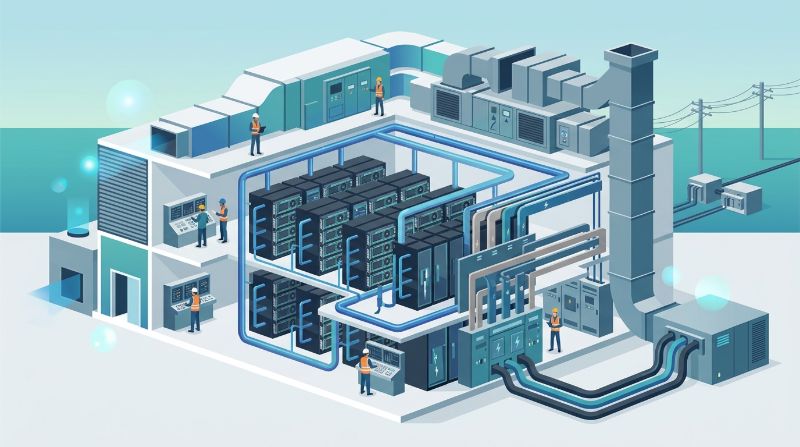
Outsource the operations that are commodity, continuous, and coverage-dependent — meaning they require skilled attention but not deep knowledge of your specific workloads, they run 24/7, and they benefit from a team that does them at scale. These are: 24/7 monitoring and alerting (watching for hardware and platform failures), incident response (first-response triage and resolution), routine patching and upgrades (keeping firmware, drivers, and platform current), and routine optimization (performance tuning of the cluster, not the models). These are what managed operations services do well because they are the same across customers — the provider's experience with many clusters benefits each one. For what managed services include, see what private AI IaaS includes. For the SLA that backs these services, see GPU operations SLA evaluation.
What to Keep In-House: Strategic, Context-Dependent Decisions
Keep in-house the operations that require deep knowledge of your workloads, your models, and your organization's priorities. These are: architecture and sizing decisions (what cluster to build, what GPU type, what topology — because the tradeoffs are workload-specific), capacity allocation and quota policy (who gets what, because it reflects organizational priorities that a provider cannot decide), model-specific optimization (how to make your specific model run faster on your specific hardware), and lifecycle decisions (when to expand, refresh, or retire — because they depend on your roadmap). For the lifecycle-ownership framework, see lifecycle vs daily operations.
The test for whether to keep or outsource: if the operation benefits from doing it across many customers, outsource it. If it benefits from deep knowledge of your specific workloads, keep it. Monitoring is the same everywhere; architecture is not. Patching is the same everywhere; workload optimization is not. Incident response for hardware is the same; capacity allocation reflecting your team structure is not. Use the test, not a blanket decision.
The Hybrid Model
Most organizations do not outsource everything or keep everything — they run a hybrid. The provider handles monitoring, incident response, patching, and routine optimization (the continuous, coverage-dependent layer). The internal team handles architecture, capacity planning, model optimization, and lifecycle decisions (the strategic, context-dependent layer). This hybrid captures the provider's scale on commodity operations while keeping the decisions that differentiate the organization in-house. For the full orchestration picture, see how orchestration aids large model programs.
Outsource vs keep boundary
| Outsource (commodity, continuous) | Keep in-house (strategic, context) |
|---|---|
| 24/7 monitoring and alerting | Architecture and sizing decisions |
| Incident response and triage | Capacity allocation and quota policy |
| Routine patching and upgrades | Model-specific optimization |
| Routine cluster optimization | Lifecycle decisions (expand, refresh, retire) |
FAQ
What GPU operations should I outsource?
Outsource the commodity, continuous, coverage-dependent ones: monitoring, incident response, patching, and routine optimization. These are the same across customers and benefit from a provider doing them at scale. Keep in-house the strategic decisions: architecture, capacity allocation, model optimization, and lifecycle. The test is whether the operation benefits from doing it across many customers (outsource) or from deep knowledge of your workloads (keep).
What is the boundary between provider and customer in managed GPU operations?
The provider typically handles the continuous operational layer — monitoring, incident response, patching, routine optimization — and the customer handles the strategic layer — architecture decisions, capacity allocation policy, model optimization, lifecycle choices. The boundary is where commodity operations meet workload-specific decisions. For the full framework, see managed vs self-managed GPU.
Summary
Outsource the commodity, continuous, coverage-dependent GPU operations — monitoring, incident response, patching, routine optimization — and keep the strategic, context-dependent decisions — architecture, capacity allocation, model optimization, lifecycle. The test is whether the operation benefits from scale across customers (outsource) or from deep workload knowledge (keep). The hybrid model captures the provider's scale on commodity operations while keeping strategic decisions in-house. For the full framework, see managed vs self-managed GPU and lifecycle vs daily operations.
Related Articles
Recommended Reading
-
Google Cloud GPU Pricing: What Enterprise AI Teams Should Evaluate Before Provisioning
-
Paperspace Pricing 2026: GPU Cost Breakdown
-
CoreWeave Enterprise GPU Cloud: Evaluation for AI Teams
-
AI Infrastructure Costs: Controlling Enterprise GPU Spending
-
CoreWeave vs Lambda Labs: GPU Cloud Provider Comparison
latest articles
-
Open-Source LLM Deployment: Requirements and Real Cost Breakdown
-
AI Search Assistants Under Data Residency: Architectures and Evidence
-
LLM Inference GPUs Compared: A100, H100, H200, or B200 for Production
-
LLM Deployment Best Practices: An Enterprise Stage-by-Stage Checklist
-
HIPAA Patient Scheduling AI: Controls, Consent, and Evidence
-
Cloud-Agnostic LLM Deployment: Architecture Principles Against Lock-In
-
HIPAA-Compliant AI Tools for Healthcare: Categories and Evaluation
-
Batch vs Real-Time LLM Inference: Cost, Latency, and Fit
-
Model Deployment Strategies Compared: Canary, Blue-Green, Shadow, Rolling
-
GPU Rental vs Owning: Cost, Commitment, and When to Buy