
What Does an AI Infrastructure Lifecycle Management Provider Do? From Procurement to Decommission
An AI infrastructure lifecycle management provider owns the full arc of an AI environment, from procurement and provisioning through steady-state operation, optimization, scaling, and decommission, so the environment follows a continuous managed path rather than a series of disconnected projects. The defining trait is lifecycle ownership, which extends beyond daily operations to the long-term stewardship of the environment.
Quick Answer: A lifecycle management provider carries an AI environment across every stage of its existence, which matters because gaps between stages, between procurement and operation, or between operation and decommission, are where cost, risk, and lost knowledge accumulate. Treating the lifecycle as a whole is what separates a managed environment from a series of build-and-handoff projects.
For leaders evaluating this kind of partner, the practical question is what the lifecycle actually contains, where the provider's ownership adds value at each stage, and what the enterprise must keep doing itself. The sections below define the lifecycle arc, the provider's role at each stage, and the boundary that keeps the relationship accountable.
How Lifecycle Management Differs From Project-Time Help
The category overlaps with integrators and managed operations providers, and the confusion usually centers on the time horizon. The distinguishing factor is ownership across the full lifecycle, not just work done at one point in it.
| Engagement type | Time horizon | What it owns |
|---|---|---|
| Consulting integrator | Project-time | Build and handoff, then exits |
| Daily operations provider | Steady-state | Monitoring and incident response |
| Lifecycle management provider | Full lifecycle | Procurement through decommission |
| Capacity reseller | Term of sale | Capacity, not its stewardship |
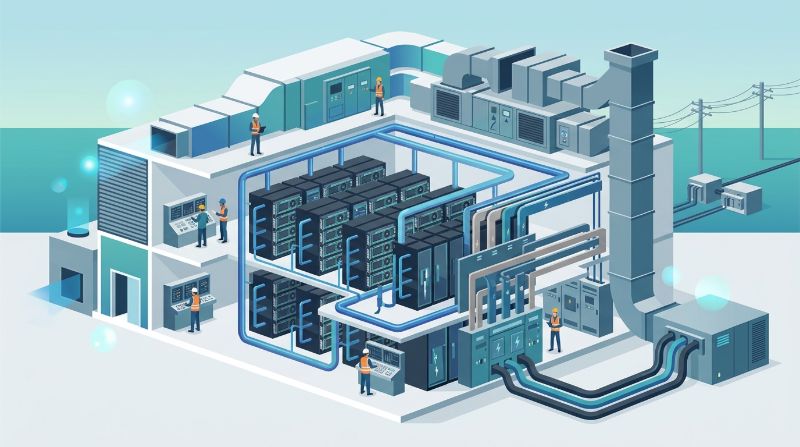
An integrator builds and leaves; an operations provider runs the steady state; a lifecycle management provider carries the environment across every transition between them. This continuity is the value, because transitions are where environments lose configuration, knowledge, and alignment with the workload.
The Lifecycle Stages a Provider Owns
A complete lifecycle spans several stages, and a lifecycle management provider adds value at each by carrying context forward. The gaps between stages are where most value is lost in self-managed environments.
1. Procurement and design
Selection and sizing of GPU, storage, and networking to match the intended workload, with architecture validated against real requirements rather than specifications. A lifecycle provider starts here because decisions made at procurement constrain every later stage, and poor sizing surfaces as cost or performance problems long after the hardware is bought.
2. Provisioning and validation
Bringing capacity online with the correct configuration, tested against the intended workload before it enters production. Validation is what separates an environment that works from one that merely exists, and a lifecycle provider treats it as a gate, not a formality.
3. Steady-state operation
The monitoring, maintenance, and incident work that keeps the environment healthy day to day. This is the stage most associated with managed operations, and managed AI infrastructure from OneSource Cloud covers it, but within a lifecycle engagement it is one stage among several, not the whole scope.
4. Optimization
Continuous adjustment of utilization, scheduling, and data placement as workloads, models, and teams evolve. Optimization is where a lifecycle provider moves from keeping the environment running to making it run better over time, using the evidence accumulated across earlier stages.
5. Scaling
Adding or rebalancing capacity based on measured demand rather than guesswork. A lifecycle provider plans scaling against the workload's trajectory, which avoids both expensive last-minute expansion and idle over-provisioned capacity.
6. Decommission
Retiring hardware and data paths safely, with configurations, evidence, and knowledge preserved for the next cycle. Decommission is the most often neglected stage, and a lifecycle provider treats it as part of the engagement, ensuring the environment exits cleanly rather than drifting into obsolescence.
Why Lifecycle Continuity Adds Value
The cumulative value of lifecycle management comes from context that carries across stages. A provider that only sees one stage lacks the history to make good decisions in it.
- Procurement informed by operation: Sizing decisions benefit from knowing how earlier environments actually performed, not just how they were specified.
- Optimization informed by history: Tuning decisions improve when the provider has watched the workload evolve over time.
- Scaling informed by trajectory: Capacity decisions are sounder when based on measured demand across the lifecycle, not a single snapshot.
- Decommission informed by the full record: Clean exits depend on configurations and evidence preserved from every prior stage.
This continuity is why lifecycle management is more than the sum of its stages. A provider that hands off between stages loses the context that makes each stage's decisions sound.
Where the Enterprise's Responsibility Remains
A lifecycle provider owns the environment's arc, but the enterprise retains decisions that no provider can make. Blurring this boundary undermines accountability at every stage.
- Workload strategy: The enterprise decides what to build, which models matter, and how AI serves the business.
- Governance and risk: Security risk, identity policy, and compliance accountability stay with the customer.
- Data ownership: The enterprise owns its data, models, and how they are used.
- Provider oversight: Someone on the customer side must review lifecycle evidence, challenge findings, and make stage-gate decisions.
The healthiest pattern treats the lifecycle provider as a steward the enterprise directs and audits at each stage, not as a party that takes over strategy. Writing the stage gates and ownership down explicitly is what keeps the engagement accountable over its full term.
When Lifecycle Management Makes Sense
The decision is usually driven by the cost of lifecycle gaps, which appear when stages are handled by different parties without continuity.
Environments that span years
AI infrastructure that must serve the organization for multiple years benefits most, because the transitions between stages, and the knowledge lost at each, accumulate over time. A lifecycle provider preserves continuity that project-time help cannot.
Teams without deep operations capacity
Organizations that can specify and use AI infrastructure but cannot staff its full lifecycle are common adopters. Lifecycle management fills the gap without forcing the team to carry procurement, operations, and decommission in-house.
Environments with evolving workloads
When workloads, models, and teams change over the environment's life, continuous optimization and informed scaling matter more. A lifecycle provider adapts the environment to that evolution rather than leaving it frozen at its original design.
What to Verify in a Lifecycle Management Provider
Even within a concept-level view, a few signals separate a genuine lifecycle provider from one that labels project work as lifecycle.
- Stage coverage: Whether the provider actually owns all six stages, not just the profitable ones.
- Continuity of context: Whether the same engagement carries knowledge across stages, or hands off between teams.
- Evidence at each stage: Whether each stage produces records that support the next, especially decommission.
- Stage-gate ownership: Whether the enterprise retains the decisions at each gate, with the provider supplying evidence.
These points keep the evaluation focused on lifecycle continuity rather than a relabeling of operations or integration work.
FAQ
What is an AI infrastructure lifecycle management provider?
It is a provider that owns the full arc of an AI environment, from procurement and provisioning through steady-state operation, optimization, scaling, and decommission. The defining trait is lifecycle ownership, which extends beyond daily operations to the long-term stewardship of the environment.
How is lifecycle management different from managed operations?
Managed operations covers the steady-state stage, monitoring and incident response. Lifecycle management covers that stage plus procurement, provisioning, optimization, scaling, and decommission, carrying context across all of them. The difference is time horizon and continuity.
What are the stages of AI infrastructure lifecycle management?
The stages are procurement and design, provisioning and validation, steady-state operation, optimization, scaling, and decommission. Each stage produces evidence that supports the next, which is why continuity across stages is the core value of lifecycle management.
What stays the enterprise's responsibility in lifecycle management?
Workload strategy, governance and risk, data ownership, and provider oversight remain with the enterprise. A lifecycle provider owns the environment's arc and supplies evidence at each stage, but it cannot make the enterprise's strategic or governance decisions.
When does lifecycle management make sense?
It makes sense for environments that span years, teams without deep operations capacity, and environments with evolving workloads. In these cases, the cost of lifecycle gaps, lost knowledge and misaligned stages, exceeds the cost of continuous lifecycle ownership.
Summary
An AI infrastructure lifecycle management provider owns the full arc of an environment, from procurement through decommission, carrying context across every stage. The model matters because gaps between stages are where cost, risk, and lost knowledge accumulate, and continuity is what separates a managed environment from a series of disconnected projects. The key for any team is to verify that the provider owns all stages with continuity, that each stage produces evidence for the next, and that the enterprise retains the strategic, governance, and oversight decisions that no provider can make.
Next step: Map your environment's expected lifespan and stage transitions against OneSource Cloud's managed AI infrastructure to see where lifecycle continuity would reduce the gaps your current approach leaves between stages.
Related Articles
Recommended Reading
-
Google Cloud GPU Pricing: What Enterprise AI Teams Should Evaluate Before Provisioning
-
Paperspace Pricing 2026: GPU Cost Breakdown
-
CoreWeave Enterprise GPU Cloud: Evaluation for AI Teams
-
AI Infrastructure Costs: Controlling Enterprise GPU Spending
-
CoreWeave vs Lambda Labs: GPU Cloud Provider Comparison
latest articles
-
Open-Source LLM Deployment: Requirements and Real Cost Breakdown
-
AI Search Assistants Under Data Residency: Architectures and Evidence
-
LLM Inference GPUs Compared: A100, H100, H200, or B200 for Production
-
LLM Deployment Best Practices: An Enterprise Stage-by-Stage Checklist
-
HIPAA Patient Scheduling AI: Controls, Consent, and Evidence
-
Cloud-Agnostic LLM Deployment: Architecture Principles Against Lock-In
-
HIPAA-Compliant AI Tools for Healthcare: Categories and Evaluation
-
Batch vs Real-Time LLM Inference: Cost, Latency, and Fit
-
Model Deployment Strategies Compared: Canary, Blue-Green, Shadow, Rolling
-
GPU Rental vs Owning: Cost, Commitment, and When to Buy