
What Is AI Compute Storage Networking as a Service? The Converged Stack
AI compute storage networking as a service is a delivery model where a provider supplies the three layers AI workloads depend on, accelerated compute, high-throughput storage, and low-latency networking, as a single balanced system consumed as a service rather than as separate components an enterprise must integrate. The defining trait is convergence: the three layers are designed, sized, and operated together.
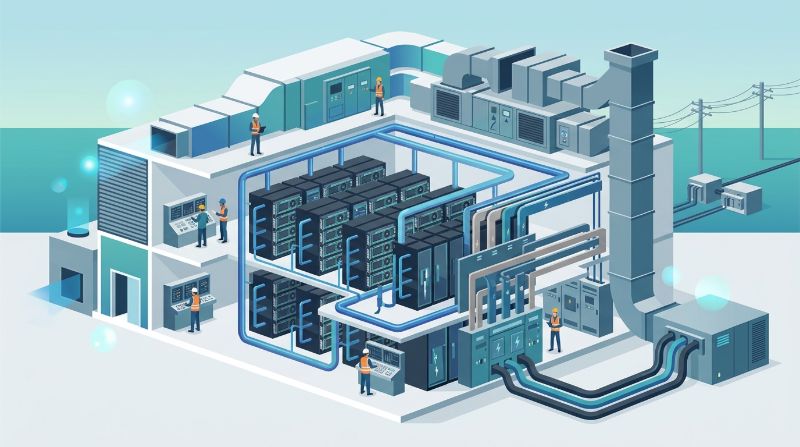
Quick Answer: This model delivers compute, storage, and network as one coherent stack, which matters because AI workloads fail most often from imbalance between these layers, not from weakness in any one. A GPU cluster is only as fast as its slowest layer, and a converged service removes the integration burden that creates the bottlenecks that sink self-assembled clusters.
For engineering and platform leaders, the useful question is what convergence actually delivers, why balance matters more than peak specifications, and how this model differs from buying the components separately. The sections below define the converged stack, the balance problem it solves, and the points worth verifying.
Why AI Needs the Three Layers Together
AI workloads are unusual in how tightly their three foundational layers are coupled. Understanding this coupling is what makes the converged model meaningful rather than just convenient.
| Layer | Its job in AI | What happens if undersized |
|---|---|---|
| Compute | Runs training and inference | Slower throughput, longer runs |
| Storage | Feeds data and holds checkpoints | GPUs idle waiting for data |
| Networking | Connects nodes for distributed work | Distributed training stalls |
Each layer has a distinct job, but the workload depends on all three together. The most expensive GPU is worthless if storage cannot feed it or the network cannot connect its nodes, which is why AI infrastructure is properly understood as a system, not a parts list.
The Balance Problem the Converged Model Solves
The core problem the converged model addresses is imbalance, which is the most common and most expensive failure mode in self-assembled AI clusters. Imbalance does not appear in specifications; it appears in throughput.
Storage-starved compute
When storage throughput is undersized relative to the GPUs, the accelerators spend much of their time idle, waiting for data. This is the single most common reason AI infrastructure underperforms its potential, and it is invisible in a spec sheet that lists only the GPUs.
Network-bound clusters
When node-to-node networking cannot sustain the traffic distributed training requires, multi-node jobs stall, and the value of additional GPUs collapses. AI networking is where clusters fail as often as at the compute, yet it is frequently treated as an afterthought.
Facility-limited density
When power or cooling cannot support the intended hardware density, the cluster cannot run at its designed capacity, reducing effective throughput. A converged service that includes the facility avoids this limit, since the hardware is sized against the environment that supports it.
The converged model solves these by sizing all three layers together, against the workload, so no layer becomes the bottleneck. The value is not in any single component but in the balance between them.
What the Converged Service Delivers
A credible converged offering delivers the three layers as a coordinated system, often with the platform and operations that make them usable. Each layer is part of the whole, and receiving them together is the point.
Accelerated compute as part of the system
GPU capacity sized in balance with the storage and network that feed it, so sustained throughput holds rather than peaks and stalls. Private AI infrastructure from OneSource Cloud delivers compute as part of this balanced system.
Storage tuned for AI data patterns
High-throughput storage for training data, checkpoints, and retrieval corpora, positioned to keep the GPUs busy. AI storage architecture within a converged service is designed for AI access patterns, not general-purpose storage assumptions.
Networking designed for distributed work
Low-latency interconnects that sustain the node-to-node traffic distributed training and multi-node inference require, sized so the network does not become the bottleneck as the cluster scales.
Optional platform and operations
Many converged services add an orchestration layer such as OnePlus and managed operations as in managed AI infrastructure. These extend the system from raw layers to a usable, operated environment, but they build on the converged foundation.
How Convergence Differs From Buying Components Separately
The alternative to a converged service is assembling the three layers from separate vendors, which is where most imbalance originates. The comparison clarifies why convergence is more than convenience.
- Sizing risk: Separate components are sized against assumptions, not against each other, so imbalance is likely. A converged service sizes them together.
- Integration burden: Separate layers must be integrated, tuned, and debugged together, a burden the converged service removes.
- Accountability gaps: When layers come from different vendors, finger-pointing across them delays problem resolution. A converged service owns the whole system.
- Refresh complexity: Upgrading one layer in a separate stack risks rebalancing problems; a converged service manages refresh as a system.
Each difference maps to a cost or risk that the converged model removes. The value is not in owning all three layers but in having them designed, operated, and accountable as one.
When the Converged Model Makes Sense
The decision is usually driven by workloads where imbalance, integration burden, or accountability gaps make separate assembly costly or risky.
Distributed training at scale
Multi-node training is the most sensitive to balance, since any layer bottleneck stalls the whole job. Converged services fit these workloads because they remove the integration risk that creates the stalls.
Teams without integration depth
Organizations that can use AI infrastructure but cannot integrate compute, storage, and network into a balanced system adopt the converged model to receive a working stack rather than a parts list.
Workloads needing single accountability
When a failure in any layer must be resolved quickly, single accountability across the stack matters. A converged service owns the whole system, which avoids the cross-vendor delays that separate assembly produces.
What to Verify in a Converged AI Service
Even within a concept-level view, a few signals separate a genuinely converged system from a bundle of separately sourced components.
- Balanced sizing: Whether the three layers are sized together for the workload, with evidence the storage and network keep pace with compute.
- Single accountability: Whether one party owns the whole system, including cross-layer problems.
- System-level evidence: Whether throughput is measured under the real workload, not just per-component specifications.
- Converged operations: Whether the layers are operated together, not handed off across vendors.
These points keep the evaluation focused on whether the service delivers a balanced, accountable system rather than a rebranded bundle.
FAQ
What is AI compute storage networking as a service?
It is a delivery model where a provider supplies accelerated compute, high-throughput storage, and low-latency networking as a single balanced system, consumed as a service. The defining trait is convergence: the three layers are designed, sized, and operated together.
Why does AI need the three layers together?
Because AI workloads depend on all three layers as a system, and imbalance between them, such as storage-starved or network-bound clusters, is the most common reason AI infrastructure underperforms. A GPU is only as fast as the slowest layer that feeds or connects it.
How is a converged service different from buying components separately?
Separate components are sized against assumptions and integrated by the customer, which creates imbalance and accountability gaps. A converged service sizes, operates, and owns the layers together, removing the integration burden and the cross-vendor delays that separate assembly produces.
Does a converged AI service help with performance?
It can, because balanced sizing prevents the storage and network bottlenecks that idle GPUs. A converged provider such as OneSource Cloud delivers the layers as a system, so sustained throughput holds rather than peaking and stalling.
When should teams use a converged AI service?
It fits distributed training at scale, teams without integration depth, and workloads needing single accountability across the stack. Workloads that are small, single-node, or tolerant of imbalance may not need the converged model.
Summary
AI compute storage networking as a service delivers the three layers AI depends on as a single balanced system, consumed as a service. The model matters because AI workloads fail most often from imbalance between the layers, not from weakness in any one, and a converged service removes the integration burden that creates the bottlenecks that sink self-assembled clusters. The key for any team is to verify that the service delivers balanced sizing, single accountability, and system-level evidence, so the convergence is real rather than a rebranded bundle.
Next step: Assess your workload's balance sensitivity against OneSource Cloud's private AI infrastructure to see whether a converged stack would remove the integration and imbalance burdens your current approach carries.
Related Articles
Recommended Reading
-
Google Cloud GPU Pricing: What Enterprise AI Teams Should Evaluate Before Provisioning
-
Paperspace Pricing 2026: GPU Cost Breakdown
-
CoreWeave Enterprise GPU Cloud: Evaluation for AI Teams
-
AI Infrastructure Costs: Controlling Enterprise GPU Spending
-
CoreWeave vs Lambda Labs: GPU Cloud Provider Comparison
latest articles
-
Open-Source LLM Deployment: Requirements and Real Cost Breakdown
-
AI Search Assistants Under Data Residency: Architectures and Evidence
-
LLM Inference GPUs Compared: A100, H100, H200, or B200 for Production
-
LLM Deployment Best Practices: An Enterprise Stage-by-Stage Checklist
-
HIPAA Patient Scheduling AI: Controls, Consent, and Evidence
-
Cloud-Agnostic LLM Deployment: Architecture Principles Against Lock-In
-
HIPAA-Compliant AI Tools for Healthcare: Categories and Evaluation
-
Batch vs Real-Time LLM Inference: Cost, Latency, and Fit
-
Model Deployment Strategies Compared: Canary, Blue-Green, Shadow, Rolling
-
GPU Rental vs Owning: Cost, Commitment, and When to Buy