
GPU-as-a-Service vs Bare Metal GPU Infrastructure: Which One Fits Enterprise AI
GPU-as-a-Service gives teams on-demand access to GPU capacity, while bare metal GPU infrastructure provides dedicated physical GPU servers for greater control, performance consistency, and data isolation. Enterprises often start with GPU-as-a-Service for experimentation, then evaluate bare metal or private AI infrastructure when workloads become persistent, sensitive, expensive, or operationally complex. OneSource Cloud helps teams assess, deploy, and manage dedicated GPU environments for private LLMs, regulated workloads, and production AI infrastructure.
What Is GPU-as-a-Service?
GPU-as-a-Service is a cloud delivery model where teams rent GPU capacity without owning or operating the underlying hardware. It may be offered by hyperscale cloud platforms, GPU cloud providers, developer platforms, or managed AI infrastructure vendors.
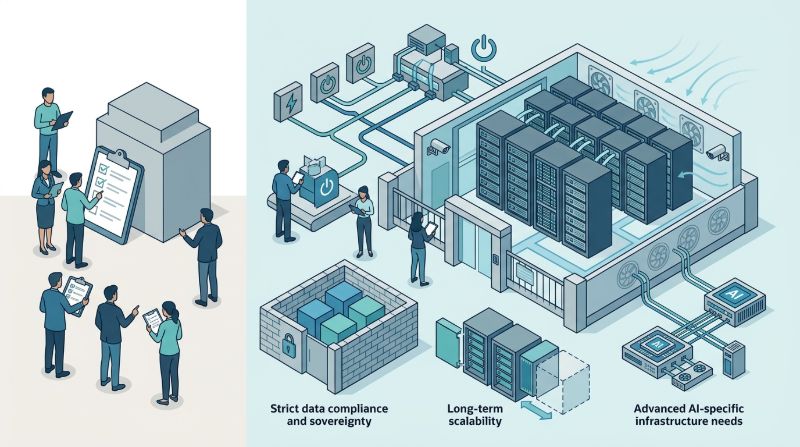
GPU-as-a-Service is often useful for:
- AI experimentation
- Short-term training jobs
- Model prototyping
- Burst capacity
- Teams without infrastructure staff
- Variable workloads
- Early-stage LLM testing
Providers such as AWS, Azure, Google Cloud, CoreWeave, Lambda Labs, Paperspace, NVIDIA GPU Cloud, Modal, Replicate, and others can fit different AI workload patterns. The right choice depends on availability, workload duration, compliance requirements, operating model, and cost predictability.
What Is Bare Metal GPU Infrastructure?
Bare metal GPU infrastructure means dedicated physical servers equipped with GPUs, storage, networking, and management layers. Unlike virtualized or shared cloud GPU environments, bare metal gives the customer dedicated access to the underlying hardware environment.
Bare metal GPU infrastructure is often considered when enterprises need:
| Requirement | Why Bare Metal Helps |
|---|---|
| Dedicated GPU access | Reduces dependency on shared capacity or quota availability |
| Performance consistency | Helps avoid variability from shared infrastructure layers |
| Private AI workloads | Supports controlled environments for sensitive models and data |
| Data residency planning | Helps teams evaluate where AI data is stored and processed |
| Long-running workloads | Can support predictable cost models for persistent usage |
| Custom architecture | Allows storage, networking, and orchestration to be designed together |
| Regulated AI use cases | Supports stronger isolation, auditability, and access control patterns |
OneSource Cloud’s Private AI Infrastructure is designed for enterprises that need dedicated GPU clusters, private AI cloud environments, private LLM deployment, and U.S.-based infrastructure options.
GPU-as-a-Service vs Bare Metal GPU Infrastructure
The best model depends on workload maturity. GPU-as-a-Service is often attractive when speed and flexibility matter most. Bare metal becomes more relevant when control, predictable performance, compliance posture, and long-term economics become more important.
| Decision Area | GPU-as-a-Service | Bare Metal GPU Infrastructure |
|---|---|---|
| Best fit | Experimentation, burst workloads, early AI development | Persistent, sensitive, production, or high-utilization workloads |
| Control | Varies by provider and abstraction layer | Higher control over hardware, network, storage, and access patterns |
| Cost model | Flexible but may fluctuate with usage | More predictable when utilization is steady |
| GPU availability | Depends on provider capacity and quota | Dedicated capacity once deployed |
| Performance consistency | Can vary by platform and configuration | More consistent when architecture is properly designed |
| Compliance posture | Requires careful provider and configuration review | Better fit for dedicated, data-sensitive environments |
| Operations | Provider handles much of the base infrastructure | Requires internal or managed operations model |
| Deployment speed | Often faster to start | Requires architecture planning and deployment work |
| Custom storage/networking | May be limited or abstracted | Can be designed around AI workload requirements |
When GPU-as-a-Service Fits Enterprise AI
GPU-as-a-Service is often the right starting point when AI teams need flexibility and fast access more than dedicated control.
It can fit well when:
- Workloads are experimental or temporary
- GPU demand is unpredictable
- Teams are testing model sizes and frameworks
- Procurement needs to move quickly
- Data is not highly sensitive
- Production requirements are still unclear
- The team does not yet know utilization patterns
For many enterprises, GPU-as-a-Service helps answer early questions: Which model architecture works? Which GPU class is required? How much memory is needed? How often will training or inference run?
However, once usage becomes steady, the same flexibility can become harder to budget. Finance teams may ask why GPU cloud costs are rising. Platform teams may struggle with quota limits. Compliance teams may question where data, model artifacts, and logs are stored.
When Bare Metal GPU Infrastructure Fits Enterprise AI
Bare metal GPU infrastructure becomes more compelling when AI moves from exploration into production or regulated use.
It can fit well when:
- AI workloads run continuously or predictably
- GPU capacity is business-critical
- Public cloud GPU quota is unreliable
- Sensitive data cannot enter general shared workflows
- Private LLM deployment requires controlled infrastructure
- Multi-team GPU sharing needs governance
- Storage and networking must be tuned for performance
- Data residency and auditability influence architecture
- Internal teams want predictable long-term infrastructure planning
Bare metal is not automatically simpler. It requires planning, deployment, monitoring, lifecycle management, and performance validation. That is why many enterprises evaluate managed AI infrastructure rather than building and operating everything internally.
OneSource Cloud’s Managed AI Infrastructure supports monitoring, optimization, lifecycle management, capacity planning, and performance validation for enterprise AI and GPU environments.
Cost Factors: GPU-as-a-Service vs Bare Metal
The cost comparison is not only hourly GPU pricing versus hardware cost. Enterprises should evaluate total cost of operation.
| Cost Driver | GPU-as-a-Service Consideration | Bare Metal Consideration |
|---|---|---|
| GPU usage | Flexible, but spend can rise with persistent workloads | More predictable if utilization is high and steady |
| Idle capacity | Lower risk if capacity is rented only when needed | Must be managed through scheduling and workload planning |
| Data movement | Transfer and storage costs can add complexity | Data paths can be designed with infrastructure |
| Operations | Some infrastructure burden shifts to provider | Requires internal or managed operations |
| Storage | Cloud storage can scale flexibly | Storage can be designed for training, inference, and RAG |
| Networking | Depends on provider architecture and configuration | Can be designed for distributed training and low latency |
| Compliance | May require additional controls and review | Dedicated environments can support stronger governance patterns |
| Time to deploy | Usually faster | Requires architecture and implementation planning |
A practical rule: GPU-as-a-Service often fits variable demand, while bare metal or private GPU infrastructure often fits persistent, sensitive, or high-utilization workloads that need predictable operations.
Compliance, Data Residency, and Security Considerations
Compliance-sensitive AI workloads require more than GPU access. Healthcare, financial services, research, SaaS, and government-adjacent organizations must consider how data moves, where it resides, who can access it, and how infrastructure activity is logged.
Enterprise teams should evaluate:
- Whether GPUs are shared or dedicated
- Where datasets, model artifacts, logs, and prompts are stored
- Whether administrative access is controlled and logged
- How data residency requirements are supported
- Whether workloads can be segmented by team or project
- How backups, retention, and deletion workflows are managed
- Whether the infrastructure supports audit review
For healthcare AI workloads, teams should seek a HIPAA-ready infrastructure posture with secure data paths, access controls, auditability, and operational governance. Infrastructure can support HIPAA compliance, but compliance also depends on the customer’s broader legal, administrative, and security program.
OneSource Cloud’s private and U.S.-based AI infrastructure options, including Texas / Richardson trust signals, are relevant for teams evaluating data residency and regulated AI workload requirements.
Architecture Differences That Matter
GPU Compute and Scheduling
GPU-as-a-Service may provide fast access, but quota, availability, and instance selection can vary by provider and region. Bare metal infrastructure gives teams dedicated capacity, but they need scheduling rules so teams do not compete manually for GPUs.
OnePlus Platform, OneSource Cloud’s AI orchestration platform, helps private GPU environments manage workload scheduling, GPU quota visibility, developer workspaces, usage metrics, and model deployment workflows.
AI Storage Architecture
AI workloads are often limited by storage, not GPUs. Training data throughput, model checkpoints, embeddings, vector indexes, and RAG pipelines all require careful storage planning.
OneSource Cloud’s AI Storage Architecture services help enterprises design storage for training, inference, fine-tuning, RAG, unstructured data, and secure data paths.
AI Networking Services
Distributed training and multi-node inference require low-latency, high-throughput networking. Technologies such as RDMA, InfiniBand, and lossless fabric may matter when workloads need fast node-to-node communication.
OneSource Cloud’s AI Networking Services help teams evaluate networking for GPU clusters, inference serving, storage-to-compute data movement, and AI data center environments.
Public Cloud, GPU Cloud, Self-Managed, and Private Managed AI Infrastructure
Enterprises rarely choose between only two options. The real comparison includes hyperscale cloud, GPU cloud providers, self-managed bare metal, and private managed AI infrastructure.
| Infrastructure Model | Best Fit | Potential Tradeoff |
|---|---|---|
| AWS, Azure, Google Cloud | Flexible cloud services, experimentation, existing cloud teams | Cost variability, quota limits, and governance complexity |
| CoreWeave, Lambda Labs, Paperspace, NVIDIA GPU Cloud | AI-focused GPU access and developer speed | Operational ownership and compliance planning still need review |
| Self-managed bare metal | Mature infrastructure teams needing direct control | High operational burden and lifecycle complexity |
| Private managed AI infrastructure | Dedicated capacity, sensitive data, predictable operations | Requires upfront architecture planning |
OneSource Cloud is most relevant when enterprises need private, dedicated, managed, and U.S.-based AI infrastructure rather than a purely self-service GPU rental model.
A Practical Decision Framework
Choose GPU-as-a-Service When
- You are still validating models and workloads
- GPU demand is temporary or highly variable
- Speed to start matters more than infrastructure control
- Data sensitivity is limited
- Internal teams do not yet know long-term utilization
- You need burst capacity for short periods
Choose Bare Metal GPU Infrastructure When
- Workloads are steady or production-critical
- GPU availability must be predictable
- Sensitive data or model artifacts require stronger control
- Multi-team usage needs quota and governance
- Storage and networking must be optimized together
- Long-term cost predictability matters
- Private LLM deployment is moving into production
Choose Managed Private AI Infrastructure When
- You need dedicated GPU environments without full internal operations burden
- DevOps or MLOps teams are stretched
- Compliance-sensitive workloads require stronger operational discipline
- Monitoring, patching, scaling, and performance validation need ongoing ownership
- Finance wants clearer capacity and cost planning
Common Mistakes in GPU Infrastructure Selection
One common mistake is choosing GPU-as-a-Service based only on initial speed. Fast access is valuable, but persistent workloads may create cost and governance issues later.
Another mistake is choosing bare metal based only on hardware control. Dedicated servers still need orchestration, storage, networking, monitoring, security, and lifecycle operations.
A third mistake is ignoring data movement. AI infrastructure cost can rise when datasets, checkpoints, embeddings, and model artifacts move across environments without planning.
A fourth mistake is treating compliance as a provider checkbox. Regulated AI workloads require shared responsibility across infrastructure, policy, access control, auditability, and operating process.
How to Evaluate a GPU Infrastructure Provider
Enterprise buyers should evaluate providers across architecture, operations, security, and business predictability.
| Evaluation Question | Why It Matters |
|---|---|
| Does the provider support dedicated GPU environments? | Important for control, performance consistency, and sensitive workloads |
| Can the provider support U.S.-based data residency needs? | Relevant for regulated and compliance-sensitive teams |
| Is managed operations available? | Reduces burden on internal infrastructure teams |
| How are GPU quotas and workloads orchestrated? | Supports multi-team AI usage |
| Can storage and networking be designed with GPUs? | Prevents hidden performance bottlenecks |
| How is performance validated? | Confirms infrastructure works under real workloads |
| What monitoring is included? | Supports reliability, optimization, and capacity planning |
| How does the provider support migration? | Reduces risk when moving from public cloud or fragmented GPU environments |
For teams unsure which model fits, an Architecture Review or AI Cluster Survey can clarify workload patterns, utilization expectations, compliance requirements, and cost drivers.
5. FAQ
What is GPU-as-a-Service?
GPU-as-a-Service is a cloud model where teams rent GPU capacity instead of owning physical GPU infrastructure. It is commonly used for experimentation, model development, burst workloads, and teams that need quick access to AI compute.
What is bare metal GPU infrastructure?
Bare metal GPU infrastructure is dedicated physical GPU server infrastructure. It gives enterprises more control over compute, storage, networking, access patterns, and workload isolation than many shared or virtualized GPU environments.
Is GPU-as-a-Service cheaper than bare metal GPU infrastructure?
It depends on workload duration, utilization, storage, networking, operations, and data movement. GPU-as-a-Service can be cost-effective for variable or short-term workloads. Bare metal or private GPU infrastructure may be more predictable for steady, high-utilization, or sensitive workloads.
When should an enterprise choose bare metal GPUs?
Enterprises should consider bare metal GPUs when AI workloads are persistent, production-critical, compliance-sensitive, or require dedicated capacity, predictable performance, custom networking, private LLM deployment, or stronger data control.
How do AWS, Azure, Google Cloud, CoreWeave, and Lambda Labs compare?
Each provider fits different needs. Hyperscale clouds offer broad services and flexibility. GPU-focused providers may offer AI-oriented compute access. Enterprises should compare control, data residency, cost predictability, GPU availability, workload orchestration, support model, and operational ownership.
Can GPU-as-a-Service support HIPAA-ready AI workloads?
It may support regulated workloads if the provider, configuration, contracts, access controls, logging, and governance processes are appropriate. Teams should avoid assuming automatic compliance. A HIPAA-ready infrastructure posture requires technical, legal, administrative, and operational review.
What is private GPU cloud?
A private GPU cloud is a dedicated or controlled GPU environment designed for AI workloads, often with private access, managed operations, orchestration, storage, and networking. It is useful when enterprises need more control than general shared GPU services.
Is managed AI infrastructure different from bare metal?
Yes. Bare metal refers to dedicated physical infrastructure. Managed AI infrastructure refers to the operational service around the environment, including monitoring, optimization, lifecycle management, capacity planning, and performance validation. The two can work together.
6. Conclusion
GPU-as-a-Service and bare metal GPU infrastructure both have a place in enterprise AI. GPU-as-a-Service is often a strong fit for experimentation, burst usage, and fast-start projects. Bare metal GPU infrastructure becomes more relevant when workloads are persistent, sensitive, production-grade, or difficult to manage within shared cloud models.
For enterprise teams evaluating private LLM deployment, regulated AI workloads, multi-team GPU clusters, or predictable AI infrastructure cost, the best decision should account for compute, storage, networking, orchestration, monitoring, compliance, and operations. OneSource Cloud helps organizations assess and deploy private, dedicated, and managed AI infrastructure so teams can focus on AI instead of infrastructure complexity.
Related Articles
Recommended Reading
-
How Paged Attention Manages Inference KV Cache
-
Google Cloud GPU Pricing: What Enterprise AI Teams Should Evaluate Before Provisioning
-
Paperspace Pricing 2026: GPU Cost Breakdown
-
AI Infrastructure Costs: Controlling Enterprise GPU Spending
-
CoreWeave Enterprise GPU Cloud: Evaluation for AI Teams
-
CoreWeave vs Lambda Labs: GPU Cloud Provider Comparison
-
AWS GPU Pricing: Instance Types, Cost Structure & Alternatives Guide
-
CoreWeave Alternatives: Compare GPU Clouds
latest articles
-
Cost-Effective Isolated GPU Compute and When Single-Tenant Wins
-
Single-Tenant GPU for Confidential AI Workloads: Isolation Without TEE Overhead
-
GPU Cluster Provisioning and Deployment: From Racking to First Training Run
-
HIPAA-Ready LLM Hosting: Making Your Model Deployment Compliant
-
HIPAA-Ready H100 Hosting: How to Verify Scope for Enterprise PHI
-
How Much GPU Cluster Bandwidth AI Training Actually Needs
-
On-Shore GPU for HIPAA Workloads and Why Jurisdiction Matters
-
AI Infrastructure Providers for Startups: Credit Programs, Pricing, and Selection
-
GPU Cloud Service Model Comparison for Healthcare Teams
-
H100 GPU Cluster Rental Pricing and Contract Terms Explained