
Sovereign AI Clouds Explained for Regulated Workloads
A sovereign AI cloud is a cloud of AI compute, storage, and services operated entirely under a single nation's law, with infrastructure, personnel, and jurisdiction arranged so that no foreign government or provider can compel access to the data or models it holds. It is the cloud form of sovereign AI, distinguished from ordinary cloud by who controls it and which law governs it, not just by where the servers sit.
For government, defense, critical infrastructure, and nationally sensitive organizations, the sovereign AI cloud is increasingly the relevant unit of AI infrastructure, as nations assert jurisdictional control over the compute and data that power AI. Understanding what makes a cloud sovereign — and how it differs from the public cloud most organizations use by default — is the foundation for deciding whether and where it fits. This concept is distinct from how to achieve sovereign AI operationally; here the focus is what the sovereign AI cloud is as a category.
This guide explains what a sovereign AI cloud is, what makes a cloud sovereign, how it differs from public and private AI clouds, who needs it, and how to recognize one. It treats the sovereign AI cloud as a distinct infrastructure category with specific defining properties.
What a Sovereign AI Cloud Actually Is
A sovereign AI cloud is an AI cloud service — compute, storage, and often platform tooling — operated under the full jurisdictional control of a single nation, such that the nation's law governs the data, models, and operations, and no foreign jurisdiction can reach them. The sovereignty is legal and operational, not merely geographic: the cloud is sovereign because of who operates it, under what law, with what access controls, not simply because its servers are in a given country. A cloud with servers in-country but operated by a foreign provider subject to foreign law is not sovereign, because the foreign law can compel access.
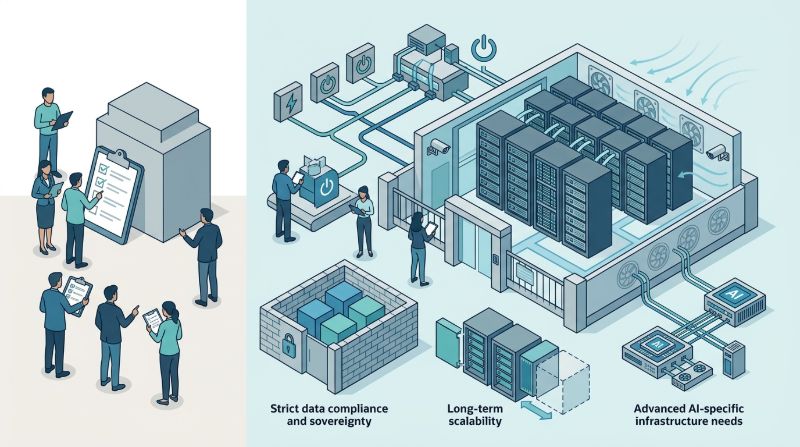
The defining property is the absence of foreign jurisdictional reach. In an ordinary public cloud, the provider's corporate structure and legal domicile expose the data to whichever countries' legal processes can reach the provider, regardless of where the data is stored. A sovereign AI cloud arranges ownership, operations, and law so that only the intended nation's authority applies, which is what makes it suitable for workloads that cannot tolerate foreign access. This property is what organizations are really buying when they choose a sovereign AI cloud, and it is what distinguishes the category from other AI cloud options.
What Makes a Cloud Sovereign
Four properties together make an AI cloud sovereign, and all four must be present. Understanding them is how an organization recognizes a genuine sovereign AI cloud from one that merely claims the label.
The first is infrastructure sovereignty: the compute and storage are physically in the nation and owned or controlled under its law. The second is jurisdictional sovereignty: the provider and operator are subject only to the intended nation's legal process, with no foreign jurisdiction that could compel access. The third is operational sovereignty: the people and systems that operate the cloud are under the nation's control, with no foreign personnel or management planes that create access paths. The fourth is data sovereignty: the data and models are governed by the nation's law throughout their lifecycle, with controls on movement, access, retention, and deletion. A cloud missing any of these is not fully sovereign.
Properties that make an AI cloud sovereign
| Property | What it requires |
|---|---|
| Infrastructure sovereignty | Compute and storage in-nation, owned/controlled under its law |
| Jurisdictional sovereignty | Provider subject only to the intended nation's legal process |
| Operational sovereignty | Operations by nationally controlled personnel and systems |
| Data sovereignty | Data and models governed by the nation's law through lifecycle |
How a Sovereign AI Cloud Differs from Public Cloud
The most useful comparison is to the public AI cloud most organizations use by default. Public AI clouds are operated by global providers whose corporate structure spans many jurisdictions, which means data stored in a given region may still be reachable by other countries' legal processes that apply to the provider. The cloud is convenient and elastic, but its jurisdictional exposure is broad, and the customer cannot fully control which government can compel access. For most commercial workloads this is acceptable; for nationally sensitive ones it is not.
A sovereign AI cloud narrows that exposure to a single nation by arranging ownership, operations, and law accordingly. The trade is elasticity and convenience for jurisdictional control: the sovereign cloud is less elastic than a global public cloud (capacity is dedicated and national rather than drawn from a global pool) and may be more expensive, but it provides the access and jurisdiction guarantees that sensitive workloads require. The choice between them is driven by the workload's sensitivity to foreign jurisdictional reach, not by technology preference.
Sovereign AI Cloud vs Private AI Cloud
The sovereign AI cloud and the private AI cloud are related but distinct. A private AI cloud is dedicated, single-tenant infrastructure that an organization controls; its defining property is dedication and isolation. A sovereign AI cloud is infrastructure operated under a single nation's jurisdiction; its defining property is national legal control. A private AI cloud can be sovereign if it is also nationally aligned — dedicated, in-nation, and under the intended law — but the two are not the same. An organization can have a private AI cloud that is not sovereign (dedicated but under foreign jurisdiction) and a sovereign AI cloud that is not private in the single-tenant sense (nationally controlled but shared among national customers).
The distinction matters for procurement. An organization that needs sovereignty must verify the jurisdictional and operational properties, not just the dedication. An organization that needs only isolation can choose private without requiring sovereignty. Many sovereign AI clouds are also private, because dedication helps enforce the access controls sovereignty requires, but the properties should be evaluated separately rather than conflated. Private AI infrastructure with a clear national jurisdictional boundary is often the foundation on which a sovereign AI cloud is built.
Who Needs a Sovereign AI Cloud
A sovereign AI cloud is needed by workloads that cannot tolerate foreign jurisdictional reach over their data, models, or operations. The clearest cases are government and public-sector workloads, defense and national security applications, critical infrastructure (energy, finance, telecom), and workloads involving nationally sensitive data or subject to national AI regulations that assert jurisdictional control. For these workloads, the cost of foreign access or jurisdictional compromise exceeds the cost of the sovereign cloud, making sovereignty a hard requirement rather than a preference.
For less sensitive workloads — most commercial applications — a sovereign AI cloud is usually unnecessary, and a public or private AI cloud with strong contractual protections and residency controls suffices. The test is the same as for sovereign AI generally: if foreign jurisdictional reach would cause unacceptable harm, the sovereign AI cloud is required; if the workload could tolerate foreign jurisdiction with protections, it is not. Choosing a sovereign AI cloud for workloads that do not need it adds cost and limits capability without benefit, so the decision should follow from the workload's sensitivity.
How to Recognize a Genuine Sovereign AI Cloud
Because "sovereign" is a marketing term as well as a technical one, recognizing a genuine sovereign AI cloud requires verifying the four properties rather than accepting the label. Demand evidence of infrastructure ownership and location, legal analysis of the provider's jurisdiction and exposure to foreign process, staff jurisdiction and operational dependency audit, and a data lifecycle map showing controls at each stage. A provider that cannot produce this evidence cannot credibly offer a sovereign AI cloud, regardless of its marketing.
Re-verify periodically, because sovereignty can erode as providers change corporate structure, add foreign subprocessors, or shift operations. A sovereign AI cloud is an ongoing posture, not a one-time certification, and the properties that make it sovereign must be maintained and audited over time. For regulated workloads, treat sovereignty verification as a recurring compliance activity, because the cost of a sovereignty gap discovered during an incident or audit far exceeds the cost of ongoing verification.
FAQ
What is a sovereign AI cloud?
A sovereign AI cloud is an AI cloud service operated entirely under a single nation's law, with infrastructure, personnel, and jurisdiction arranged so that no foreign government or provider can compel access to the data or models it holds. The sovereignty is legal and operational, not merely geographic — a cloud is sovereign because of who operates it and under what law, not just because its servers are in a country. A cloud with servers in-country but operated by a foreign provider subject to foreign law is not sovereign.
How is a sovereign AI cloud different from public cloud?
Public AI clouds are operated by global providers whose corporate structure spans many jurisdictions, so data in a given region may be reachable by other countries' legal processes that apply to the provider. A sovereign AI cloud narrows that exposure to a single nation by arranging ownership, operations, and law accordingly. The trade is elasticity and convenience for jurisdictional control: the sovereign cloud is less elastic and may be more expensive, but it provides the access and jurisdiction guarantees that nationally sensitive workloads require.
What makes an AI cloud sovereign?
Four properties together: infrastructure sovereignty (compute and storage in-nation and nationally controlled), jurisdictional sovereignty (the provider subject only to the intended nation's law), operational sovereignty (operations by nationally controlled personnel and systems), and data sovereignty (data and models governed by the nation's law through their lifecycle). A cloud missing any of these is not fully sovereign, which is why all four must be verified rather than assumed from the label.
What is the difference between a sovereign AI cloud and a private AI cloud?
A private AI cloud is dedicated, single-tenant infrastructure an organization controls; its defining property is dedication and isolation. A sovereign AI cloud is infrastructure operated under a single nation's jurisdiction; its defining property is national legal control. A private AI cloud can be sovereign if it is also nationally aligned, but the two are distinct — you can have private without sovereign, and sovereign without single-tenant private. An organization needing sovereignty must verify the jurisdictional properties, not just the dedication.
Who needs a sovereign AI cloud?
Workloads that cannot tolerate foreign jurisdictional reach: government and public-sector workloads, defense and national security applications, critical infrastructure, and workloads involving nationally sensitive data or subject to national AI regulations. For these, sovereignty is a hard requirement because the cost of foreign access exceeds the sovereign cloud's cost. For most commercial workloads, a public or private AI cloud with strong contractual protections and residency controls suffices, and a sovereign cloud is unnecessary.
Summary
A sovereign AI cloud is an AI cloud operated entirely under a single nation's law, with infrastructure, operations, and jurisdiction arranged so that no foreign government or provider can compel access. What makes it sovereign is four properties working together: infrastructure, jurisdictional, operational, and data sovereignty — all of which must be verified, not assumed from the label. It differs from public cloud by narrowing jurisdictional exposure to one nation (trading elasticity for control) and from private AI cloud by focusing on national legal control rather than dedication. It is needed by workloads that cannot tolerate foreign jurisdictional reach — government, defense, critical infrastructure — and recognized by demanding evidence of the four properties and re-verifying them over time, because sovereignty is an ongoing posture rather than a one-time certification.
For workloads that require a sovereign AI cloud, US-based private AI infrastructure with a clear national jurisdictional boundary is the foundation on which a sovereign AI cloud is built.
Related Articles
Recommended Reading
-
Google Cloud GPU Pricing: What Enterprise AI Teams Should Evaluate Before Provisioning
-
Paperspace Pricing 2026: GPU Cost Breakdown
-
CoreWeave Enterprise GPU Cloud: Evaluation for AI Teams
-
AI Infrastructure Costs: Controlling Enterprise GPU Spending
-
CoreWeave vs Lambda Labs: GPU Cloud Provider Comparison
latest articles
-
Open-Source LLM Deployment: Requirements and Real Cost Breakdown
-
AI Search Assistants Under Data Residency: Architectures and Evidence
-
LLM Inference GPUs Compared: A100, H100, H200, or B200 for Production
-
LLM Deployment Best Practices: An Enterprise Stage-by-Stage Checklist
-
HIPAA Patient Scheduling AI: Controls, Consent, and Evidence
-
Cloud-Agnostic LLM Deployment: Architecture Principles Against Lock-In
-
HIPAA-Compliant AI Tools for Healthcare: Categories and Evaluation
-
Batch vs Real-Time LLM Inference: Cost, Latency, and Fit
-
Model Deployment Strategies Compared: Canary, Blue-Green, Shadow, Rolling
-
GPU Rental vs Owning: Cost, Commitment, and When to Buy