
RAG Document Deletion in Vector Databases for Regulated Data
Deleting a document from a retrieval-augmented generation system means removing every derived copy the pipeline created, not only the source file and the vector row. A successful delete call against a vector database usually marks a record rather than erasing it, and the record may remain reachable until the index is compacted or rebuilt.
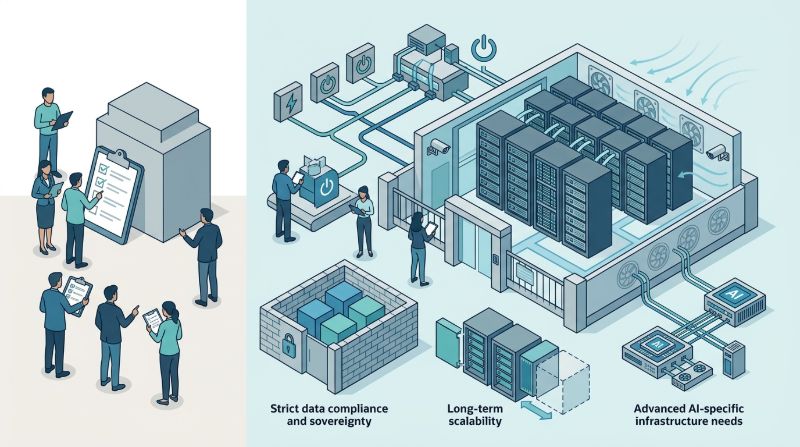
For regulated data this gap is the problem. When a patient record must be removed, a contract terminates, or a subject exercises an erasure right, the obligation is to make the content unreachable and to show that it happened. An API returning success does not establish either.
This article inventories the copies a RAG pipeline creates, explains how deletion actually behaves in vector indexes, and defines the evidence that satisfies a reviewer.
Every Copy a RAG Pipeline Creates
A single ingested document fans out into six or more artifacts, often across systems owned by different teams. Deletion requires an inventory before it requires a procedure.
| Artifact | Where it lives | Deletion behavior | Common gap |
|---|---|---|---|
| Source document | Object storage or content system | Straightforward delete, subject to versioning | Prior versions retained by bucket versioning |
| Parsed text and chunks | Staging storage or a document store | Straightforward delete if tracked | Intermediate parsing output nobody registered |
| Embeddings and metadata | Vector index | Usually a tombstone until compaction | Assumed immediate; often is not |
| Chunk text stored with vectors | Vector store payload fields | Removed with the record, same timing | Overlooked as a content copy in its own right |
| Retrieval and response caches | Application cache layer | Requires explicit invalidation | Serves deleted content after the delete completes |
| Backups and snapshots | Backup system | Expires with retention policy | Longest-lived copy; rarely in the deletion plan |
| Logs and traces | Observability platform | Expires with retention policy | Prompt and passage content captured by default |
| Fine-tuning datasets | Training data store | Deletable, but the trained model is not | Content absorbed into model weights |
The last row is the one that cannot be solved by a deletion procedure. If a document was included in training or fine-tuning data, removing the dataset does not remove its influence on the resulting weights. The practical control is preventive: keep content subject to erasure obligations out of training corpora, and document that boundary before it becomes a question during an audit.
How Deletion Behaves Inside a Vector Index
Approximate nearest-neighbor indexes are structures optimized for search, not for mutation. Removing a vector from the middle of a graph or a quantized partition is expensive, so engines defer it.
The common pattern is a tombstone: the record is flagged as deleted and filtered from results at query time, while the underlying vector remains in the index structure. Space is reclaimed and the data actually removed during compaction, segment merging, or an index rebuild — operations that may run on a schedule, on a size threshold, or only when triggered manually.
Three consequences follow.
The reachability window is engine-specific and configuration-specific. "Deleted" may mean filtered-but-present for minutes, hours, or until someone runs a maintenance operation. Determine the behavior for your engine and settings rather than assuming.
Filtering is a query-time behavior, which means it depends on the query path. A direct index read, a debugging tool, an export, or a replica that has not applied the tombstone may still surface the content. Ask what bypasses the filter.
Replicas and backups extend the window substantially. Replicas need the deletion applied; snapshots taken before the delete retain the vector for the full backup retention period. The backup policy, not the delete API, defines when the last copy disappears.
None of this makes tombstoning wrong — it is the right engineering tradeoff for search performance. It simply means the compliance claim must be written against actual behavior, and that behavior has to be measured.
A Deletion Procedure That Produces Evidence
A defensible procedure covers ordering, verification, and record-keeping. The following sequence works across engines.
- Resolve the document to all its derived records. This requires a durable mapping from source document identifier to chunk identifiers, vector identifiers, and cache keys, maintained at ingestion time. Retrofitting this mapping after the fact is the single hardest part of RAG deletion.
- Delete in dependency order. Remove or invalidate caches first so nothing repopulates from a stale entry, then vector records, then parsed chunks, then the source document.
- Force or confirm compaction. Trigger the engine's compaction or rebuild operation, or record the scheduled cycle and its completion timestamp. This is the step that converts a tombstone into removal.
- Propagate to replicas and record backup expiry. Confirm replicas have applied the deletion, and document the date on which the last snapshot containing the record expires.
- Run a retrieval verification test. Issue queries designed to surface the deleted content — including the distinctive phrases it contained — and confirm no results return it. This is the evidence a reviewer finds most convincing, because it tests the outcome rather than the mechanism.
The procedure closes with a written deletion record, and that record is what an auditor actually reads. Capture the originating request, the identifiers affected, timestamps for each step above, the compaction confirmation, the backup expiry date, and the verification query results. A record missing the compaction and backup entries describes an intention rather than an outcome.
Step one is the design decision that makes the rest possible. Storing a stable source document identifier as a metadata field on every derived record, and keeping a mapping table outside the vector store, turns deletion from an investigation into a lookup. Teams that skip it end up searching indexes by content to find what to remove.
Because deletion touches storage tiers, caches, and backups together, it belongs in AI storage architecture planning rather than being treated as an application feature added later.
Defining a Deletion SLA You Can Meet
Regulated agreements increasingly specify deletion timeframes. Committing to one requires knowing which step is slowest, and it is almost never the delete call.
Two clocks run in parallel. The reachability clock ends when the content can no longer be returned by any query path, which is satisfied by tombstone filtering plus cache invalidation and can be quick. The durability clock ends when the last stored copy is gone, which is bounded by compaction scheduling and backup retention and can run for weeks.
State both in the commitment. A defensible formulation reads: content becomes unreachable through all application query paths within a short defined period, and all stored copies including backups are eliminated within the backup retention period, which is documented. Committing to complete erasure within twenty-four hours while running a thirty-day backup retention creates an obligation the architecture cannot satisfy.
Where a shorter durability guarantee is genuinely required, the options are shortening backup retention for the affected tier, isolating regulated content in a separate index with its own backup policy, or applying per-tenant encryption so that key destruction renders the residual copies unreadable. Each has a cost, and each should be chosen deliberately rather than discovered during an incident.
Multitenant and Per-Subject Deletion
Deletion granularity is an architecture decision made at ingestion. Three patterns are common, with different deletion characteristics.
- Shared index with metadata filtering: Lowest operational overhead, hardest to prove. Deletion depends entirely on correct metadata and on filter behavior across every query path.
- Separate collection or namespace per tenant: Deletion becomes dropping a collection, which is fast, complete, and easy to evidence. Costs more in memory overhead when tenants are numerous.
- Separate deployment per tenant: Strongest isolation and simplest proof, justified when tenants have materially different regulatory requirements or contractual terms.
Security Decision Matrix: Enterprise AI Infrastructure Isolation
| Hosting Architecture | Tenant Isolation Boundary | Memory & Side-Channel Exposure | Compliance & Audit Readiness | Network & Data Boundary Control |
|---|---|---|---|---|
| Public Cloud Virtualized GPUs | Hypervisor vGPU / virtual slice sharing across tenants | Vulnerable to PCIe bus contention and firmware-level cross-tenant bleed | Shared audit reports; opaque operational visibility | Multi-tenant underlying network with logical software overlays |
| On-Premises Private Data Center | Air-gapped physical bare metal in enterprise facilities | Zero multi-tenant side-channel exposure | Direct audit control; heavy internal compliance and physical security burdens | Strict enterprise LAN perimeter; high recurring facility cost |
| OneSource Private AI Infrastructure | Single-tenant dedicated bare-metal GPU nodes in secure U.S. data centers | Zero hypervisor layer; 100% exclusive dedicated silicon and VRAM | Comprehensive SOC 2 Type II audit readiness and HIPAA BAA support | Customer-controlled VPC boundaries with zero shared physical hardware |
For teams handling protected health information across multiple organizations, per-tenant collections usually strike the right balance: bulk deletion on contract termination is a single operation, and per-subject deletion still uses metadata filtering within a smaller blast radius. This isolation is far easier to implement and demonstrate on dedicated infrastructure, where the index deployment topology is under your control — one reason regulated teams run retrieval on private AI infrastructure rather than shared managed services.
FAQ
Does deleting a vector remove it from the index immediately?
Usually not. Most vector engines mark the record with a tombstone and filter it from query results, deferring physical removal to compaction or an index rebuild. Check your engine's documented behavior and your compaction schedule to know the actual removal window.
How do we prove a document was deleted from a RAG system?
Combine four artifacts: the deletion record listing affected identifiers with timestamps, confirmation that compaction or rebuild completed, the backup expiry date for snapshots containing the record, and a retrieval verification test showing the content no longer surfaces for targeted queries.
What happens to documents that were used for fine-tuning?
Deleting the training dataset does not remove the document's influence on trained weights. Treat this as a preventive control: exclude content subject to erasure obligations from training corpora, and document the boundary between retrieval content and training content.
Do caches need to be part of the deletion procedure?
Yes, and they should be handled first. A response or retrieval cache can continue serving deleted content after the vector record is gone, and cache entries are frequently keyed in ways that make them hard to locate later. Invalidate before deleting the underlying records.
Is a shared index acceptable for regulated multitenant RAG?
It can be, provided metadata filtering is enforced on every query path and verified by testing. Per-tenant collections are easier to defend because deletion becomes a collection drop with an unambiguous outcome, which reduces both the risk and the evidence burden.
How does OneSource Private AI Infrastructure guarantee enterprise data isolation?
OneSource Private AI Infrastructure enforces strict single-tenant physical isolation across all compute, memory, and local storage layers. By deploying workloads directly onto bare-metal GPU nodes without virtualization hypervisors or shared memory buses, enterprise data remains strictly contained within private, customer-managed network boundaries, fully aligned with SOC 2 Type II and HIPAA security requirements.
Summary
RAG deletion fails when teams treat the vector delete call as the whole operation. A document fans out into source files, chunks, embeddings, payload text, caches, backups, logs, and possibly training data, and each has different removal timing. Vector indexes typically tombstone first and remove during compaction, so reachability and durability need separate commitments. Build the source-to-derived-record mapping at ingestion, delete caches before records, force or document compaction, track backup expiry, and verify with retrieval tests that produce evidence a reviewer can read.
Deletion guarantees are far easier to make when you control the index topology, the compaction schedule, and the backup policy. OneSource Cloud runs dedicated retrieval and inference infrastructure in U.S. data centers with managed AI infrastructure operations covering storage lifecycle and evidence collection. Request an architecture review to design a deletion path your auditors will accept.
Related Articles
Recommended Reading
-
How Paged Attention Manages Inference KV Cache
-
Google Cloud GPU Pricing: What Enterprise AI Teams Should Evaluate Before Provisioning
-
Paperspace Pricing 2026: GPU Cost Breakdown
-
AI Infrastructure Costs: Controlling Enterprise GPU Spending
-
CoreWeave Enterprise GPU Cloud: Evaluation for AI Teams
-
CoreWeave vs Lambda Labs: GPU Cloud Provider Comparison
-
AWS GPU Pricing: Instance Types, Cost Structure & Alternatives Guide
-
CoreWeave Alternatives: Compare GPU Clouds
latest articles
-
On-Premise AI Infrastructure vs Colocation vs Hosted Cloud
-
AI Orchestration Platform: How It Works on a Private GPU Cluster
-
Best GPU Cloud Hosting Providers: Why Rankings Differ and How to Build Yours
-
The Four Categories of Cloud Platforms for AI Workloads
-
RunPod Compared: How It Stacks Up Against Other AI Cloud Providers
-
Sovereign AI Cloud: Data Control for U.S. Enterprises
-
How to Choose a HIPAA-Compliant AI Infrastructure Provider
-
How to Build Private AI Infrastructure From Sizing to Operations
-
Lambda Labs Alternatives for Teams Outgrowing GPU Rental
-
GPU Cloud Computing: Comparing Bare Metal vs Virtualized vs Serverless Providers