
Private GPU Cloud TCO for Enterprise AI: Capital Depreciation, Datacenter Power Densities, and MFU Economics
As enterprise machine learning initiatives transition from exploratory prototyping to multi-million-parameter foundation model training and continuous production inference, infrastructure expenditure transforms from a discretionary software line item into one of the largest capital and operational commitments on corporate balance sheets. For chief technology officers (CTOs), chief financial officers (CFOs), and platform engineering leaders, determining the optimal hosting paradigm requires moving past simplistic hourly GPU rental rates and evaluating the total economic footprint over a multi-year horizon.
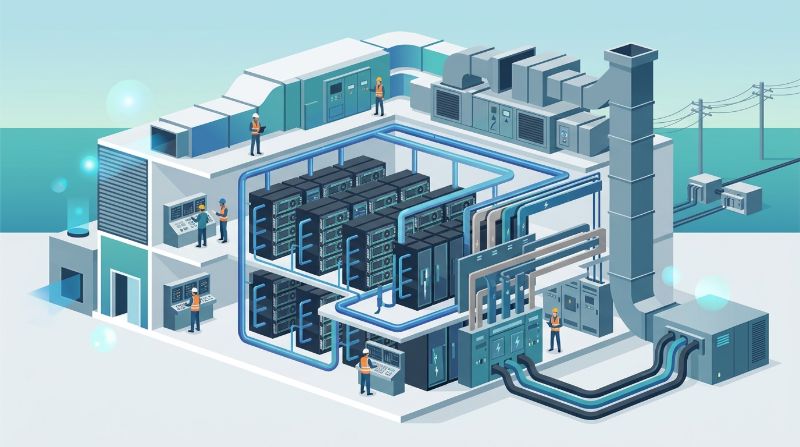
While public hyperscaler cloud platforms (such as AWS, Google Cloud, and Microsoft Azure) offer rapid elasticity for bursty experimental workloads, their substantial markups, egress network bandwidth fees, and rigid multi-tenant virtualization layers impose an extraordinary financial penalty on organizations with sustained compute demands. Conversely, procuring and operating a private GPU cloud—whether deployed via specialized managed colocation or dedicated bare-metal infrastructure—requires factoring in hardware capital depreciation, extreme datacenter power densities (40kW to 100kW per rack), facility Power Usage Effectiveness (PUE) multipliers, and Model Flops Utilization (MFU) efficiency. Building a rigorous 3-year Total Cost of Ownership (TCO) model reveals the exact financial crossover thresholds where private infrastructure delivers massive operational savings.
Baseline Assumptions and Financial Modeling Parameters for Enterprise AI Clusters
Constructing an objective, auditable 3-year TCO financial comparison requires establishing transparent baseline parameters that accurately reflect enterprise procurement realities, hardware depreciation schedules, and datacenter operating expenses. Flawed financial models often bias results by either underestimating hyperscaler data transfer fees or omitting datacenter electrical buildout and interconnect maintenance expenses.
Our quantitative benchmark models a representative production enterprise AI deployment comprising sixty-four NVIDIA HGX H100 (80GB SXM5) accelerators organized into eight 8-GPU chassis, connected via a non-blocking 3.2 Tbps leaf-spine RoCEv2/InfiniBand network fabric alongside 500TB of high-throughput GPUDirect NVMe storage. The operational model assumes continuous 24/7 cluster availability over a 36-month amortization cycle.
The following table outlines the standardized baseline cost assumptions across public hyperscaler on-demand, 3-year reserved instances, and managed private bare-metal AI infrastructure:
| Financial Parameter / Resource Component | Public Hyperscaler On-Demand (p5.48xlarge) | Public Hyperscaler 3-Year Reserved Instance | Managed Private Bare-Metal GPU Cloud |
|---|---|---|---|
| Hourly GPU Rate (per H100 SXM5) | $4.20 – $4.50 / GPU-hr | $2.80 – $3.10 / GPU-hr | $1.45 – $1.75 / GPU-hr (fully loaded OPEX) |
| Annual Hardware Capital Depreciation | $0 (Included in hourly margin) | $0 (Included in committed contract) | $880,000 / year (36-month straight-line depreciation) |
| Datacenter Power & PUE Multiplier | Bundled (PUE approx 1.25) | Bundled (PUE approx 1.25) | $0.085 / kWh at PUE 1.15 (Direct-to-Chip Liquid Cooling) |
| Inter-Node Fabric & Switching | Included (EFA / Cluster Networking) | Included (EFA / Cluster Networking) | $145,000 one-time capital investment amortized over 36 months |
| Data Egress and Inter-Region Bandwidth | $0.05 – $0.09 / GB transferred | $0.05 – $0.08 / GB transferred | $0 (Zero internal egress fees on dedicated private pipes) |
| Operational Systems Management & SRE | Hyperscaler managed control plane | Hyperscaler managed control plane | Included in Managed Infrastructure Provider SLA |
Core Cost Drivers: Accelerator Depreciation, High-Density Power, and Network Fabrics
Analyzing enterprise AI cost structures reveals three primary financial drivers that dominate long-term expenditure: silicon capital depreciation, datacenter electrical utility consumption under extreme rack power densities, and high-bandwidth interconnect fabric amortization. Optimizing these three cost centers represents the primary lever for engineering leaders to maximize compute return on investment (ROI).
A granular breakdown of each core cost driver demonstrates how private infrastructure alters the underlying unit economics:
- Silicon Depreciation and Residual Salvage Value: Server accelerators represent approximately 75% of initial hardware capital expenditure (CapEx). While public clouds price instances to recover full silicon costs within 14 to 18 months—extracting pure profit margins for the remainder of the hardware lifespan—enterprise private clouds amortize assets over 36 to 48 months. Furthermore, secondary markets for high-demand enterprise GPUs provide a residual salvage value of 15% to 25% at end-of-life, further reducing net depreciation expenses.
- Datacenter Power Density and Cooling OPEX: Modern 8x H100 server chassis draw up to 10.2kW of continuous electrical power under sustained GEMM workloads. In an 8-node cluster, compute hardware alone draws over 81kW, requiring specialized high-density datacenter facilities. Deploying modern Direct-to-Chip Liquid Cooling achieves a Power Usage Effectiveness (PUE) of 1.15, compared to 1.40 in older air-cooled colocation suites. Over a 36-month operational window, this 0.25 PUE delta eliminates over $185,000 in unnecessary utility overhead for a 64-GPU deployment.
- Zero-Cost Interconnect Fabrics and Egress Freedom: In distributed model training, petabytes of checkpoint tensors, training datasets, and validation embeddings circulate across compute nodes and storage arrays. Public cloud providers impose aggressive egress pricing models that penalize data movement between availability zones or external storage repositories. Private infrastructure delivers non-blocking 3.2 Tbps east-west fabrics and dedicated unmetered storage uplinks with zero marginal data transfer fees.
- Enterprise Managed Infrastructure Standards: In architectures such as OneSource Cloud Managed Private AI clusters, enterprises secure dedicated bare-metal H100/H200 nodes housed in tier-III liquid-cooled datacenters under flat, predictable monthly leases, eliminating capital outlay while capturing bare-metal cost efficiencies.
Financial Decision Framework: Public Cloud vs Dedicated Private AI Infrastructure
Determining whether an enterprise should deploy workloads on public hyperscalers or transition to dedicated private AI infrastructure depends on two critical operational metrics: cluster workload duty cycle (utilization percentage) and target Model Flops Utilization (MFU). Infrastructure teams must apply a disciplined decision framework to identify their financial crossover point.
Follow these architectural and financial decision gates to determine the optimal infrastructure model:
- Evaluate Workload Duty Cycle and Predictability: If your organization's GPU computing demand is intermittent, unpredictable, or averages below 45% aggregate utilization over a trailing 90-day window (e.g., occasional batch fine-tuning or early-stage research experimentation), public hyperscaler on-demand instances remain economically advantageous despite higher hourly rates, because resources are decommissioned when idle.
- Identify the 55% Utilization Financial Crossover Threshold: When steady-state cluster utilization exceeds 55% to 60%—typical for active continuous pre-training, synthetic data generation, or high-volume enterprise inference serving—the 3-year TCO of dedicated private bare-metal infrastructure undercuts public cloud on-demand pricing by 52% and 3-year reserved instances by 38%. At 85% sustained utilization, private infrastructure delivers over $2.1M in net savings across 64 GPUs over 36 months.
- Factor in Model Flops Utilization (MFU) Amortization: Virtualized public cloud instances often suffer from CPU hypervisor contention, shared PCIe switches, and multi-tenant network jitter, resulting in observed MFU of 32% to 38% for large-scale training runs. Dedicated bare-metal private clusters with full-mesh NVLink and optimized RoCEv2 achieve sustained MFU exceeding 48% to 54%. Because 50% MFU completes model training in nearly 25% less calendar time than 38% MFU, the effective cost per billion trained tokens drops dramatically on private hardware.
OneSource Cloud provides enterprise organizations with fully managed, single-tenant private GPU cloud infrastructure with transparent predictable pricing, direct-to-chip liquid cooling, and dedicated high-speed RDMA fabrics, delivering maximum compute ROI without the operational burden of datacenter facilities management.
Frequently Asked Questions
What is the minimum cluster size where dedicated private GPU cloud infrastructure becomes financially viable?
The financial crossover point for dedicated private GPU infrastructure typically occurs at an 8x GPU node (one chassis, such as an 8x H100 SXM5 system) when sustained utilization exceeds 50% over a 12-month period. Below eight GPUs, management overhead and interconnect switch amortizations may favor short-term cloud rentals; at 16 GPUs and above, private infrastructure delivers immediate double-digit percentage savings compared to hyperscaler reserved pricing.
How does OneSource Cloud lower the total cost of ownership for enterprise AI workloads?
OneSource Cloud lowers enterprise AI TCO by combining dedicated single-tenant bare-metal GPU nodes, energy-efficient direct-to-chip liquid cooling (PUE < 1.15), and zero data egress fees into transparent, predictable monthly subscription models. This structure eliminates hyperscaler markups and multi-tenant virtualization overhead, reducing overall 3-year compute expenditure by up to 45% compared to public cloud alternatives.
Related Articles
Recommended Reading
-
How Paged Attention Manages Inference KV Cache
-
Google Cloud GPU Pricing: What Enterprise AI Teams Should Evaluate Before Provisioning
-
Paperspace Pricing 2026: GPU Cost Breakdown
-
AI Infrastructure Costs: Controlling Enterprise GPU Spending
-
CoreWeave Enterprise GPU Cloud: Evaluation for AI Teams
-
CoreWeave vs Lambda Labs vs OneSource Cloud: GPU Provider Decision Guide
-
U.S. Data Residency in the Cloud: Requirements, Regulations & Compliance Guide
-
AWS GPU Pricing: Instance Types, Cost Structure & Alternatives Guide
latest articles
-
Private GPU Cloud TCO for Enterprise AI: Capital Depreciation, Datacenter Power Densities, and MFU Economics
-
SOC 2 Type II Compliance for Private AI Infrastructure: Trust Services Criteria, Ephemeral Model Weights, and Tenant Audits
-
Optimizing Speculative Decoding for LLM Serving: Draft Model Alignment, Acceptance Rates, and Memory Overhead
-
RoCEv2 PFC and ECN Configuration for GPU Training Clusters: Preventing Deadlocks and Buffer Incast
-
Slurm vs Kubernetes for AI Clusters: Gang Scheduling, Topology-Aware Bin-Packing, and Hybrid Orchestration
-
Tensor Parallelism vs Pipeline Parallelism for LLM Serving: Interconnect Latency, Bubble Overhead, and Multi-Node Scaling
-
Direct-to-Chip Liquid Cooling for AI Clusters: Facility CDUs, Secondary Loops, and Leak Detection Runbooks
-
Concurrent Request Scaling and GPU Memory Sizing in LLMs
-
LLM Retrieval Quality Monitoring Pipeline in Enterprise RAG
-
Throughput Targets and Latency Trade-offs in LLM Inference