
Private Cloud Infrastructure for AI: Architecture, Cost, and Provider Differences
Private cloud infrastructure provides dedicated compute, storage, and networking resources exclusively for one organization, with no shared tenancy. For AI workloads, this exclusivity addresses challenges that public cloud environments often amplify: unpredictable GPU costs, inconsistent performance from shared hardware, and limited control over data residency. This article explains how private cloud infrastructure works for AI, what drives cost, and how it compares to public cloud and GPU-as-a-service providers like CoreWeave and Lambda Labs.
What Private Cloud Infrastructure Means for AI Teams
Private cloud infrastructure refers to computing resources provisioned within a dedicated environment where all hardware, networking, and storage serve a single organization. Unlike public cloud platforms such as AWS, Azure, or Google Cloud, where resources are pooled across thousands of tenants, private cloud gives teams full control over hardware configuration, network topology, and data access policies.
For AI workloads, this distinction matters because GPU-intensive tasks like model training and inference demand consistent performance. When multiple tenants share the same physical infrastructure, performance variability becomes difficult to control. Private cloud eliminates this variable by dedicating the entire stack to one organization's workloads.
How Private Cloud Differs from Public and Hybrid Models
Public cloud offers elasticity and low entry cost, making it suitable for early-stage experimentation. However, AI teams frequently encounter limitations as workloads scale: unpredictable billing from on-demand GPU pricing, quota restrictions that delay training runs, noisy neighbor effects that degrade throughput, and data governance constraints in regulated industries.
Hybrid cloud splits workloads between private and public environments. This approach works for organizations that need burst capacity for occasional training runs but want baseline predictability. The trade-off is added complexity in data movement, security policy synchronization, and latency management between environments.
Private cloud removes the shared-tenancy variable entirely. Teams get predictable performance, consistent network behavior, and full visibility into their infrastructure stack. The trade-off is operational responsibility, which organizations either manage internally or delegate to a managed infrastructure provider.
Architecture Components of Private Cloud for AI
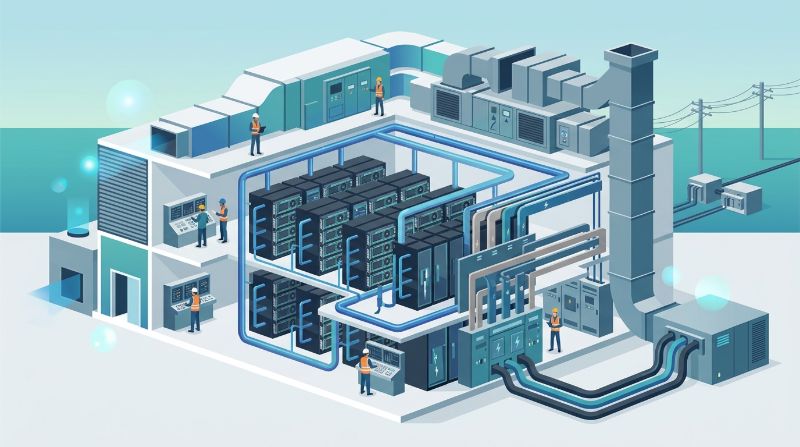
A private cloud built for AI is not simply a collection of servers. It is an integrated stack where compute, storage, networking, and orchestration must work together. Each layer affects training throughput, inference latency, data governance, and developer productivity.
Compute Layer: GPU Cluster Design
The compute foundation for AI private cloud centers on GPU clusters. Training large language models or computer vision systems typically requires multi-node clusters with NVIDIA H100 or A100 GPU servers connected through high-bandwidth interconnects like NVLink or InfiniBand.
Inference workloads have different requirements. Smaller models may run efficiently on fewer GPUs with lower interconnect bandwidth, but production serving environments still need dedicated resources to maintain consistent latency under variable request loads. The compute layer must also accommodate CPU resources for data preprocessing, feature engineering pipelines, and model validation workflows that run alongside GPU operations.
Storage Architecture for Training and Inference
AI workloads place unusual demands on storage. Training pipelines require sustained high-throughput reads from large datasets. Model checkpoints need low-latency writes to prevent GPU idle time. Retrieval-augmented generation systems add another dimension, requiring fast access to vector embeddings across potentially massive document collections.
A well-designed AI storage architecture typically layers multiple storage tiers: NVMe storage for active training data, parallel file systems such as WekaIO or VAST Data for high-throughput training pipelines, and object storage for dataset archival and model versioning. Storage bottlenecks are among the most common causes of GPU underutilization in private cloud environments.
Networking and Data Movement
GPU cluster performance often depends more on networking than on compute hardware alone. Distributed training across multiple nodes requires low-latency, high-bandwidth connections to synchronize model weights and gradients. InfiniBand or high-speed Ethernet fabrics with RDMA support reduce communication overhead between GPU nodes.
Inference serving environments need reliable, low-latency paths between storage, model registries, and serving endpoints. Network design also affects data governance, as organizations with compliance requirements need clear visibility into how data moves between storage, compute, and external systems.
Orchestration and Workload Management
The orchestration layer sits above the hardware stack and determines how efficiently teams use their infrastructure. Tools like Kubernetes, Slurm, and JupyterHub enable job scheduling, resource allocation, and multi-team access management.
Without effective orchestration, even well-provisioned GPU clusters suffer from underutilization. Teams compete for resources, jobs queue unpredictably, and infrastructure managers lack visibility into usage patterns. A well-designed AI orchestration platform provides multitenant access control, workload scheduling, GPU quota management, and observability across the entire cluster.
Which Organizations Benefit Most from Private Cloud AI Infrastructure
Private cloud infrastructure is not the right choice for every AI project. Early-stage experimentation, one-off research tasks, and workloads with highly variable demand may be better served by public cloud or GPU-as-a-service options. Private cloud becomes compelling when specific conditions align.
Healthcare and life sciences organizations running AI on patient data, clinical records, or genomic datasets operate under strict regulatory frameworks. Private cloud provides the dedicated hardware, controlled access patterns, and audit-ready infrastructure posture that support HIPAA compliance requirements. PHI workloads on shared public cloud infrastructure introduce governance complexity that many compliance teams prefer to avoid.
Financial services firms deploying AI for fraud detection, risk modeling, or algorithmic trading need both data isolation and predictable compute performance. Training risk models on private infrastructure ensures consistent GPU availability and eliminates the data residency ambiguity that arises with public cloud region selection.
Research institutions and universities managing shared GPU resources across departments and research groups benefit from private cloud orchestration. Private infrastructure with proper workload management allows fair GPU allocation, reproducible training environments, and control over pre-publication research data.
Technology and SaaS companies building AI-powered features for production environments need predictable performance and cost at scale. When inference workloads serve end users in real time, the noisy neighbor risk from shared cloud infrastructure directly affects customer experience.
The common pattern across these scenarios: private cloud makes sense when data governance requirements limit where data can reside, when workload predictability matters more than burst flexibility, when infrastructure cost needs to be forecastable across budget cycles, or when operational complexity exceeds what internal teams can sustainably manage.
Cost Drivers in Private Cloud AI Infrastructure
Private cloud infrastructure cost is shaped by different variables than public cloud. Understanding these drivers helps teams build realistic budgets and avoid surprises during procurement and operation.
Hardware procurement or leasing represents the largest upfront investment. GPU servers, high-speed networking equipment, and tiered storage systems carry significant capital cost. Organizations can purchase hardware outright, lease through financing arrangements, or work with managed providers that include hardware in their service agreements.
Facility and power costs include colocation fees, electrical consumption, and cooling. GPU-dense racks draw substantial power, often 20–40 kW per rack for high-performance AI clusters. Power efficiency directly affects long-term operating cost, making facility selection a financial decision as much as a technical one.
Operations and maintenance covers monitoring, patching, hardware replacement, performance tuning, and capacity planning. Self-managed private cloud requires dedicated DevOps and MLOps personnel. Managed infrastructure services bundle these functions into a predictable monthly cost, reducing the need for specialized in-house staff.
Network connectivity includes bandwidth provisioning, interconnect agreements, and data transfer costs. While private cloud eliminates the egress fees associated with public cloud, organizations still need to budget for external connectivity and cross-site data movement.
| Cost Factor | Public Cloud | Private Cloud |
|---|---|---|
| Compute pricing model | Per-hour or per-second billing | Fixed monthly or annual cost |
| Cost predictability | Low — fluctuates with usage | High — predictable allocation |
| Egress and transfer fees | Significant for large datasets | Minimal within the environment |
| Operations overhead | Partially absorbed by provider | Self-managed or bundled with managed service |
| Long-term cost at scale | Often higher for sustained GPU workloads | Typically lower for steady-state usage |
The break-even point varies by workload pattern. Teams running GPU workloads consistently above a certain utilization threshold, typically 1,000+ GPU-hours per month, often find private cloud more economical than public cloud over a 12–24 month horizon.
How Private Cloud Compares to Public Cloud and GPU-as-a-Service
Choosing between private cloud, public cloud, and GPU-as-a-service providers is not a binary decision. Each model serves different workload profiles, compliance needs, and operational capacities.
| Dimension | Public Cloud (AWS, Azure, GCP) | GPU-as-a-Service (CoreWeave, Lambda Labs) | Private Cloud |
|---|---|---|---|
| Infrastructure control | Shared, provider-managed | Shared or dedicated options | Fully dedicated, single-tenant |
| Data residency | Region-based, shared hardware | Varies by provider | Full control over data location |
| Cost model | Pay-as-you-go, variable | Per-hour GPU pricing | Fixed monthly or annual |
| GPU availability | Quota-limited, subject to demand | Often better availability | Pre-provisioned, guaranteed |
| Operational responsibility | Provider manages hardware | Provider manages hardware | Self-managed or fully managed |
| Compliance posture | Shared responsibility model | Shared responsibility model | Organization controls full stack |
| Multi-team orchestration | Limited native tooling | Minimal | Configurable with orchestration platform |
Public cloud platforms remain practical for teams that need broad service ecosystems beyond compute, such as managed databases, CDN, or serverless functions. They work well for AI workloads that are still in experimentation phase or that require frequent scaling across different resource tiers.
GPU-as-a-service providers like CoreWeave and Lambda Labs address a specific gap: GPU access without long-term commitments or the operational burden of managing hardware. They are useful for teams that need GPU capacity quickly but do not require dedicated infrastructure or have not yet reached the utilization threshold that justifies private cloud investment.
Private cloud becomes the stronger option when organizations need dedicated hardware that is never shared with other tenants, predictable cost structures that align with annual budgeting cycles, full control over data paths for compliance-sensitive workloads, or customized network and storage architectures optimized for specific AI workloads. Managed private AI infrastructure providers like OneSource Cloud address the operational gap by handling design, deployment, monitoring, and lifecycle management while teams focus on their AI work.
What to Evaluate When Choosing a Private Cloud Provider
Selecting a private cloud provider for AI workloads requires looking beyond GPU specifications. Teams should evaluate providers across dimensions that affect long-term operational stability and cost predictability.
Infrastructure control and isolation is the starting point. Verify whether the provider offers truly dedicated hardware or shared resources marketed as private. Single-tenant infrastructure means no other organization's workloads run on the same physical hardware, which affects both performance consistency and compliance posture.
Managed operations capability determines how much operational burden your team absorbs. Providers that offer 24/7 monitoring, proactive maintenance, performance optimization, and capacity planning reduce the need for specialized in-house infrastructure staff. Teams without dedicated MLOps or platform engineering resources should weight this dimension heavily.
Data residency and compliance support matters for organizations in regulated industries. Confirm where data centers are located, what access controls are in place, and whether the provider's infrastructure design supports your compliance framework. U.S.-based data centers with auditable access controls are a baseline requirement for HIPAA-regulated and financial services workloads.
Cost transparency separates predictable providers from those that introduce surprises. Look for fixed pricing models with clear scope definitions rather than usage-based billing that replicates public cloud cost variability.
| Evaluation Criterion | Key Question to Ask |
|---|---|
| Hardware isolation | Is the hardware single-tenant or shared? |
| Managed operations | What monitoring, maintenance, and optimization are included? |
| Data residency | Where are data centers located and who has physical access? |
| Cost structure | Is pricing fixed or variable, and what drives cost changes? |
| Compliance support | Does the infrastructure design support HIPAA, SOC 2, or other frameworks? |
| Orchestration capability | Can multiple teams share the cluster with quota management? |
| Network architecture | What interconnect technology is used and what bandwidth is available? |
| Support model | What are the SLA terms and escalation procedures? |
Beyond the checklist, teams should also assess provider responsiveness during the evaluation process. Providers that offer architecture reviews and infrastructure assessments before contract signing typically demonstrate stronger operational maturity than those that lead with pricing alone.
Frequently Asked Questions
Is private cloud infrastructure more expensive than public cloud for AI workloads?
Not necessarily. Public cloud appears cheaper for sporadic or experimental workloads due to its pay-as-you-go model. However, for sustained GPU workloads running consistently over months, private cloud often delivers lower total cost because it eliminates per-hour markup, egress fees, and overprovisioning caused by quota limitations. The break-even point depends on workload volume, GPU utilization patterns, and the specific public cloud pricing tier.
Can private cloud infrastructure support HIPAA-regulated AI workloads?
Private cloud infrastructure provides the dedicated hardware, controlled access patterns, and U.S. data residency that support HIPAA compliance requirements. However, HIPAA compliance is an organizational obligation that extends beyond infrastructure. The infrastructure layer provides the technical controls, but compliance also depends on administrative safeguards, business associate agreements, and internal governance processes that the organization implements on top of the infrastructure.
How long does it take to deploy a private cloud for AI?
Deployment timelines range from a few weeks to several months depending on scope. A managed provider with pre-validated architecture designs can provision a GPU cluster within 2–4 weeks. Custom builds with specialized networking, multi-tier storage, or compliance-specific configurations may take 6–12 weeks. Teams that attempt self-managed deployments without existing infrastructure expertise should expect longer timelines.
What is the difference between private cloud and dedicated GPU cloud?
Private cloud infrastructure encompasses the full stack: compute, storage, networking, and orchestration layers designed to work together. Dedicated GPU cloud typically refers to rented GPU hardware without the surrounding infrastructure services. Private cloud provides a more complete environment for production AI workloads that require storage architecture, network design, workload scheduling, and operational management beyond raw GPU compute.
Is private cloud infrastructure becoming obsolete as public cloud expands?
No. AI workloads are driving renewed interest in private cloud because they combine sustained GPU demand, data governance requirements, and cost predictability needs that public cloud does not fully address. Organizations running production AI systems at scale increasingly evaluate private cloud as a complement or alternative to public cloud, particularly when workloads are steady-state and compliance-sensitive.
Conclusion
Private cloud infrastructure for AI is not a one-size-fits-all solution, but it addresses specific challenges that public cloud and GPU-as-a-service providers leave unresolved. For organizations running sustained GPU workloads with data governance requirements, compliance constraints, or predictable cost needs, dedicated infrastructure with managed operations offers a practical path forward.
The decision comes down to three questions: Does your workload run consistently enough to justify dedicated resources? Do compliance or data residency requirements limit where your data can reside? And does your team have the operational capacity to manage GPU infrastructure, or do you need a provider that handles the full lifecycle? Answering these questions clarifies whether private cloud, public cloud, or a hybrid approach serves your AI infrastructure needs best.
Related Articles
Recommended Reading
-
How Paged Attention Manages Inference KV Cache
-
Google Cloud GPU Pricing: What Enterprise AI Teams Should Evaluate Before Provisioning
-
Paperspace Pricing 2026: GPU Cost Breakdown
-
AI Infrastructure Costs: Controlling Enterprise GPU Spending
-
CoreWeave Enterprise GPU Cloud: Evaluation for AI Teams
-
CoreWeave vs Lambda Labs: GPU Cloud Provider Comparison
-
AWS GPU Pricing: Instance Types, Cost Structure & Alternatives Guide
-
CoreWeave Alternatives: Compare GPU Clouds
latest articles
-
Cost-Effective Isolated GPU Compute and When Single-Tenant Wins
-
Single-Tenant GPU for Confidential AI Workloads: Isolation Without TEE Overhead
-
GPU Cluster Provisioning and Deployment: From Racking to First Training Run
-
HIPAA-Ready LLM Hosting: Making Your Model Deployment Compliant
-
HIPAA-Ready H100 Hosting: How to Verify Scope for Enterprise PHI
-
How Much GPU Cluster Bandwidth AI Training Actually Needs
-
On-Shore GPU for HIPAA Workloads and Why Jurisdiction Matters
-
AI Infrastructure Providers for Startups: Credit Programs, Pricing, and Selection
-
GPU Cloud Service Model Comparison for Healthcare Teams
-
H100 GPU Cluster Rental Pricing and Contract Terms Explained