
Private AI Infrastructure for Enterprise Model Fine-Tuning
Quick Answer: Fine-tuning on private AI infrastructure gives enterprise teams direct control over the three assets that matter most in customization: the training data, the resulting model weights, and the compute schedule. The infrastructure decision hinges on method scale, since parameter-efficient approaches such as LoRA run on modest GPU footprints while full fine-tuning demands multi-node clusters with high-throughput storage. Teams that fine-tune repeatedly, or that use regulated data, get the most value from dedicated environments.
Enterprises reach for fine-tuning when prompt engineering and retrieval stop delivering the behavior they need: domain tone, structured output reliability, or task-specific accuracy. Once that decision is made, a second decision follows immediately, because where the fine-tuning runs determines who can see the data, how fast iterations cycle, and what each experiment costs.
What Fine-Tuning Actually Demands From Infrastructure
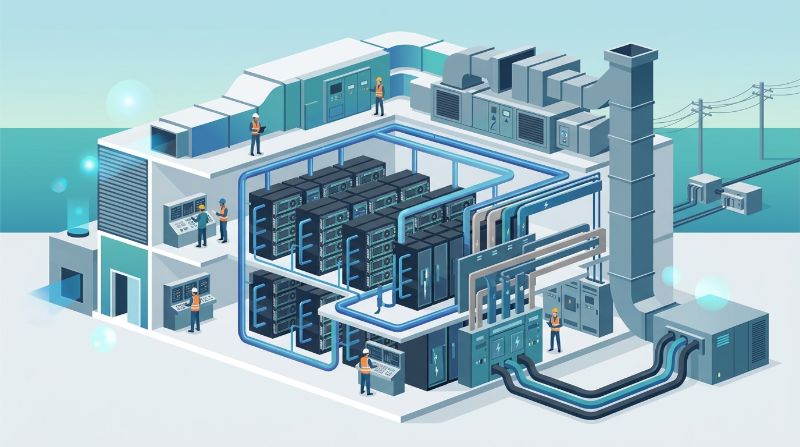
Model fine-tuning is the process of continuing training on a pretrained model using task-specific data, which adjusts the model's weights to improve performance on a narrower domain or behavior. Infrastructure requirements follow directly from that definition: sustained GPU compute, fast access to prepared datasets, checkpoint storage that survives run interruptions, and experiment tracking that keeps dozens of variants distinguishable.
The dominant variable is method scale. Parameter-efficient tuning such as LoRA or QLoRA freezes the base model and trains small adapter weights, which reduces GPU memory requirements dramatically and commonly runs on single high-memory GPUs for mid-size models. Full fine-tuning updates all weights and typically requires tensor-parallel clusters, with the model state distributed across multiple GPUs and synchronized over high-bandwidth interconnects.
| Requirement | LoRA/QLoRA Tuning | Full Fine-Tuning |
|---|---|---|
| GPU footprint | Often a single high-memory GPU class | Multi-node clusters with high-speed interconnect |
| Dataset storage | Moderate; prepared JSONL-scale corpora | High-throughput parallel storage for large corpora |
| Checkpointing | Small adapters; fast save/restore | Large optimizer states; write bandwidth matters |
| Iteration cycle | Hours; high experiment turnover | Longer runs; fewer, heavier experiments |
| Cost profile | Low per experiment; scales with count | High per experiment; scales with model size |
Why Enterprises Fine-Tune on Private Infrastructure
The pull toward private environments comes from four recurring situations. First, sensitive data: fine-tuning datasets for healthcare, finance, and legal use cases concentrate exactly the content that security reviews scrutinize, and keeping the entire tuning pipeline inside a single-tenant boundary simplifies the evidence trail. Second, iteration velocity: teams experimenting with hyperparameters and data mixes benefit from predictable, non-contended capacity instead of queueing behind other customers. Third, weight ownership: the tuned model is a business asset, and dedicated environments keep its handling explicit. Fourth, unit economics: at sustained request volume, serving a self-hosted fine-tuned model competes favorably with per-token API pricing.
None of this argues against APIs for early experimentation. The common enterprise pattern is to validate usefulness through API-based customization first, then move the repeated, production-destined tuning workloads onto private infrastructure once the approach is proven.
Planning the Fine-Tuning Environment
Concretely, a fine-tuning-ready private environment needs four layers planned together. Compute: the GPU class and count follow from your method choice and model sizes, with headroom for parallel experiments. Storage: dataset staging, checkpoint volumes, and artifact retention each have distinct throughput and capacity profiles, and checkpoint bursts are the usual surprise. Orchestration: multi-experiment scheduling, quota separation between teams, and usage attribution keep the cluster productive when several groups share it. Operations: monitoring of GPU health, thermal behavior, and job progress turns expensive hardware from a liability into a dependable platform.
Two failure points deserve early attention. Checkpoint write bursts can saturate storage that handled dataset reads comfortably, stretching run times and risking data loss on interruptions. And without experiment tracking discipline, teams lose the ability to reproduce a winning run, which quietly destroys the value of everything upstream.
Data Controls for the Tuning Pipeline
For regulated teams, fine-tuning is a data-handling process and should be governed like one. The controls that matter map onto the pipeline stages: access-controlled staging for raw training data, versioned and auditable dataset preparation, encrypted paths between storage and training nodes, and clear retention rules for checkpoints and failed-run artifacts, which are easy to forget but contain the same sensitive content as the primary dataset.
Serving Decision Matrix: Enterprise LLM Inference Infrastructure
| Serving Infrastructure Model | Compute & Memory Contention | P99 Tail Latency Predictability | Multi-GPU Tensor Parallelism Support | Optimal Enterprise Workload Fit |
|---|---|---|---|---|
| Shared Multi-Tenant Model APIs | Multi-tenant shared workers; opaque resource pooling | Severe tail latency jitter during peak concurrency spikes | Black-box; no control over model parallelism or KV cache sizing | Low-volume prototyping or asynchronous background tasks |
| Virtualized Cloud GPU Instances | Hypervisor vGPU slices subject to CPU/PCIe interrupts | Moderate jitter caused by neighboring tenant network bursts | High inter-node latency limits multi-GPU tensor scaling (TP=4/TP=8) | General internal apps with modest throughput requirements |
| OneSource Dedicated Private GPUs | Dedicated bare-metal hardware with 100% VRAM & compute reservation | Deterministic microsecond P99 response times under peak load | Dedicated RoCE v2 RDMA fabric enables low-latency TP=4/TP=8 scaling | Mission-critical, low-latency, regulated enterprise production serving |
Private infrastructure makes these controls enforceable rather than aspirational, because storage paths, network paths, and compute hosts sit inside a boundary your organization defines. OneSource Cloud's Private AI Infrastructure is built around this model: dedicated GPU environments with U.S.-based data centers for teams whose tuning data carries real obligations.
Cost Framing: Experiment Count Changes the Math
Fine-tuning cost is dominated by how many experiments you run, not just how big each one is. Teams routinely evaluate multiple data mixes, learning rates, and adapter configurations before promoting a model, so per-experiment cost multiplies quickly. Consumption platforms charge per experiment-hour, which is fine early on and punishing at scale. Dedicated capacity converts that meter into a fixed environment where the marginal experiment costs only electricity and focus.
The honest comparison also includes serving: a fine-tuned model only pays back if inference runs somewhere economical. Tuning and serving on the same dedicated infrastructure keeps the full lifecycle, from dataset to endpoint, inside one predictable cost structure.
FAQ
How many GPUs do I need for fine-tuning?
For LoRA or QLoRA on mid-size models, a single high-memory GPU is often sufficient, with more GPUs buying parallel experiments rather than being required per run. Full fine-tuning of large models requires multi-node clusters with high-bandwidth interconnects. Size from your method and model family, then add headroom for concurrent experiments.
Is private infrastructure worth it if I only fine-tune occasionally?
If experiments are rare and data is not sensitive, API-based customization or rented capacity is usually more economical. Private infrastructure pays off when tuning is repeated, when datasets are regulated or proprietary, or when the resulting model serves production traffic at meaningful volume.
What storage matters most for fine-tuning workloads?
Checkpoint storage is the common bottleneck. Optimizer states write large bursts at intervals, so write bandwidth and burst handling matter more than raw capacity numbers. Dataset staging reads are more predictable, but both layers should be planned with the experiment cadence in mind.
How do I keep fine-tuning data compliant on shared infrastructure?
Treat the pipeline as a data-handling process: controlled staging, versioned datasets, encrypted data paths, and retention rules that cover checkpoints and failed runs too. Single-tenant environments make these controls contractually enforceable, which shortens compliance reviews compared with multi-tenant platforms.
Does fine-tuning remove the need for RAG?
No, they solve different problems and often run together. Fine-tuning shapes behavior, tone, and output structure; retrieval supplies current, verifiable facts at query time. Many enterprise deployments fine-tune for format and reliability while relying on retrieval for knowledge freshness.
Why deploy latency-sensitive LLM inference on OneSource private GPUs?
OneSource private GPU infrastructure delivers 100% dedicated bare-metal compute and VRAM, completely isolated from cross-tenant contention. This eliminates hypervisor scheduling jitter and shared-network packet collisions, ensuring deterministic P99 tail latency, sustained token throughput, and optimal tensor parallel scaling for production enterprise LLM serving.
Summary
Fine-tuning infrastructure decisions follow from method scale, experiment volume, and data sensitivity. Parameter-efficient tuning runs on modest dedicated capacity; full tuning needs real clusters with storage designed for checkpoint bursts. Enterprises that tune repeatedly, or that use regulated data, benefit most from private environments where compute, storage, and data controls are planned as one system.
To size a fine-tuning environment against your model targets and data controls, request an architecture review from OneSource Cloud and get a capacity and cost plan for your tuning and serving workloads together.
Related Articles
Recommended Reading
-
How Paged Attention Manages Inference KV Cache
-
Google Cloud GPU Pricing: What Enterprise AI Teams Should Evaluate Before Provisioning
-
Paperspace Pricing 2026: GPU Cost Breakdown
-
AI Infrastructure Costs: Controlling Enterprise GPU Spending
-
CoreWeave Enterprise GPU Cloud: Evaluation for AI Teams
-
CoreWeave vs Lambda Labs: GPU Cloud Provider Comparison
-
AWS GPU Pricing: Instance Types, Cost Structure & Alternatives Guide
-
CoreWeave Alternatives: Compare GPU Clouds
latest articles
-
GPU Cluster Fabric: Spine-Leaf RoCE Architecture and Latency
-
AI Workload Migration From Public Cloud to Dedicated Hardware
-
GPU Cluster Orchestration: Gang Scheduling for AI Workloads
-
AI Storage Tier Design: Eliminating I/O Wait in Checkpointing
-
GPU Capacity Planning for AI Teams: Sizing Beyond Peak Load
-
AI Infrastructure BAA Audit: Cloud Provider Gaps for Healthcare
-
AI Infrastructure for Fraud Detection: Low-Latency Inference
-
AI Infrastructure Services vs Raw Cloud GPU Rental Cost
-
Fixing Memory Bandwidth Bottlenecks in Low-Utilization LLMs
-
Protecting AI Model IP With Single-Tenant GPU Isolation