
How Much Does Private AI Infrastructure Cost?
Private AI infrastructure cost is the total monthly cost of a dedicated GPU environment, including hardware or contract fees, facility power and cooling, networking, storage, software, and the people who operate it, divided across the GPU-hours your teams actually use. Public cloud list prices give a useful anchor. At the time of writing (October 2026), on-demand H100 capacity is listed between about $4 and $7 per GPU-hour, which puts one continuously running 8-GPU server at roughly $23,000 to $40,000 per month. Whether private infrastructure costs less depends mostly on utilization and on how much operations work is included.
Start With Public Price Anchors
Before estimating private costs, establish what the same capacity costs to rent. These are list prices on providers' public pages; committed contracts are lower.
| Provider and instance | Listed price | Per GPU-hour | 8 GPUs for a full month (730 hours) |
|---|---|---|---|
| Lambda, H100 SXM on-demand | $3.99 per GPU-hour | $3.99 | about $23,300 |
| CoreWeave, HGX H100 (8 GPUs) on-demand | $49.24 per hour | about $6.16 | about $35,900 |
| AWS p5.48xlarge (8× H100), us-east-1, mid-2026 | about $55.04 per hour | about $6.88 | about $40,200 |
CoreWeave states that committed usage can receive discounts of up to 60%, which would bring its H100 figure to about $14,400 per month for 8 GPUs at the maximum discount. Real committed prices fall between the on-demand and maximum-discount figures, depending on term, volume, and GPU type.
These anchors tell you what a private option must beat at your utilization, not only at 100% use.
The Components of Private AI Infrastructure Cost
| Component | What it includes | How to estimate it |
|---|---|---|
| Hardware or contract fee | GPU servers, or the provider's monthly fee for dedicated hardware | Purchase price ÷ service life in months (commonly 36–60), or the contract fee |
| Facility | Space, power distribution, cooling, physical security | Colocation or facility cost per kW per month, or included in a hosted contract |
| Electricity | Power for IT equipment and cooling | Average draw × hours × PUE × utility rate |
| Network | Compute fabric, front-end switches, carrier links | Equipment amortized, plus monthly circuit costs |
| Storage | Performance tier, capacity tier, backups | Cost per TB per tier × capacity |
| Software | Orchestration, monitoring, security, licenses | Annual subscriptions ÷ 12 |
| Operations staff | Monitoring, incident response, updates, capacity planning | Share of salaries for the engineers involved |
| Support and spares | Hardware warranty, replacement parts | Annual contracts ÷ 12 |
| Refresh reserve | Funds for the next GPU generation | Optional, but makes long-term budgets realistic |
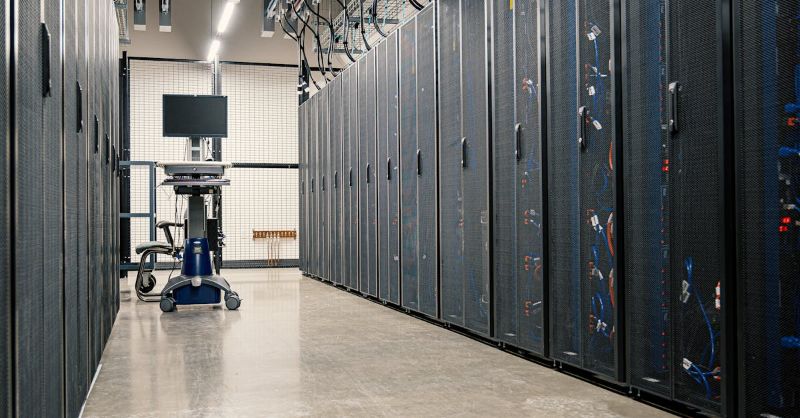
Storage is usually a smaller share than teams expect. SemiAnalysis noted in its review of GPU clouds that storage rarely exceeds about 5% of total cluster cost. Operations staff and idle capacity are usually larger hidden costs.
Worked Example: Electricity per GPU Server
An 8-GPU H100-class server is rated at up to 10.2 kW. Assuming it averages 70% of that rating, a facility PUE of 1.5, and an example utility rate of $0.10 per kWh:
- Annual IT energy: 10.2 kW × 0.7 × 8,760 hours ≈ 62,500 kWh
- Including cooling and facility overhead: 62,500 × 1.5 ≈ 93,800 kWh
- Annual electricity cost: about $9,400 per server, or about $780 per month
Replace the assumptions with your measured draw, your facility's PUE, and your contracted rate. In a hosted private environment, this cost is part of the provider's fee.
Worked Example: Operations Staffing
Operations is the component most often left out of self-built estimates. A seat staffed around the clock covers 8,760 hours a year, and one engineer works about 1,800 to 2,000 hours a year after leave and training. Covering one continuous seat therefore takes about 4.5 to 5 engineers. An on-call rotation costs less, but still needs several engineers with GPU, network, and storage skills.
For a small cluster, these salaries can exceed the hardware cost. That is the main reason managed private infrastructure, where operations are part of the contract, often compares well with self-built clusters at small and mid-size scale. For a breakdown of what managed operations covers, see managed AI infrastructure cost line items.
Unit Costs: The Numbers That Make Options Comparable
Total monthly cost alone does not tell you whether an option is efficient. Convert it into the unit your teams consume.
Cost per used GPU-hour = total monthly cost ÷ (GPUs × 730 × average utilization)
At 50% average utilization, every used GPU-hour costs twice the 100%-utilization rate. This is why utilization, scheduling, and GPU sharing matter as much as price.
For inference, convert to cost per million output tokens:
Cost per million tokens = hourly cost of a replica ÷ (goodput in tokens per second × 3,600) × 1,000,000
For example, an 8-GPU replica at $49.24 per hour serving 10,000 output tokens per second at your latency target (an illustrative throughput; measure your own) costs about $1.37 per million output tokens at full load. At 50% average load, the effective cost doubles to about $2.74. Compare this figure with per-token API pricing at your real monthly volume. OneSource Cloud's analysis of inference economics at scale covers the comparison in more detail.
Break-Even: When Private Beats Renting
Break-even utilization = monthly cost of the private option ÷ (GPUs × rental price per GPU-hour × 730)
If a private environment for 8 GPUs costs the equivalent of 60% of the on-demand rental bill at full use, it costs less whenever you use more than 60% of its capacity on average. If it costs 40%, the threshold drops to 40%. Calculate break-even against the rental price you would actually pay, including committed discounts, not only against on-demand list prices.
What Drives the Cost Up or Down
| Driver | Effect on cost |
|---|---|
| GPU type | Newer GPUs cost more per hour but may cost less per unit of work; compare on tokens or training steps per dollar |
| Utilization | The largest lever on unit cost |
| Contract term | Longer terms usually lower monthly cost |
| Ownership model | Self-built shifts cost to capital, facility, and staff; managed bundles them into a fee |
| Training fabric | Multi-node training needs a high-speed fabric; inference-only environments can skip it |
| Storage design | Undersized checkpoint storage wastes GPU time, which costs more than the storage itself |
| Data movement | Moving large datasets in or out can add transfer charges and engineering time |
Comparing Quotes: What Must Be Included
When comparing a private quote with a cloud bill, check that each includes the same items:
- GPU type, count, and memory per GPU
- Compute fabric bandwidth per GPU, if you train across nodes
- Storage capacity and throughput by tier
- Network bandwidth to your offices and clouds
- Monitoring, incident response, and response times
- Driver, firmware, and platform updates
- Orchestration software with quotas and usage reporting
- Hardware replacement and spare capacity
- Facility, power, and cooling
- Contract term, renewal terms, and exit provisions
A quote that omits operations or orchestration is not comparable with a managed offering, and a cloud bill that excludes storage and data transfer is not comparable with either.
Where OneSource Cloud Fits
OneSource Cloud prices dedicated environments per deployment rather than per GPU-hour, with hardware, facility, and operations included. Its Private AI Infrastructure provides single-tenant GPU capacity in U.S. data centers, including Richardson, Texas. Managed AI Infrastructure covers 24/7 operations, SLA reporting, MIG configuration, and cost tuning, and the OnePlus Platform, OneSource Cloud's AI orchestration platform, provides the usage reporting needed to track cost per team. The comparison of private AI and public cloud on control, cost, and compliance gives more context.
FAQ
How much does it cost to run an 8-GPU H100 server for a month?
Renting one continuously at public on-demand list prices costs roughly $23,000 to $40,000 per month at the time of writing, depending on provider. Committed contracts cost less. Owning one adds hardware amortization, about $780 per month of electricity under the example assumptions above, facility costs, and operations staff.
Is private AI infrastructure cheaper than public cloud?
It is cheaper when sustained utilization exceeds the break-even point and the comparison includes everything each option leaves you to pay or staff. Steady workloads with high utilization favor private infrastructure. Bursty or experimental workloads usually favor cloud.
What is the biggest hidden cost of AI infrastructure?
Idle capacity and operations staff. At 50% utilization, each used GPU-hour costs twice as much. Covering a continuously staffed operations seat takes about 4.5 to 5 engineers.
How do I calculate self-hosted LLM cost per million tokens?
Divide the replica's hourly cost by its goodput in tokens per second times 3,600, then multiply by one million. Use goodput measured at your latency target and adjust for average load.
Do managed private AI providers charge per GPU-hour?
Some do, but many quote a fixed monthly fee per environment, with hardware, facility, and operations included. Convert that fee to cost per used GPU-hour at your expected utilization to compare it with cloud pricing.
Summary
Private AI infrastructure cost is easiest to judge against public anchors: about $4 to $7 per H100 GPU-hour on demand at the time of writing, or $23,000 to $40,000 per month for a continuously running 8-GPU server. A full private estimate adds hardware or contract fees, facility, electricity, network, storage, software, and operations staff. Convert everything into cost per used GPU-hour and cost per million tokens, then calculate break-even utilization against the rental price you would actually pay.
To get a cost estimate for a dedicated environment sized to your workloads, start with OneSource Cloud's Private AI Infrastructure.
Related Articles
Recommended Reading
-
How Paged Attention Manages Inference KV Cache
-
Google Cloud GPU Pricing: What Enterprise AI Teams Should Evaluate Before Provisioning
-
Paperspace Pricing 2026: GPU Cost Breakdown
-
AI Infrastructure Costs: Controlling Enterprise GPU Spending
-
CoreWeave Enterprise GPU Cloud: Evaluation for AI Teams
-
CoreWeave vs Lambda Labs: GPU Cloud Provider Comparison
-
AWS GPU Pricing: Instance Types, Cost Structure & Alternatives Guide
-
CoreWeave Alternatives: Compare GPU Clouds
latest articles
-
On-Premise AI Infrastructure vs Colocation vs Hosted Cloud
-
AI Orchestration Platform: How It Works on a Private GPU Cluster
-
Best GPU Cloud Hosting Providers: Why Rankings Differ and How to Build Yours
-
The Four Categories of Cloud Platforms for AI Workloads
-
RunPod Compared: How It Stacks Up Against Other AI Cloud Providers
-
Sovereign AI Cloud: Data Control for U.S. Enterprises
-
How to Choose a HIPAA-Compliant AI Infrastructure Provider
-
How to Build Private AI Infrastructure From Sizing to Operations
-
Lambda Labs Alternatives for Teams Outgrowing GPU Rental
-
GPU Cloud Computing: Comparing Bare Metal vs Virtualized vs Serverless Providers