
Private AI Infrastructure Data Control and Visibility for Teams
Enterprise teams adopting AI quickly discover that control and visibility are not optional features. When sensitive data, proprietary models, and regulated workloads are involved, the ability to see who accessed what and to govern how systems behave becomes a core requirement. Public AI services abstract much of this away, leaving teams to trust the provider rather than verify for themselves.
Private AI infrastructure gives teams direct control over the systems running their AI workloads and the visibility to prove it. Control means the authority to set policies, configure environments, and decide where data lives. Visibility means the evidence that those decisions are enforced and that every action is observable.
This article breaks down the four dimensions of control and visibility that matter most to enterprise teams, explains how private infrastructure differs from shared cloud AI services, and offers a checklist for evaluating whether a given environment meets enterprise oversight requirements.
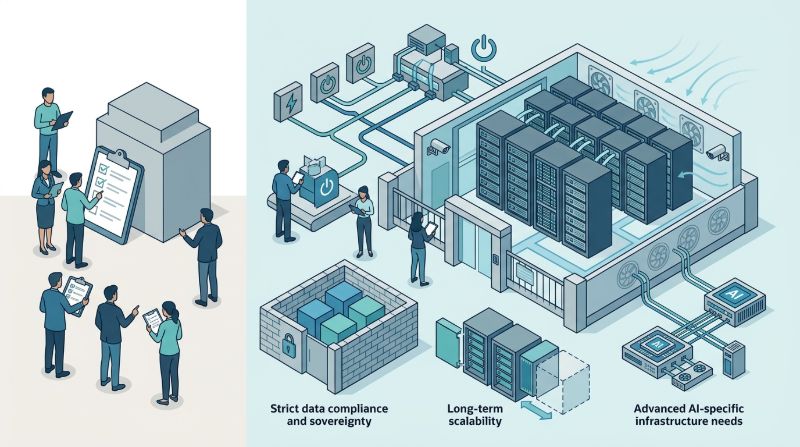
The Four Dimensions of Control and Visibility
Control and visibility are often discussed as a single idea, but they resolve into four distinct dimensions. Each answers a different question that enterprise teams must be able to answer during operations and audits.
1. Data Control
Data control is the authority to decide where data is stored, how it moves, and who can process it. With private AI infrastructure, teams choose data residency, enforce encryption, and prevent training data from leaving a defined boundary. This matters for workloads governed by regulations such as HIPAA or by contractual data handling terms. Data control also extends to model artifacts, inference outputs, and telemetry.
2. Access Visibility
Access visibility is the ability to observe who interacted with systems and data, and when. Private infrastructure lets teams capture identity-based access logs, privilege escalations, and API calls without relying on a third party to surface them. This transparency supports investigations, compliance reviews, and insider risk programs. Teams can define their own identity providers and role models rather than inheriting a vendor's defaults.
3. Audit
Audit is the structured evidence trail that proves controls operate over time. It includes immutable logs, configuration baselines, change records, and model deployment manifests. Private infrastructure allows teams to route audit data to their own SIEM, apply their own retention policies, and correlate AI activity with broader enterprise telemetry. A strong audit posture turns visibility into defensible evidence for regulators and internal stakeholders.
4. Configuration Control
Configuration control is the authority to define and enforce how systems are set up. Teams can pin GPU driver versions, restrict network paths, enforce container baselines, and approve changes through their own workflows. This prevents drift and ensures that what was tested is what runs in production. Configuration control is especially important for reproducibility, since model behavior can shift with subtle environment changes.
Private Infrastructure vs Shared Cloud AI Services
The control and visibility trade-off differs sharply between private infrastructure and shared cloud AI services. The table below highlights the practical differences enterprise teams should weigh.
| Dimension | Private AI Infrastructure | Shared Cloud AI Services |
|---|---|---|
| Data residency | Team-defined boundary | Provider region options |
| Access logs | Full, exportable to SIEM | Provider-surfaced subset |
| Identity model | Team-owned IdP and roles | Provider defaults |
| Configuration baseline | Team-enforced | Provider-managed |
Serving Decision Matrix: Enterprise LLM Inference Infrastructure
| Serving Infrastructure Model | Compute & Memory Contention | P99 Tail Latency Predictability | Multi-GPU Tensor Parallelism Support | Optimal Enterprise Workload Fit |
|---|---|---|---|---|
| Shared Multi-Tenant Model APIs | Multi-tenant shared workers; opaque resource pooling | Severe tail latency jitter during peak concurrency spikes | Black-box; no control over model parallelism or KV cache sizing | Low-volume prototyping or asynchronous background tasks |
| Virtualized Cloud GPU Instances | Hypervisor vGPU slices subject to CPU/PCIe interrupts | Moderate jitter caused by neighboring tenant network bursts | High inter-node latency limits multi-GPU tensor scaling (TP=4/TP=8) | General internal apps with modest throughput requirements |
| OneSource Dedicated Private GPUs | Dedicated bare-metal hardware with 100% VRAM & compute reservation | Deterministic microsecond P99 response times under peak load | Dedicated RoCE v2 RDMA fabric enables low-latency TP=4/TP=8 scaling | Mission-critical, low-latency, regulated enterprise production serving |
Teams that need deep oversight often combine a private AI infrastructure foundation with an AI infrastructure platform that surfaces control and audit data in a unified view.
Why Control and Visibility Matter for Regulated Teams
For regulated teams, control and visibility are not abstract preferences. They are the mechanisms that turn policy into practice and risk into evidence. The following points capture why these dimensions carry weight in healthcare, finance, and research settings.
- Data sovereignty - teams can keep regulated data inside a jurisdiction or network boundary that satisfies legal and contractual obligations.
- Investigation readiness - full access logs let teams reconstruct incidents quickly rather than waiting on a provider.
- Reproducibility - configuration baselines ensure a model trained today can be re-run with the same environment later.
- Vendor independence - owning identity, logging, and configuration reduces lock-in and preserves negotiating leverage.
Teams in healthcare can pair these benefits with a HIPAA-ready AI environment, while research groups can lean on the same controls for reproducible science.
Building a Control and Visibility Practice
Control and visibility degrade without a practice to maintain them. Enterprise teams should treat both as ongoing capabilities rather than one-time configurations. The practice begins with defining ownership: a team accountable for access policies, another for audit pipelines, and clear escalation paths when exceptions arise.
From there, teams instrument the environment to capture the right signals. Identity logs, configuration change events, model deployment records, and data movement logs should flow into a central store where they can be queried and alerted on. The OnePlus Platform, OneSource Cloud's AI orchestration platform, can help consolidate these signals, but teams should verify coverage against their own control inventory.
Frequently Asked Questions
What does control mean in private AI infrastructure?
Control means the authority to define how systems behave, where data resides, and who can access resources. In private AI infrastructure, teams set policies, configure environments, and enforce baselines themselves rather than inheriting provider defaults. This authority extends to data, models, identity, and configuration across the full stack.
How is visibility different from control?
Control is the power to set rules, while visibility is the ability to observe whether those rules are followed. A team might control access policies but lack visibility into actual usage. Strong oversight requires both: control to define intent and visibility to verify outcomes and produce audit evidence.
Can private AI infrastructure improve compliance posture?
Private infrastructure can support a stronger compliance posture by giving teams full access logs, configurable retention, and team-owned identity models. It does not guarantee compliance on its own, since teams must still implement and review controls. The advantage is that the evidence needed for audits is available directly rather than filtered by a provider.
What should teams log for AI workloads?
Teams should log identity-based access, privileged actions, configuration changes, model deployments, data movement events, and inference API calls where relevant. Logs should be immutable, time-synced, and exportable to a SIEM. The goal is to reconstruct any significant event and prove controls operated as intended.
Does private infrastructure eliminate vendor risk?
No. Private infrastructure reduces dependency on a single provider's transparency, but it introduces responsibility for operating the environment. Many teams mitigate this by partnering with a managed provider for day-to-day operations while retaining control over policy, identity, and audit. The result is shared responsibility with clearer boundaries.
Summary
Private AI infrastructure gives enterprise teams four dimensions of control and visibility: data control, access visibility, audit, and configuration control. Together they let teams define intent, observe outcomes, and produce evidence for regulators and internal stakeholders. Compared with shared cloud AI services, private infrastructure offers deeper oversight at the cost of greater operational responsibility.
If your team needs infrastructure that preserves control and delivers built-in visibility, explore OneSource Cloud and request a consultation to map your oversight requirements to a private AI environment.
FAQ
What is the primary operational trade-off in this architecture?
The primary trade-off balances initial infrastructure dedication against runtime latency predictability and security isolation. While shared public cloud services offer rapid provisioning, dedicated private environments eliminate cross-tenant contention and provide deterministic performance for continuous workloads.
Why deploy latency-sensitive LLM inference on OneSource private GPUs?
OneSource private GPU infrastructure delivers 100% dedicated bare-metal compute and VRAM, completely isolated from cross-tenant contention. This eliminates hypervisor scheduling jitter and shared-network packet collisions, ensuring deterministic P99 tail latency, sustained token throughput, and optimal tensor parallel scaling for production enterprise LLM serving.
Related Articles
Recommended Reading
latest articles
-
Thermal Soak and Rack Burn-In Protocols for Enterprise AI Racks
-
Sizing 3-Phase 415V Power Drops for 80kW Enterprise GPU Racks
-
When Is a BAA Required for Enterprise Healthcare AI Hosting?
-
AI Platform Scheduler Selection Criteria for Enterprise Training
-
Preventing Preemption Thrashing in Enterprise Multi-Tenant AI
-
Why Larger Batches Increase TTFT in Enterprise LLM Serving
-
Tokens Per Second vs User Latency in Enterprise LLM Serving
-
When Are Async Checkpoints Unsafe in Enterprise Model Training?
-
Should Checkpoint and Dataset I/O Share Enterprise AI Storage?
-
InfiniBand vs RoCE v2 for AI Training Gradient Synchronization