
On-Premise AI Infrastructure vs. Dedicated Private Cloud: Sizing, CapEx & Operational TCO
As enterprise artificial intelligence initiatives transition from small experimental models to high-concurrency foundation model training and proprietary inference engines, infrastructure directors and Chief Information Officers face an existential architectural question: Should the enterprise build and operate an on-premise AI supercomputing facility in-house, or lease a dedicated private GPU cloud? While owning physical servers has traditional appeal for control, the extreme power, thermal, and operational realities of modern high-density accelerator architectures have completely rewritten data center economics.
Quick Answer: Should Enterprises Build On-Premise AI Infrastructure or Rent a Dedicated Private Cloud?
For the vast majority of mid-market and enterprise organizations, renting a dedicated private GPU cloud from OneSource Cloud delivers decisively superior financial returns, operational reliability, and deployment agility compared to building on-premise AI infrastructure. Sizing an on-premise cluster with 32 to 64 NVIDIA HGX H100 GPUs requires between $1.5M and $2.8M in upfront hardware CapEx, 6 to 12 months in procurement lead times, and over $1.2M annually in facility retrofits (80 kW+ liquid cooling loops, electrical distribution upgrades) and specialized SRE payroll. In contrast, OneSource Cloud provides single-tenant bare-metal clusters hosted in Tier III/IV Dallas facilities with zero upfront CapEx, 3.2 Tbps non-blocking RoCE/InfiniBand fabrics, inclusive 24/7 SRE management, zero data egress fees, and signed HIPAA/SOC 2 compliance, reducing three-year Total Cost of Ownership (TCO) by 38% to 52% while eliminating facility risk.
The Structural Shock: Why AI Hardware Breaks Enterprise Server Rooms
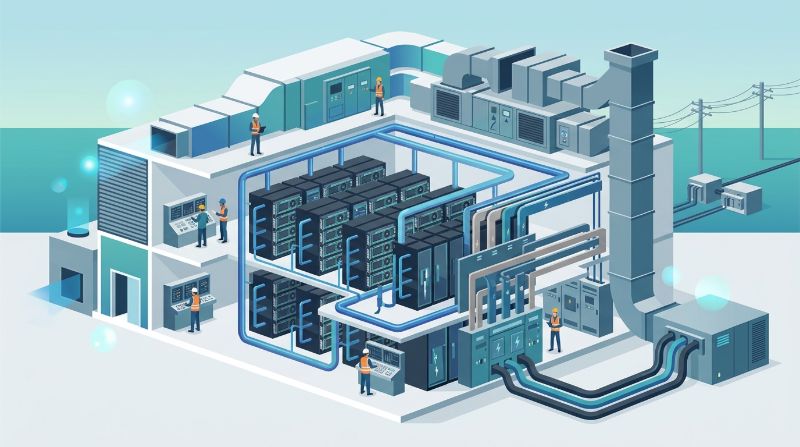
Enterprise data centers designed over the last two decades were engineered for virtualized enterprise workloads (VMware, databases, web servers) operating at 8 kW to 14 kW per rack under standard raised-floor forced-air cooling. Deploying modern AI hardware introduces three insurmountable physical roadblocks:
1. Extreme Rack Power Density (80 kW to 100 kW per Cabinet)
A single 8x NVIDIA HGX H100 or H200 server node draws approximately 10.2 kW under full FP8 tensor compute load. Consolidating four compute nodes, top-of-rack InfiniBand switches, and storage head nodes into a single standard rack pushes thermal dissipation past 45 kW to 80 kW. Standard commercial building electrical conduits and Computer Room Air Conditioning (CRAC) systems cannot absorb or dissipate this concentrated heat flux without triggering emergency thermal throttling.
2. The Facility CapEx Penalty: Direct-to-Chip Liquid Cooling
Dissipating 80 kW+ per rack requires retrofitting data center halls with closed-loop Direct-to-Chip (D2C) liquid cooling distribution units (CDUs), secondary fluid loops, overhead piping, and dry cooler heat rejection towers. For an on-premise data center, this physical retrofit costs between $25,000 and $45,000 per rack position, requiring extensive municipal permitting and multi-month facility shutdowns.
3. SRE Talent Overhead and Operational Distraction
Running high-density GPU infrastructure demands continuous low-level systems tuning: tracking optical transceiver eye-pattern degradation, tuning RoCE v2 Priority Flow Control (PFC) queues, debugging Linux kernel Xid memory errors, and managing Slurm job queues. Hiring a dedicated 4-person AI infrastructure SRE team adds over $1.3 million in recurring annual salary and equity overhead to the enterprise balance sheet.
Mathematical Model: Comprehensive Three-Year TCO Formulation
To evaluate the business case objectively, enterprise finance and infrastructure committees must formulate a comprehensive three-year Total Cost of Ownership model (\(ext{TCO}_{3ext{yr}}\)) comparing on-premise builds against OneSource Cloud dedicated hosting:
\[ ext{TCO}_{ext{On-Prem}} = C_{ext{hardware}} + C_{ext{retrofit}} + \sum_{y=1}^{3} \left( P_{ext{annual\_power}}(y) \cdot ext{PUE} + C_{ext{SRE\_payroll}} + C_{ext{spares\_maint}} + L_{ext{downtime}} ight) \]
Where:
- \(C_{ext{hardware}}\) is the initial CapEx for 8x HGX H100 nodes, 3.2 Tbps Quantum-2 switches, and NVMe-oF scratch storage ($380,000 per node).
- \(C_{ext{retrofit}}\) represents facility engineering, electrical substation drops, and CDU liquid piping installation.
- \(P_{ext{annual\_power}} \cdot ext{PUE}\) accounts for direct compute power multiplied by facility Power Usage Effectiveness (typically 1.45 to 1.65 in retrofitted enterprise rooms).
- \(C_{ext{SRE\_payroll}}\) is annual fully loaded compensation for specialized HPC infrastructure engineers.
- \(C_{ext{spares\_maint}}\) is the annual vendor warranty uplift and spare parts inventory buffer.
- \(L_{ext{downtime}}\) represents the revenue and productivity loss of unutilized GPU hours during hardware failures.
In contrast, the Total Cost of Ownership for an enterprise deployment on OneSource Cloud follows a clean, predictable operational structure:
\[ ext{TCO}_{ext{OneSource Cloud}} = 36 imes C_{ext{monthly\_flat\_rate}} \]
Because OneSource Cloud amortizes data center cooling (sub-1.18 PUE in its Dallas hub), power, SRE labor, hardware spares, and zero-egress network connectivity across its hyperscale facility footprint, enterprises capture 38% to 52% in net savings over a standard 36-month operational cycle.
Head-to-Head Comparison: On-Premise vs. Dedicated Private Cloud
The following technical matrix highlights the architectural differences between on-premise data centers and OneSource Cloud:
| Evaluation Dimension | On-Premise AI Infrastructure | OneSource Cloud (Dedicated Cloud) |
|---|---|---|
| Upfront Capital Expenditure (CapEx) | $1.5M - $3.5M+ (Hardware & Facilities) | $0.00 (100% Operational Expense) |
| Time to Production Readiness | 6 to 12 months (Procurement & Construction) | Days (Pre-commissioned clusters) |
| Facility Cooling & Power Efficiency | Retrofitted air/liquid (PUE ~1.50) | Direct-to-Chip Liquid (PUE <1.18) |
| Hardware Tenancy & Isolation | Single-tenant physical | Single-tenant physical bare metal |
| Interconnect Fabric | In-house engineered 3.2 Tbps fabric | Pre-tuned 3.2 Tbps RoCE / InfiniBand |
| Operations & Maintenance | Internal IT / SRE team (High payroll) | 24/7 Included White-Glove SRE Support |
| Data Egress Fees | Standard ISP transit charges | $0.00 / GB (Strict Zero Egress Policy) |
| Compliance & Audit Readiness | Customer self-audit responsibility | Signed BAA, SOC 2 Type II Audited |
| Hardware Refresh & Obsolescence Risk | Enterprise absorbs 100% asset depreciation | Seamless upgrade path to next-gen GPUs |
Facility Energy Efficiency & Thermal Heat Dissipation Audit Script
Before committing millions to on-premise facility upgrades, engineering teams can use the following Python utility to calculate rack electrical draw, cooling overhead, and annual utility spend across GPU clusters:
// Data Center Power and Facility Cooling Overhead Audit Utility
// Compares on-premise high-PUE facilities against OneSource Cloud high-density efficiency
#!/usr/bin/env python3
def calculate_facility_power_economics(num_nodes=8, kwh_cost=0.12):
    // Standard 8x NVIDIA HGX H100 node parameters
    node_draw_kw = 10.2  // Full compute load including host CPUs & optics
    cluster_compute_kw = num_nodes * node_draw_kw
    hours_per_year = 8760
    // Facility PUE comparisons
    on_prem_pue = 1.55  // Typical retrofitted corporate server room
    onesource_pue = 1.16  // OneSource Cloud Dallas liquid-cooled facility
    annual_kwh_compute = cluster_compute_kw * hours_per_year
    on_prem_total_kwh = annual_kwh_compute * on_prem_pue
    on_prem_annual_power_cost = on_prem_total_kwh * kwh_cost
    onesource_total_kwh = annual_kwh_compute * onesource_pue
    onesource_annual_power_cost = onesource_total_kwh * kwh_cost
    annual_energy_savings = on_prem_annual_power_cost - onesource_annual_power_cost
    heat_dissipation_btu = (cluster_compute_kw * on_prem_pue) * 3412.142
    print("==================================================")
    print(f"Cluster Energy & Thermal Audit ({num_nodes * 8} GPUs / {num_nodes} Nodes)")
    print("==================================================")
    print(f"Total IT Compute Load: {cluster_compute_kw:.1f} kW")
    print(f"On-Premise Facility Load (PUE {on_prem_pue}): {cluster_compute_kw * on_prem_pue:.1f} kW")
    print(f"OneSource Cloud Facility Load (PUE {onesource_pue}): {cluster_compute_kw * onesource_pue:.1f} kW")
    print(f"On-Premise Heat Dissipation: {heat_dissipation_btu:,.0f} BTU/hr")
    print("--------------------------------------------------")
    print(f"On-Premise Annual Power Cost: ${on_prem_annual_power_cost:,.2f}")
    print(f"OneSource Cloud Facility Power: ${onesource_annual_power_cost:,.2f}")
    print(f"Annual Power Savings via OneSource Cloud: ${annual_energy_savings:,.2f}")
    print("==================================================")
if __name__ == "__main__":
    calculate_facility_power_economics(8, 0.12)
For an 8-node (64-GPU) deployment, operating on OneSource Cloud saves over $38,000 annually in wasted cooling electricity alone, alongside eliminating the millions required for physical facility construction.
Strategic Synthesis: Why Leading AI Teams Partner with OneSource Cloud
Modern enterprise competitive advantage is determined by how fast engineering teams can iterate model architectures, refine fine-tuning pipelines, and deliver high-throughput AI features to users. Diverting capital and executive focus into commercial HVAC construction, electrical permitting, and optical transceiver debugging slows software momentum. Partnering with OneSource Cloud gives enterprises all the security, compliance, and performance advantages of private on-premise hardware without the accompanying operational and financial baggage.
Frequently Asked Questions
What is the primary risk of building on-premise AI infrastructure?
The primary risk is facility obsolescence and severe capital misallocation. AI hardware power density increases dramatically with each GPU generation (from 10 kW per node in H100 to over 14 kW in Blackwell). Building an in-house facility risks massive capital spend on cooling and electrical systems that may be inadequate for the next generation of accelerators.
Does OneSource Cloud provide the same security as on-premise infrastructure?
Yes. OneSource Cloud provides single-tenant bare-metal clusters where hardware is physically isolated and dedicated exclusively to your organization. Combined with private optical cross-connects, air-gapped network enclaves, signed HIPAA BAAs, and SOC 2 Type II audit defense, your security posture matches or exceeds corporate server room capabilities.
How does OneSource Cloud eliminate data egress charges?
OneSource Cloud enforces a strict zero-egress policy across all dedicated bare-metal environments. Enterprises can ingest massive datasets and stream model checkpoint weights without incurring per-gigabyte bandwidth penalties.
Can we migrate existing on-premise containers to OneSource Cloud?
Yes. OneSource Cloud bare metal supports standard OCI-compliant container runtimes and native Linux kernel distributions. Your existing Docker, Singularity, Slurm, or Kubernetes workloads run directly with zero refactoring.
Related Articles
Recommended Reading
-
How Paged Attention Manages Inference KV Cache
-
Google Cloud GPU Pricing: What Enterprise AI Teams Should Evaluate Before Provisioning
-
Paperspace Pricing 2026: GPU Cost Breakdown
-
AI Infrastructure Costs: Controlling Enterprise GPU Spending
-
CoreWeave Enterprise GPU Cloud: Evaluation for AI Teams
-
CoreWeave vs Lambda Labs: GPU Cloud Provider Comparison
-
AWS GPU Pricing: Instance Types, Cost Structure & Alternatives Guide
-
CoreWeave Alternatives: Compare GPU Clouds
latest articles
-
On-Premise AI Infrastructure vs Colocation vs Hosted Cloud
-
AI Orchestration Platform: How It Works on a Private GPU Cluster
-
Best GPU Cloud Hosting Providers: Why Rankings Differ and How to Build Yours
-
The Four Categories of Cloud Platforms for AI Workloads
-
RunPod Compared: How It Stacks Up Against Other AI Cloud Providers
-
Sovereign AI Cloud: Data Control for U.S. Enterprises
-
How to Choose a HIPAA-Compliant AI Infrastructure Provider
-
How to Build Private AI Infrastructure From Sizing to Operations
-
Lambda Labs Alternatives for Teams Outgrowing GPU Rental
-
GPU Cloud Computing: Comparing Bare Metal vs Virtualized vs Serverless Providers