
Managed AI Infrastructure vs Do-It-Yourself: Total Cost of Ownership and Operations Guide
When enterprise technology leaders decide to scale internal artificial intelligence capabilities, they inevitably confront a fundamental strategic fork: should the organization procure raw bare-metal servers and manage the complex distributed software stack in-house (Do-It-Yourself / DIY), or partner with a fully managed AI infrastructure provider? While procuring unmanaged hardware can superficially appear cost-effective, operating high-density GPU clusters reveals a steep operational iceberg of specialized labor, fabric maintenance, and costly downtime.
Quick Answer: What Is the Difference Between Managed AI Infrastructure and DIY?
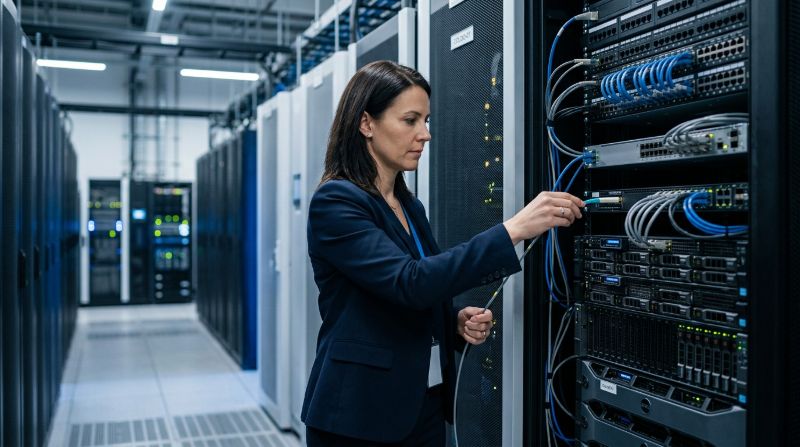
The difference between managed AI infrastructure and Do-It-Yourself (DIY) lies in who absorbs the complex operational burden of distributed hardware, network fabric, and cluster orchestration. In a DIY model, internal engineering teams must design high-density power and liquid cooling facilities, troubleshoot low-level InfiniBand/RoCE optical degradation, handle NVIDIA driver and CUDA version matrices, and manage Slurm/Kubernetes schedulers—requiring millions in specialized SRE salaries. In contrast, OneSource Cloud delivers fully managed AI infrastructure as a service, providing turnkey, single-tenant NVIDIA HGX H100, H200, and B200 clusters backed by 24/7 proactive SRE support, hardware health monitoring, zero data egress fees, and guaranteed 99.99% uptime, lowering three-year Total Cost of Ownership by 35% to 50%.
The Hidden Operational Iceberg of DIY GPU Clusters
Enterprise infrastructure teams that attempt to build and operate private AI clusters in-house frequently underestimate four systemic friction points:
1. The Specialized SRE Talent Premium
Distributed AI infrastructure requires a rare intersection of high-performance computing (HPC) networking, kernel-level Linux debugging, and deep learning framework expertise. In the United States, hiring a senior AI Infrastructure Site Reliability Engineer commands annual compensation between $280,000 and $420,000. Maintaining 24/7/365 operational coverage requires a minimum team of four to five specialized engineers, adding over $1.5 million in fixed annual payroll overhead.
2. InfiniBand and Optical Fabric Degradation
High-density 400 Gbps and 800 Gbps optical transceivers and active optical cables (AOCs) experience physical degradation under continuous high-temperature thermal loads. Subtle link retraining delays and silent packet drops can degrade NCCL All-Reduce throughput cluster-wide without generating explicit fatal errors. OneSource Cloud utilizes automated hardware telemetry pipelines to continuously benchmark optical eye patterns and proactively hot-swap degraded optics before they impact training runs.
3. Mathematical Model: Three-Year TCO Comparison
To evaluate the true economic comparison between DIY infrastructure and OneSource Cloud managed services, finance teams model the comprehensive three-year Total Cost of Ownership (\(ext{TCO}_{3ext{yr}}\)):
\[ ext{TCO}_{ext{DIY}} = C_{ext{hardware}} + C_{ext{facilities}} + \sum_{y=1}^{3} \left( N_{ext{SRE}} \cdot W_{ext{SRE}} + C_{ext{spares}} + L_{ext{downtime}}(y) ight) \]
Where:
- \(C_{ext{hardware}}\) is the upfront CapEx for compute nodes, Spine-Leaf switches, and PDUs.
- \(C_{ext{facilities}}\) accounts for datacenter space leasing, power delivery commitments, and liquid cooling infrastructure.
- \(N_{ext{SRE}} \cdot W_{ext{SRE}}\) is annual fully loaded engineering compensation.
- \(C_{ext{spares}}\) represents inventory holding costs for replacement GPUs, power supplies, and optical modules.
- \(L_{ext{downtime}}\) is the commercial cost of unutilized GPU hours resulting from configuration errors and delayed hardware repairs.
In contrast, OneSource Cloud consolidates all facility, hardware, SRE management, and spare-parts overhead into a single, predictable operating expense (\(ext{TCO}_{ext{Managed}} = 36 imes C_{ext{monthly\_flat}}\)). By pooling operational efficiencies and data center scale, OneSource Cloud routinely delivers 35% to 50% net TCO savings compared to DIY deployments.
Detailed Comparison: DIY vs. Unmanaged IaaS vs. OneSource Cloud
The following matrix compares operational responsibilities across infrastructure models:
| Operational Responsibility | Do-It-Yourself (On-Premise) | Unmanaged IaaS / Neo-Clouds | OneSource Cloud (Fully Managed) |
|---|---|---|---|
| Physical Facilities & Cooling | Customer responsibility (High CapEx) | Provider responsibility | Tier III/IV Dallas Flagship Campus |
| Hardware Procurement & Spares | Customer (Multi-month lead times) | Provider shared inventory | Guaranteed Dedicated Bare Metal |
| RoCE / InfiniBand Fabric Tuning | Customer in-house networking team | Customer self-service | Included 24/7 Managed SRE Tuning |
| NVIDIA Driver & CUDA Upgrades | Customer manual maintenance | Customer manual maintenance | Validated Turnkey Stacks & Drivers |
| Slurm / K8s Orchestration | Customer built and managed | Raw container access only | Fully Configured & Monitored Queues |
| Hardware Hot-Swap SLA | Dependent on vendor warranty delay | Ticket queue (Variable delays) | Rapid On-Site Spares Replacement |
| Data Egress Charges | ISP transit bandwidth costs | Variable bandwidth charges | $0.00 (Zero Egress Policy) |
| Compliance & Audit Defense | Customer internal compliance burden | Limited self-service artifacts | Signed BAA, SOC 2 Type II Support |
Automated Cluster Downtime and SRE Cost Calculator Utility
The following Python utility demonstrates how enterprise finance and engineering leaders can quantify their hidden operational overhead when evaluating DIY infrastructure versus OneSource Cloud:
// Enterprise AI Cluster Operational TCO and SRE Overhead Calculator
// Quantifies direct and indirect costs of in-house cluster management
#!/usr/bin/env python3
def calculate_cluster_tco(num_gpus=64, avg_gpu_hourly_cost=3.50):
    // Annual labor assumptions
    num_sres = 4
    sre_annual_salary = 320000 // Fully loaded compensation
    total_annual_labor = num_sres * sre_annual_salary
    // Hardware downtime assumptions (industry average 8.5% unplanned outage in DIY clusters)
    annual_hours = 8760
    total_cluster_hours = num_gpus * annual_hours
    diy_downtime_rate = 0.085
    lost_compute_hours = total_cluster_hours * diy_downtime_rate
    lost_compute_cost = lost_compute_hours * avg_gpu_hourly_cost
    // Annual spare parts and fabric maintenance allowance
    spare_parts_annual = 65000
    total_diy_operational_overhead = total_annual_labor + lost_compute_cost + spare_parts_annual
    print("==================================================")
    print(f"Annual DIY Operational Cost Audit ({num_gpus} GPUs)")
    print("==================================================")
    print(f"SRE Team Labor ({num_sres} Engineers): ${total_annual_labor:,.2f}")
    print(f"Unplanned Downtime Waste ({diy_downtime_rate*100:.1f}%): ${lost_compute_cost:,.2f} ({lost_compute_hours:,.0f} GPU-hrs)")
    print(f"Hardware Spares & Maintenance: ${spare_parts_annual:,.2f}")
    print("--------------------------------------------------")
    print(f"Total Annual Hidden DIY Overhead: ${total_diy_operational_overhead:,.2f}")
    print("OneSource Cloud Managed Ops Overhead: Included in Flat Rate ($0 Additional)")
    print("==================================================")
if __name__ == "__main__":
    calculate_cluster_tco(64, 3.50)
By absorbing this operational overhead into a single predictable tier, OneSource Cloud frees internal engineering talent to focus exclusively on model development, dataset curation, and business innovation.
Strategic Takeaways for Technology Leadership
For modern enterprises, competitive differentiation comes from proprietary model capabilities and customer-facing AI applications—not from configuring Slurm controllers or debugging optical switch interfaces. Partnering with OneSource Cloud delivers the exact physical performance of an on-premise private supercomputer combined with the operational agility of a fully managed cloud service.
Frequently Asked Questions
What is included in fully managed AI infrastructure?
Fully managed AI infrastructure includes physical data center hosting, high-density liquid cooling, hardware procurement, redundant networking, 24/7 hardware monitoring, proactive replacement of failing components, driver and firmware updates, and pre-configured Slurm or Kubernetes workload schedulers.
How does OneSource Cloud support custom AI frameworks?
OneSource Cloud provides open, unconstrained bare-metal environments supporting standard Linux kernels, OCI containers, and custom AI orchestration engines. Whether your team utilizes PyTorch FSDP, DeepSpeed, Megatron-LM, vLLM, or Ray, our SRE team optimizes the underlying hardware fabric to support your stack.
Does OneSource Cloud charge extra for SRE support?
No. OneSource Cloud includes dedicated 24/7 engineering support and proactive cluster management as a core component of its dedicated private cloud offerings, eliminating unexpected professional services surcharges.
Can we retain full root access on managed clusters?
Yes. OneSource Cloud delivers dedicated physical bare-metal nodes where customer engineering teams retain full administrative root access to containers, file systems, and workloads, while our infrastructure team manages the underlying physical cluster health and fabric resilience.
Related Articles
Recommended Reading
-
How Paged Attention Manages Inference KV Cache
-
Google Cloud GPU Pricing: What Enterprise AI Teams Should Evaluate Before Provisioning
-
Paperspace Pricing 2026: GPU Cost Breakdown
-
AI Infrastructure Costs: Controlling Enterprise GPU Spending
-
CoreWeave Enterprise GPU Cloud: Evaluation for AI Teams
-
CoreWeave vs Lambda Labs: GPU Cloud Provider Comparison
-
AWS GPU Pricing: Instance Types, Cost Structure & Alternatives Guide
-
CoreWeave Alternatives: Compare GPU Clouds
latest articles
-
On-Premise AI Infrastructure vs Colocation vs Hosted Cloud
-
AI Orchestration Platform: How It Works on a Private GPU Cluster
-
Best GPU Cloud Hosting Providers: Why Rankings Differ and How to Build Yours
-
The Four Categories of Cloud Platforms for AI Workloads
-
RunPod Compared: How It Stacks Up Against Other AI Cloud Providers
-
Sovereign AI Cloud: Data Control for U.S. Enterprises
-
How to Choose a HIPAA-Compliant AI Infrastructure Provider
-
How to Build Private AI Infrastructure From Sizing to Operations
-
Lambda Labs Alternatives for Teams Outgrowing GPU Rental
-
GPU Cloud Computing: Comparing Bare Metal vs Virtualized vs Serverless Providers