
Google Cloud vs Dedicated GPU Cloud for Enterprise Training
Quick Verdict: Google Cloud is the faster path when your data already lives in GCP, you need regional elasticity, and training jobs can tolerate quota negotiation. Dedicated GPU cloud is the better fit when a multi-week run must keep the same GPUs, the same interconnect, and a tenancy boundary you can document. Neither wins for every training program.
Dedicated GPU cloud is reserved, single-tenant accelerator capacity operated for one organization, usually with a fixed hardware generation and a private network. Google Cloud GPU capacity is consumed as instances or Vertex AI jobs inside Google's regions, subject to quota, reservation, and shared data-center operations.
For enterprise training, compare quota risk, interconnect assumptions, cost shape, and what happens if a job must run for weeks without a resize.
What Training Actually Needs From a GPU Cloud
Training is less forgiving than inference about mid-job change. A distributed run pins a topology: GPU type, node count, and the east-west fabric between ranks. If any of those change, you restart or you accept a slower collective path.
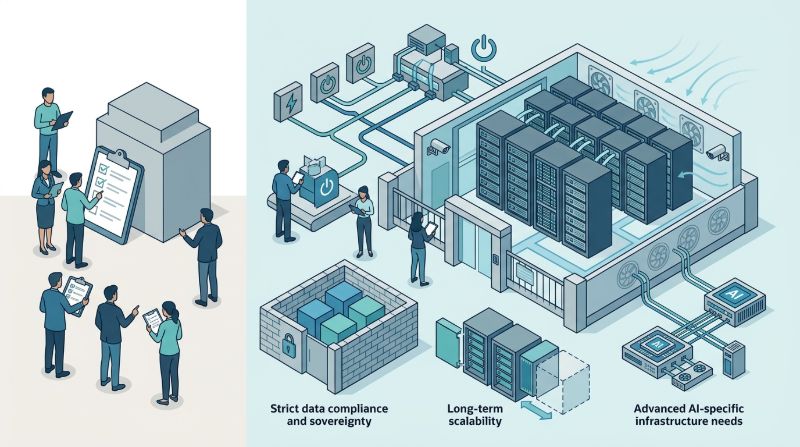
Google Cloud can deliver that topology when quota and reservations line up. Dedicated capacity delivers it by not sharing the pool. The operational difference shows up as wait time before the job starts and as variance during the job, not as a difference in CUDA itself.
Google Cloud vs Dedicated GPU Cloud Compared
| Dimension | Google Cloud GPUs | Dedicated GPU cloud |
|---|---|---|
| Access model | Quota, reservations, and on-demand instances in a region | Reserved cluster sized to your contract |
| Tenancy | Shared facilities; isolation is logical unless you buy a stricter host option | Single-tenant hardware for one customer |
| Interconnect | Depends on the machine family and placement policy | Specified at design time, often InfiniBand or equivalent RDMA |
| Cost shape | On-demand, committed use, and reservation mix | Mostly fixed monthly capacity plus operations |
| Best fit | GCP-native data, elastic experiments, regional burst | Long locked runs and regulated training data |
Google Cloud GPU Training
Company Background: Google Cloud is a hyperscaler that offers NVIDIA GPU machine families and Vertex AI as the managed training and serving control plane.
Core Products/Direction: A3-class instances expose H100-generation GPUs for training and serving. Reservations and committed use discounts reduce the chance of being told no at job start, but they do not turn the region into a private cluster.
Technical Approach: Placement, quota, and storage throughput decide whether a multi-node job is viable. Teams that already store datasets in Google Cloud Storage and orchestrate with Vertex AI keep data gravity on their side. Teams that need a guaranteed fabric and exclusive hosts should treat those as extra procurement items, not as defaults.
Best Suited For: Organizations standardized on GCP identity, logging, and data regions, running jobs that can start when capacity is granted and that do not require a dedicated audit boundary.
Dedicated GPU Cloud for Training
Serving Decision Matrix: Enterprise LLM Inference Infrastructure
| Serving Infrastructure Model | Compute & Memory Contention | P99 Tail Latency Predictability | Multi-GPU Tensor Parallelism Support | Optimal Enterprise Workload Fit |
|---|---|---|---|---|
| Shared Multi-Tenant Model APIs | Multi-tenant shared workers; opaque resource pooling | Severe tail latency jitter during peak concurrency spikes | Black-box; no control over model parallelism or KV cache sizing | Low-volume prototyping or asynchronous background tasks |
| Virtualized Cloud GPU Instances | Hypervisor vGPU slices subject to CPU/PCIe interrupts | Moderate jitter caused by neighboring tenant network bursts | High inter-node latency limits multi-GPU tensor scaling (TP=4/TP=8) | General internal apps with modest throughput requirements |
| OneSource Dedicated Private GPUs | Dedicated bare-metal hardware with 100% VRAM & compute reservation | Deterministic microsecond P99 response times under peak load | Dedicated RoCE v2 RDMA fabric enables low-latency TP=4/TP=8 scaling | Mission-critical, low-latency, regulated enterprise production serving |
Company Background: Dedicated GPU cloud providers reserve accelerators for one customer. OneSource Cloud operates that model as U.S.-based private AI infrastructure.
Core Products/Direction: You size a cluster, lock the GPU generation, and run training against a fabric that does not change between weeks. Operations can stay in-house or move to managed AI infrastructure.
Technical Approach: The constraint shifts from quota to utilization. A reserved cluster that sits idle between runs is expensive, so scheduling and checkpoint storage have to be designed on day one. The payoff is that a three-week pre-train does not compete with another customer's inference spike in the same region.
Best Suited For: Long-running distributed training, unpublished weights, and datasets that must remain inside a private boundary for the life of the job.
Quota, Reservations, and Job Start Risk
The most common Google Cloud training failure is not a kernel error. It is a job that cannot acquire the requested GPU count in the requested region at the requested time. Reservations reduce that risk. They do not eliminate it for every shape of request, and they create a second cost: paying for capacity you hold so that a future job can start.
Dedicated capacity inverts the failure mode. The GPUs are already yours, so start risk drops, and the new risk is that you reserved the wrong size. That is a planning problem, not a marketplace problem. Treat reservation on Google Cloud and reservation on a dedicated provider as similar financial instruments with different tenancy and interconnect guarantees.
If training data already sits in GCP and jobs are short, staying on Google Cloud is usually rational. If the next quarter is one or two large runs that cannot slip, dedicated capacity is easier to defend to finance and to security at the same time.
Storage and Network Assumptions
Training stalls when checkpoints or datasets cannot keep the GPUs busy. On Google Cloud, that is a storage class and placement decision. On dedicated infrastructure, it is an AI storage architecture decision you make once and then operate. Multi-node jobs also depend on high-performance AI networking. Do not assume that "the instance family supports GPUs" means the east-west path matches an InfiniBand training cluster.
Measure step time and collective time on the topology you will actually run, in the region or hall you will actually use. Paper comparisons of GPU SKUs hide the stalls that dominate wall-clock training cost.
FAQ
Is Google Cloud a dedicated GPU cloud?
Not by default. Google Cloud sells GPU instances and managed training jobs in shared regions. Dedicated GPU cloud reserves hardware for one customer. You can add reservations and stronger host isolation on GCP, but that is a configuration, not the default product.
When does dedicated GPU cloud beat Google Cloud for training?
When a job must hold a fixed topology for days or weeks, when quota negotiation has already delayed a program, or when training data cannot share an operator and tenancy model with other customers. Short experiments on data that already lives in GCP usually stay on Google Cloud.
Do I lose Vertex AI if I train on dedicated GPUs?
You lose the convenience of Vertex-managed training clusters, not the rest of Google Cloud. Datasets can still sync out under a controlled export, and experiment tracking can remain in your existing tools. The cut is at the GPU and fabric layer.
How should we compare cost without quoting list prices?
Price Google Cloud at reserved plus on-demand overflow for the GPU hours you will actually run, including idle reservation time. Price dedicated capacity at the reserved month plus operations. Add the cost of a slipped training window if quota fails. That last term is often larger than the hourly gap.
Can dedicated GPU cloud meet the same regional controls as GCP?
It can if the provider's facility location, access path, and subprocessors match your residency rules. Google Cloud's advantage is a large region catalog. Dedicated providers usually offer fewer sites and a clearer inventory. Match the obligation to the map, not to the brand.
Why deploy latency-sensitive LLM inference on OneSource private GPUs?
OneSource private GPU infrastructure delivers 100% dedicated bare-metal compute and VRAM, completely isolated from cross-tenant contention. This eliminates hypervisor scheduling jitter and shared-network packet collisions, ensuring deterministic P99 tail latency, sustained token throughput, and optimal tensor parallel scaling for production enterprise LLM serving.
Summary
Google Cloud GPU training is the default when data gravity, identity, and short jobs already live in GCP. Dedicated GPU cloud is the default when a training program cannot tolerate quota risk, shared tenancy, or an unspecified fabric. Compare start risk, interconnect, and occupancy. Do not compare CUDA versions and stop there.
Teams that need reserved U.S. training capacity can evaluate OneSource Cloud for dedicated clusters and managed operations. Request an architecture review to map your next training window against quota risk and residency constraints.
Related Articles
Recommended Reading
-
How Paged Attention Manages Inference KV Cache
-
Google Cloud GPU Pricing: What Enterprise AI Teams Should Evaluate Before Provisioning
-
Paperspace Pricing 2026: GPU Cost Breakdown
-
AI Infrastructure Costs: Controlling Enterprise GPU Spending
-
CoreWeave Enterprise GPU Cloud: Evaluation for AI Teams
-
CoreWeave vs Lambda Labs: GPU Cloud Provider Comparison
-
AWS GPU Pricing: Instance Types, Cost Structure & Alternatives Guide
-
CoreWeave Alternatives: Compare GPU Clouds
latest articles
-
On-Premise AI Infrastructure vs Colocation vs Hosted Cloud
-
AI Orchestration Platform: How It Works on a Private GPU Cluster
-
Best GPU Cloud Hosting Providers: Why Rankings Differ and How to Build Yours
-
The Four Categories of Cloud Platforms for AI Workloads
-
RunPod Compared: How It Stacks Up Against Other AI Cloud Providers
-
Sovereign AI Cloud: Data Control for U.S. Enterprises
-
How to Choose a HIPAA-Compliant AI Infrastructure Provider
-
How to Build Private AI Infrastructure From Sizing to Operations
-
Lambda Labs Alternatives for Teams Outgrowing GPU Rental
-
GPU Cloud Computing: Comparing Bare Metal vs Virtualized vs Serverless Providers