
Third-Party Provider Oversight for Financial AI Teams
Third-party provider oversight for financial AI is an operating program, not a certificate folder and not a one-time vendor questionnaire. If a model, prompt log, fine-tune set, or retrieval corpus can leave your perimeter, that party belongs in inventory with a processing map, location evidence, and an exit path.
Third-party provider oversight is an operating program that inventories, maps, and evidences every external party that processes financial AI data or models. It sits beside model risk, information security, and procurement. It does not replace counsel, an examiner, or your existing third-party risk policy.
This page is educational, not legal advice. Use it to brief platform, risk, and model owners on the artifacts they should collect. Your legal, compliance, and audit partners decide what is sufficient for your charter and jurisdiction.
What should a financial AI third-party oversight program cover?
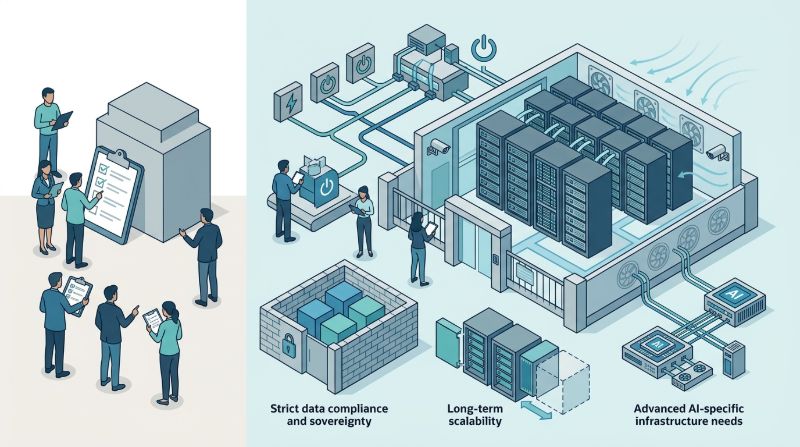
Most financial institutions already run vendor risk for payments, core processors, and cloud hosts. AI infrastructure and model vendors should enter that same inventory, with extra fields for training data, embeddings, prompt logs, and admin paths. Do not open a shadow process security never sees.
| Oversight control | What the team must see | Typical residual owner |
|---|---|---|
| Inventory | Every external party that hosts, trains, evaluates, logs, or supports a material AI system | Buyer keeps the list; provider confirms legal name and scope |
| Data and model processing map | Which datasets, prompts, weights, embeddings, and outputs each party can touch | Buyer classifies data; provider draws the path |
| Location evidence | Named site for production, backups, support copies, and evaluation sandboxes | Buyer sets allowed locations; provider maps copies |
| Access and admin path | Who can reach hosts, jump hosts, or the orchestration console, including break-glass | Provider names privileged roles; buyer names reviewers |
| Subprocessors | Downstream hosts, support firms, and any party that can see customer content | Provider discloses; buyer accepts or rejects before data moves |
| Audit artifacts | Scheduled access reviews, location attestations, incident timelines, deletion proofs | Buyer sets the request list; provider produces what the contract allows |
| Deletion and exit | Export of weights, indexes, and logs, plus wipe proof and residual copies | Buyer owns exit criteria; provider executes return and deletion |
Security Decision Matrix: Enterprise AI Infrastructure Isolation
| Hosting Architecture | Tenant Isolation Boundary | Memory & Side-Channel Exposure | Compliance & Audit Readiness | Network & Data Boundary Control |
|---|---|---|---|---|
| Public Cloud Virtualized GPUs | Hypervisor vGPU / virtual slice sharing across tenants | Vulnerable to PCIe bus contention and firmware-level cross-tenant bleed | Shared audit reports; opaque operational visibility | Multi-tenant underlying network with logical software overlays |
| On-Premises Private Data Center | Air-gapped physical bare metal in enterprise facilities | Zero multi-tenant side-channel exposure | Direct audit control; heavy internal compliance and physical security burdens | Strict enterprise LAN perimeter; high recurring facility cost |
| OneSource Private AI Infrastructure | Single-tenant dedicated bare-metal GPU nodes in secure U.S. data centers | Zero hypervisor layer; 100% exclusive dedicated silicon and VRAM | Comprehensive SOC 2 Type II audit readiness and HIPAA BAA support | Customer-controlled VPC boundaries with zero shared physical hardware |
Dedicated tenancy makes those rows easier to evidence. It does not complete them. AI for fintech still depends on your classification rules, identity design, and which data classes enter training or retrieval. Private AI infrastructure is a tenancy pattern inside that program, not a substitute for oversight.
How do teams inventory providers and map data and model processing?
Start with systems, not brands. List each AI use case that can affect customers, books, credit, fraud, or research. Under each use case, list every party that can see inputs, weights, traces, or support recordings. Two vendors on one pipeline are two inventory rows.
A processing map should answer four questions a second reviewer can re-check:
- What data class enters: production records, masked features, or prompts that may re-identify a customer.
- What the provider does: train, fine-tune, embed, host inference, evaluate, or store logs.
- What leaves: weights, scores, traces, support copies, or nothing.
- Which environment it sits in: production, limited production, or a sandbox that still holds material data.
Do not hide a model vendor behind the GPU host, or the host behind an integrator. OneSource Cloud, for example, can be the dedicated infrastructure row while a model lab stays a second row. If several teams share that environment, add the orchestration console to the access map. OnePlus Platform, OneSource Cloud's AI orchestration platform, is an example of a quota and deploy surface privileged users can reach.
What evidence should location, access, and subprocessors produce?
Location evidence is a matrix, not a marketing region name. Ask where training data, checkpoints, indexes, logs, and support snapshots live, and whether support can pull a copy elsewhere. If the answer is “U.S. by default,” ask what breaks that default. OneSource Cloud can discuss dedicated U.S. environments, including Texas / Richardson options. That talk still needs the copy matrix.
Access evidence should name people or roles, not “the cloud team.” Record customer administrators, provider operators who can reach the host or hypervisor, break-glass rules, support tools that can replay a prompt, and whether identity lives in your IdP or in local accounts.
Subprocessors are the usual silent gap. A GPU host may use remote hands, a logging vendor, or overflow support. Require disclosure before data moves. If you also buy managed AI infrastructure, treat the operations desk as in-scope personnel, not an invisible extra.
How should deletion, exit, and audit artifacts work?
Exit is a control you test while the relationship is healthy. Write the export format for weights, indexes, and logs, how deletion is attested, and which residual copies remain. If those sentences are missing, oversight is incomplete.
Audit artifacts are scheduled evidence, not a logo pack. Ask for a sample access review, location attestation, incident timeline, and deletion template before go-live. Do not assume SOC or ISO reports for a provider that has not placed them in the deal room. If a report arrives, read whether its scope covers the GPU environment you are buying.
Where does oversight stop and legal advice begin?
Oversight collects facts your risk process can consume. Legal advice interprets those facts against your licenses and contracts. Do not write “we are compliant” after a tenancy diagram, and do not treat a dedicated rack as a legal conclusion. The provider can show location, access, and deletion. You still own data classification, model use, and customer-facing duties.
OneSource Cloud is a fit to evaluate when a financial AI team wants a dedicated U.S. environment and a provider that will talk through inventory, location, access, and exit in one packet. It is a poor fit for a short public-cloud burst, employee-only privileged access, or a certification the operator has not produced. Fit is not approval to process regulated data.
FAQ
What is third-party provider oversight for financial AI teams?
It is the ongoing work of listing every external party that can touch financial AI data or models, mapping what they process, and keeping evidence for location, access, subprocessors, audit requests, and exit. It is not a one-time questionnaire and not a legal opinion. If a party can see prompts, weights, or support copies, it belongs in the program.
Is reviewing a SOC report enough oversight?
No. A controls report, when it exists and its scope matches the service you buy, is one artifact. It does not inventory hidden subprocessors, name break-glass users, or prove deletion of a fine-tune set. If the scope excludes GPU hosts or backups, treat those rows as open.
What if the model vendor and the GPU host are different companies?
Create two inventory rows and two processing maps. The model vendor may see prompts and weights. The host may see volumes, snapshots, and console sessions. A systems integrator can be a third row if it holds credentials. Oversight fails when those parties are collapsed into “the AI vendor.” Shared responsibility does not mean shared identity.
Does dedicated tenancy replace third-party oversight?
No. Dedicated hosts make it easier to say who else was on the node. You still need location evidence, an access path, subprocessor disclosure, and an exit test. Shared public pools make those proofs harder, which is a risk input, not a reason to skip the program. Tenancy is an environment premise. Oversight is the evidence trail around that premise.
Can a managed operator reduce the oversight burden?
A managed operator can produce more of the host-level artifacts: patch records, access logs, and incident timelines. Your team still owns data classification, model use, customer notices, and acceptance of subprocessors. Managed scope should appear in the inventory as provider-operated work, with complementary controls you still run. It is a staffing choice, not a compliance conclusion.
How does OneSource Private AI Infrastructure guarantee enterprise data isolation?
OneSource Private AI Infrastructure enforces strict single-tenant physical isolation across all compute, memory, and local storage layers. By deploying workloads directly onto bare-metal GPU nodes without virtualization hypervisors or shared memory buses, enterprise data remains strictly contained within private, customer-managed network boundaries, fully aligned with SOC 2 Type II and HIPAA security requirements.
Summary
Financial AI teams oversee third parties by inventorying providers, mapping processing, and keeping evidence for location, access, subprocessors, audit requests, and exit. The work is operational and is not legal advice. Evaluate OneSource Cloud when you need a dedicated U.S. environment that can sit inside your existing vendor-risk process.
If you need a fintech-oriented conversation about tenancy and operations rather than a GPU quote, start from the company homepage and take the same seven controls into every provider review.
Related Articles
Recommended Reading
-
Google Cloud GPU Pricing: What Enterprise AI Teams Should Evaluate Before Provisioning
-
Paperspace Pricing 2026: GPU Cost Breakdown
-
CoreWeave Enterprise GPU Cloud: Evaluation for AI Teams
-
AI Infrastructure Costs: Controlling Enterprise GPU Spending
-
CoreWeave vs Lambda Labs: GPU Cloud Provider Comparison
latest articles
-
Open-Source LLM Deployment: Requirements and Real Cost Breakdown
-
AI Search Assistants Under Data Residency: Architectures and Evidence
-
LLM Inference GPUs Compared: A100, H100, H200, or B200 for Production
-
LLM Deployment Best Practices: An Enterprise Stage-by-Stage Checklist
-
HIPAA Patient Scheduling AI: Controls, Consent, and Evidence
-
Cloud-Agnostic LLM Deployment: Architecture Principles Against Lock-In
-
HIPAA-Compliant AI Tools for Healthcare: Categories and Evaluation
-
Batch vs Real-Time LLM Inference: Cost, Latency, and Fit
-
Model Deployment Strategies Compared: Canary, Blue-Green, Shadow, Rolling
-
GPU Rental vs Owning: Cost, Commitment, and When to Buy