
How to Evaluate Secure AI Infrastructure Providers
Evaluating secure AI infrastructure providers means verifying five dimensions — isolation, encryption, access controls, audit evidence, and AI-specific security — with evidence rather than marketing claims, because a provider's security failure becomes your security incident. For the full audit methodology, see auditing an AI infrastructure provider. For the security architecture principles, see building secure AI infrastructure for LLMs.
The Five Evaluation Dimensions
Isolation: is the infrastructure dedicated single-tenant, or shared with logical isolation? For regulated workloads, architectural isolation is often required. Demand evidence of how isolation is implemented and tested — GPU memory clearing, storage segregation, network segmentation. For the isolation mechanism, see how solo capacity stops data leakage. Encryption: are all surfaces encrypted — storage, transit, GPU memory — and are keys governed within the required residency boundary? Access controls: who can reach your data, including the provider's own staff? Demand the access scope, the controls bounding it, and the logging recording it. Audit evidence: can the provider produce logs of every access and data movement, including AI-specific events (checkpoint saves, inference logs, model exports)? AI-specific security: are the AI surfaces — model weights, checkpoints, prompts, inference logs, GPU memory — governed with the same rigor as traditional data surfaces? For the residency requirements, see data residency compliance checklist.
The Evaluation Process
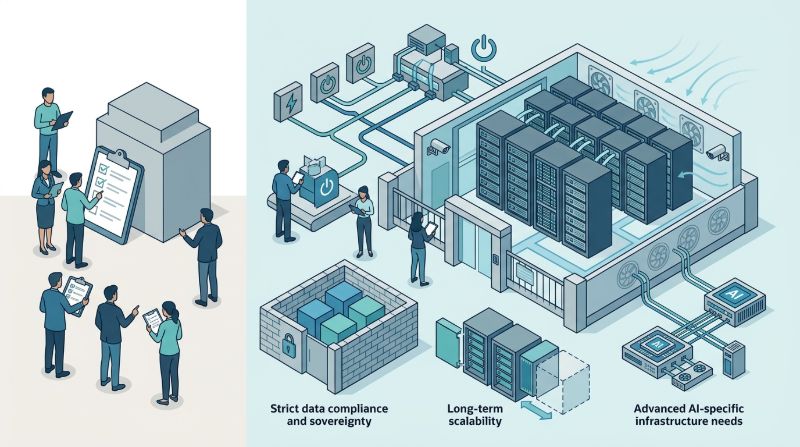
Filter first: eliminate providers that cannot produce evidence for the five dimensions. Then compare the survivors on performance, cost, and the quality of their evidence. The filter-then-compare order matters because comparing on performance before filtering for security wastes effort on providers who cannot lawfully host your workload. For the healthcare-specific selection, see choose GPU provider for healthcare AI.
FAQ
How do I evaluate an AI provider's security posture?
Verify five dimensions with evidence: isolation, encryption, access controls, audit evidence, and AI-specific security. Filter out providers who cannot produce evidence, then compare survivors. For the full methodology, see auditing an AI infrastructure provider.
What security red flags should stop an AI provider evaluation?
Inability to explain the isolation model concretely, unbounded provider staff access to customer data, logging that does not cover AI-specific events, vague incident notification commitments, and attestation scope that excludes your services or regions. Any of these should disqualify. See the five dimensions above.
Summary
Evaluate secure AI providers on isolation, encryption, access, audit, and AI-specific security — with evidence, not claims. Filter first, compare survivors. For the full audit framework, see auditing AI infrastructure providers.
Related Articles
Recommended Reading
-
Google Cloud GPU Pricing: What Enterprise AI Teams Should Evaluate Before Provisioning
-
Paperspace Pricing 2026: GPU Cost Breakdown
-
CoreWeave Enterprise GPU Cloud: Evaluation for AI Teams
-
AI Infrastructure Costs: Controlling Enterprise GPU Spending
-
CoreWeave vs Lambda Labs: GPU Cloud Provider Comparison
latest articles
-
Open-Source LLM Deployment: Requirements and Real Cost Breakdown
-
AI Search Assistants Under Data Residency: Architectures and Evidence
-
LLM Inference GPUs Compared: A100, H100, H200, or B200 for Production
-
LLM Deployment Best Practices: An Enterprise Stage-by-Stage Checklist
-
HIPAA Patient Scheduling AI: Controls, Consent, and Evidence
-
Cloud-Agnostic LLM Deployment: Architecture Principles Against Lock-In
-
HIPAA-Compliant AI Tools for Healthcare: Categories and Evaluation
-
Batch vs Real-Time LLM Inference: Cost, Latency, and Fit
-
Model Deployment Strategies Compared: Canary, Blue-Green, Shadow, Rolling
-
GPU Rental vs Owning: Cost, Commitment, and When to Buy