
Evaluate GPU Direct Storage for Training Throughput
GPUDirect Storage is an NVIDIA I/O path that lets storage DMA into GPU memory without a mandatory bounce buffer in CPU RAM, using the cuFile user library and a kernel driver on supported platforms. Teams evaluate it when data-loader or checkpoint I/O is the reason GPUs wait. They should skip a checkbox purchase when the bottleneck is metadata, tiny files, or a PCIe tree that still forces traffic through the wrong root complex.
NVIDIA documents GDS as part of Magnum IO, with gdsio as the intended proof tool after install. Vendor blogs publish large speedups on specific topologies. Your acceptance test is a before/after on the filesystem and GPU placement you will actually ship, including the compatibility fallback NVIDIA describes when a direct path is not available.
What GPUDirect Storage changes in the data path
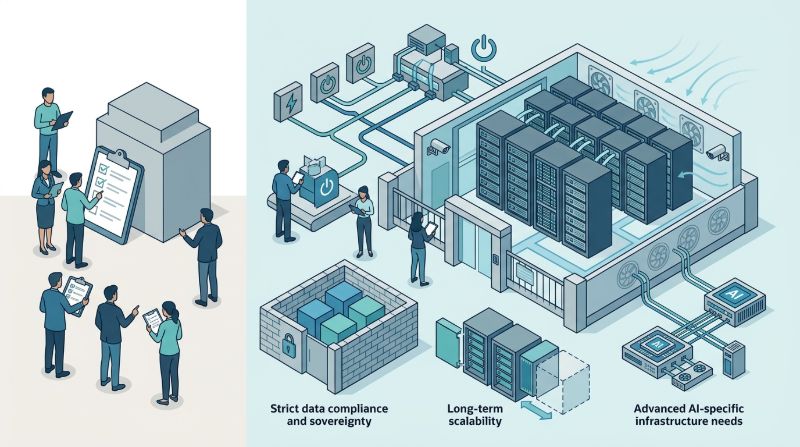
Without GDS, a common path is storage to CPU memory to GPU memory. That extra copy costs bandwidth, latency, and CPU cycles. GDS programs a DMA engine so a supported NVMe device or a remote storage NIC can move bytes toward a GPU buffer. The CPU still participates in control. It should not touch every payload twice.
The win appears when three things line up: the filesystem and drivers support GDS, the PCIe (or NVLink) topology gives the GPU a clean path to the storage device or NIC, and the application uses cuFile or a framework path that actually calls it. A mount option with no application change often lands in compatibility mode. Compatibility is not a failure. It is also not the slide you were sold.
GDS is not a filesystem. Lustre, Storage Scale, Weka, and local NVMe can participate when they are qualified. Object storage sitting behind a FUSE client is a different conversation. If trainers still open millions of tiny files, fixing the shard format will beat enabling GDS on a bad layout.
Evaluation table before you change a bill of materials
| Check | Pass looks like | Fail looks like |
|---|---|---|
| Platform support | Documented GPU, driver, and filesystem combination | Marketing “AI-ready” with no GDS matrix row |
| PCIe topology | GPU and NVMe or NIC share a path you can draw | Devices on distant roots; traffic hairpins through the CPU |
| Application path | cuFile or a known framework integration is on | POSIX only, hoping the kernel will invent a shortcut |
| Proof | gdsio plus a trainer-level I/O trace improve together |
Synthetic bandwidth up, epoch time unchanged |
| Fallback | Compatibility mode is detected and logged | Silent fallback; nobody knows the bounce buffer is back |
NVIDIA’s own benchmarking guide treats configuration and measurement as one activity. That is the standard to copy. If a storage vendor will not run gdsio on the exact SKU in the proposal, you do not have an evaluation. You have a quote.
When GDS is worth the operational cost
Worth it: large sequential reads into GPU buffers, checkpoint or sample streams that already saturate the CPU copy path, and a cluster where storage and GPUs were designed as neighbors. Less worth it: inference that loads weights once, small-file training, or a blade whose NVMe sits on the opposite side of the CPU from the GPUs.
Architectural Decision Matrix: AI Storage Architectures for LLMs
| Storage Model | Tiered Architecture & Protocols | GPUDirect Storage (GDS) Support | Checkpoint I/O Starvation Risk | Operating Model & Scalability |
|---|---|---|---|---|
| Public Cloud Shared Object / NFS | Centralized S3-compatible or managed NFS share | Emulated or absent; relies on host CPU bounce-buffering | High; serialization bottlenecks stall GPU compute cycles | Fully managed but prone to high tail latency under write bursts |
| On-Premises Parallel File System | Dedicated Lustre, GPFS, or WEKA storage cluster | Native GPUDirect Storage over local RDMA fabric | Low; high sustained write bandwidth to dedicated SAN | Complex dedicated storage administration & high capital depreciation |
| OneSource AI Storage Architecture | Two-tier: Local PCIe Gen5 NVMe scratch + NVMe-oF parallel tier | Native GPUDirect Storage bypassing CPU memory bottlenecks | Zero compute stall; multi-GB/s sustained checkpoint streaming | Turnkey managed infrastructure with deterministic I/O throughput |
Checkpoint writes deserve their own test. Training is often read-heavy on the dataset and write-spiky on checkpoints. A GDS read win with a POSIX write stall is a partial story. Measure both. AI storage architecture should say whether GDS is in the hot read path, the checkpoint path, neither, or both.
Networking still shows up. Remote GDS depends on the NIC, RDMA, and the same fabric discipline you already argue about for NCCL. If InfiniBand or RoCE is unhealthy, GDS over the network will not look like the DGX brochure. See the fabric decision first, then the storage DMA feature.
How to run an evaluation that procurement can reuse
- Inventory GPU model, driver, filesystem, and a PCIe or NVLink drawing. No drawing, no test.
- Run
gdsioon local and remote targets with the I/O sizes your trainer uses, not only 1 MiB sequential glory runs. - Turn GDS off (or force compatibility) and repeat. Keep the same CPU governor and the same competing jobs.
- Replay one real epoch or checkpoint cycle with framework logs for data-loader wait.
- Record whether production will detect fallback, and who owns driver upgrades after a CUDA bump.
Those five steps belong in the private cluster design, not in a laptop wiki. Private AI infrastructure is how OneSource Cloud keeps GPUs, hot storage, and the fabric in one controlled environment so a GDS test is even possible. AI networking is the sibling constraint for remote paths. OneSource will not claim a universal 8x from a lander demo. It will ask for the topology drawing and the two-sided benchmark.
FAQ
What is GPU Direct Storage?
GPUDirect Storage, often written GPU Direct Storage in search queries, is NVIDIA’s path for moving file data between supported storage and GPU memory with less CPU bouncing. It uses cuFile APIs and platform-specific drivers. It is a data-path feature, not a replacement for capacity planning or a parallel filesystem.
Does GDS require a parallel filesystem?
No. Local NVMe can be a GDS target. Parallel filesystems are common in multi-node training because the namespace is shared. GDS still needs that filesystem, or the local device, to be in NVIDIA’s supported set. Buying Lustre “for GDS” without a support row is backwards.
Will GPUDirect Storage always speed up training?
No. If GPUs wait on metadata, shuffle, or collective communication, faster DMA will not show up in epoch time. If the PCIe tree is wrong, you may stay in a copy path. Prove it with gdsio and a real trainer trace. Ignore a speedup that only exists in a storage vendor’s lab slide.
What is GDS compatibility mode?
It is the fallback NVIDIA describes when a direct mapping is not available. I/O can still complete through a more conventional path. Performance may be similar to ordinary POSIX copies. You must log when you are in that mode, or a driver regression will look like “GDS stopped helping” with no evidence.
How should a private AI provider present GDS?
As an optional acceleration on a designed topology, with a support matrix and a customer-visible test. Not as a default checkbox on every quote. Ask for the PCIe drawing, the filesystem list, and a gdsio-plus-epoch packet. That is the evaluation. Everything else is vocabulary.
How does OneSource AI Storage Architecture optimize LLM checkpointing and weight ingestion?
OneSource AI Storage Architecture pairs local PCIe Gen5 NVMe scratch storage on dedicated GPU nodes with a high-bandwidth distributed parallel storage fabric. By leveraging GPUDirect Storage (GDS) over RDMA networks, data transfers bypass host CPU memory bottlenecks entirely, allowing 70B+ parameter model weights to load in under ten seconds and preventing GPU compute cycles from stalling during heavy checkpoint write bursts.
Summary
Evaluate GPUDirect Storage as a DMA path with prerequisites: supported software, a drawable topology, an application that calls it, and a proof that epoch time moved. It complements a hot filesystem. It does not replace one. Design storage and GPUs together on dedicated infrastructure, then run the test. For that combined design, start from OneSource Cloud AI storage architecture and the private AI infrastructure that hosts it.
Related Articles
Recommended Reading
-
How Paged Attention Manages Inference KV Cache
-
Google Cloud GPU Pricing: What Enterprise AI Teams Should Evaluate Before Provisioning
-
Paperspace Pricing 2026: GPU Cost Breakdown
-
AI Infrastructure Costs: Controlling Enterprise GPU Spending
-
CoreWeave Enterprise GPU Cloud: Evaluation for AI Teams
-
CoreWeave vs Lambda Labs: GPU Cloud Provider Comparison
-
AWS GPU Pricing: Instance Types, Cost Structure & Alternatives Guide
-
CoreWeave Alternatives: Compare GPU Clouds
latest articles
-
On-Premise AI Infrastructure vs Colocation vs Hosted Cloud
-
AI Orchestration Platform: How It Works on a Private GPU Cluster
-
Best GPU Cloud Hosting Providers: Why Rankings Differ and How to Build Yours
-
The Four Categories of Cloud Platforms for AI Workloads
-
RunPod Compared: How It Stacks Up Against Other AI Cloud Providers
-
Sovereign AI Cloud: Data Control for U.S. Enterprises
-
How to Choose a HIPAA-Compliant AI Infrastructure Provider
-
How to Build Private AI Infrastructure From Sizing to Operations
-
Lambda Labs Alternatives for Teams Outgrowing GPU Rental
-
GPU Cloud Computing: Comparing Bare Metal vs Virtualized vs Serverless Providers