
Why Agentic AI Needs Private Infrastructure
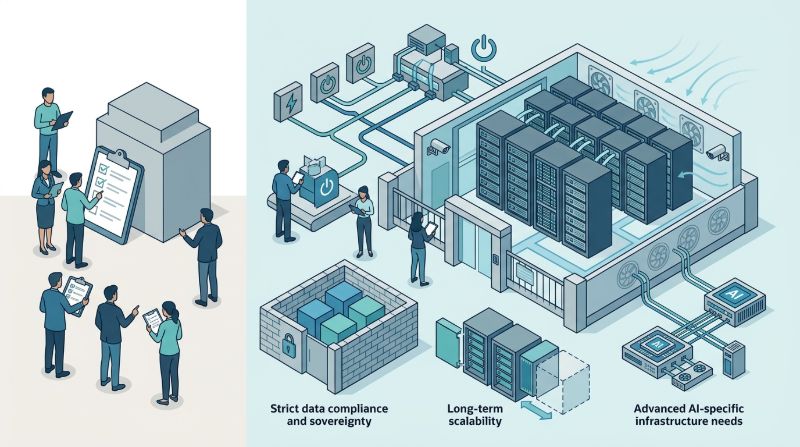
Agentic AI needs private infrastructure when autonomous workflows must access enterprise data, call tools, execute tasks, maintain context, and operate under security or compliance controls. Unlike simple chatbots, AI agents interact with systems, documents, APIs, user permissions, and business processes. OneSource Cloud helps enterprises run agentic AI on private, dedicated, and managed AI infrastructure with controlled GPU environments, U.S.-based data residency options, workload orchestration, secure storage paths, and operational lifecycle support.
What Is Agentic AI?
Agentic AI refers to AI systems that can plan, reason across steps, use tools, retrieve information, call APIs, and take actions toward a goal. Instead of only generating a response to a prompt, an AI agent may decide which system to query, which document to retrieve, which workflow to trigger, and what action to take next.
For enterprises, agentic AI may support:
| Use Case | Infrastructure Requirement |
|---|---|
| Customer support agents | Secure access to CRM, ticketing, policies, and knowledge bases |
| Clinical workflow assistants | Controlled access to sensitive healthcare data and audit logs |
| Financial research agents | Data residency, access governance, and model risk controls |
| Internal engineering agents | Secure access to code, repositories, logs, and deployment tools |
| Operations copilots | Integration with monitoring, incidents, and business systems |
| Research assistants | Shared GPU access, RAG pipelines, and controlled datasets |
Agentic AI increases the importance of infrastructure because the system is no longer only producing text. It may be interacting with operational systems.
Why Agentic AI Has Different Infrastructure Needs
A traditional LLM chatbot may use a hosted API and a limited set of documents. Agentic AI often requires persistent workflows, tool calls, memory, retrieval, permissions, monitoring, and rollback paths.
That creates new infrastructure requirements:
- Secure access to internal data and tools
- Dedicated GPU or inference capacity for predictable performance
- Private LLM deployment for sensitive workflows
- RAG storage for documents, embeddings, and metadata
- Workload orchestration across agents, models, and environments
- Monitoring of agent actions, latency, errors, and cost
- Audit logs for regulated or high-risk decisions
- Data residency planning for enterprise and regulated workloads
The more an AI agent can do, the more the enterprise must govern where it runs, what it can access, and how its activity is monitored.
Why Public APIs May Not Be Enough for Enterprise AI Agents
Public APIs and cloud AI services are useful for prototyping, experimentation, and many low-risk workflows. AWS, Azure, Google Cloud, CoreWeave, Lambda Labs, Together AI, Modal, Replicate, and other providers may fit different AI agent workloads depending on data sensitivity, model requirements, and operational maturity.
However, enterprises often evaluate private infrastructure when agentic AI becomes connected to sensitive data, internal systems, or production workflows.
| Requirement | Public or Shared Model Consideration | Private Infrastructure Advantage |
|---|---|---|
| Sensitive data access | Requires careful vendor, contract, and configuration review | Keeps data paths inside a controlled environment |
| Tool execution | External calls may create governance complexity | Access can be segmented and monitored internally |
| Cost predictability | Usage may rise as agents run multi-step tasks | Dedicated capacity can support more predictable planning |
| Compliance posture | Shared responsibility must be reviewed closely | Dedicated environments can support stronger controls |
| Latency | Multi-step workflows can amplify delays | Infrastructure can be tuned for agent workloads |
| Operational ownership | Provider abstraction may limit visibility | Teams can monitor workloads, usage, and failures more directly |
The decision is not that every agent needs private infrastructure. The decision depends on risk, volume, data sensitivity, and business impact.
Core Infrastructure Components for Agentic AI
Private AI Infrastructure for Control and Data Residency
Agentic AI often works with proprietary documents, customer records, clinical data, financial information, or internal operational systems. Private AI infrastructure gives enterprises more control over where models run, where data resides, and how workloads are isolated.
OneSource Cloud’s Private AI Infrastructure supports dedicated GPU clusters, private AI cloud environments, private LLM deployment, U.S.-based infrastructure options, and controlled environments for sensitive enterprise AI workloads.
Private infrastructure is especially relevant when:
- Agents access regulated or proprietary data
- Data residency requirements apply
- Inference volume becomes persistent
- Public cloud GPU quota is unpredictable
- Teams need dedicated capacity
- Security teams require stronger workload isolation
Managed AI Infrastructure for Operational Reliability
Agentic AI workflows can run continuously, call multiple systems, and create operational dependencies. That means infrastructure must be monitored, patched, validated, and optimized over time.
OneSource Cloud’s Managed AI Infrastructure supports monitoring, optimization, lifecycle management, capacity planning, and performance validation. This can reduce operational burden when internal DevOps or MLOps teams are already stretched.
Managed operations matter because agentic AI introduces failure modes beyond model quality: tool failures, queue delays, permission errors, storage bottlenecks, network latency, and capacity saturation.
OnePlus Platform for AI Orchestration
OnePlus Platform is OneSource Cloud’s AI orchestration platform for private GPU environments. It is not related to the smartphone brand. In agentic AI environments, the platform layer helps teams manage workloads, GPU quotas, developer workspaces, usage metrics, and model deployment workflows.
Agentic AI benefits from orchestration because multiple teams may need to deploy, test, monitor, and scale agents across shared infrastructure.
Useful orchestration capabilities include:
- GPU quota visibility
- Workload scheduling
- Developer workspaces
- Model deployment workflows
- Usage metrics by team or project
- Multi-tenant GPU cluster management
- Separation of experimentation and production workloads
AI Storage Architecture for RAG, Memory, and Auditability
Agentic AI often depends on retrieval-augmented generation, document stores, embeddings, vector indexes, prompt logs, workflow memory, and action records. Storage architecture determines whether agents can retrieve the right context securely and consistently.
OneSource Cloud’s AI Storage Architecture services help enterprises design storage paths for RAG, unstructured data, model artifacts, embeddings, vector indexes, and secure access controls.
Storage planning should include:
| Storage Layer | Agentic AI Risk |
|---|---|
| Source documents | Sensitive content may be exposed without proper permissions |
| Embeddings | Data reuse can become difficult to audit |
| Vector indexes | Stale or unauthorized content may remain searchable |
| Prompt and action logs | Logs may contain sensitive user or business data |
| Agent memory | Persistent context needs retention and access policies |
| Model artifacts | Fine-tuned or proprietary models require controlled access |
AI Networking for Low-Latency Agent Workflows
Agentic AI often performs multi-step workflows. Each step may involve model inference, retrieval, tool calls, storage access, and application integration. Small delays can compound.
OneSource Cloud’s AI Networking Services help teams evaluate low-latency, high-throughput networking for inference serving, distributed workloads, storage-to-compute data movement, and AI data center environments.
Cost Drivers for Agentic AI Infrastructure
Agentic AI can be more expensive than basic LLM inference because agents often perform multiple model calls and tool operations per user request.
Key cost drivers include:
| Cost Driver | Why It Matters |
|---|---|
| Number of model calls | Agents may call models multiple times per task |
| Context length | Planning, retrieval, and memory increase token usage |
| Tool calls | External system calls add latency, monitoring, and integration cost |
| RAG pipelines | Documents, embeddings, indexes, and retrieval add storage cost |
| GPU utilization | Poor scheduling leaves expensive capacity idle |
| Monitoring and logs | Agent behavior must be traceable in enterprise workflows |
| Security controls | Access control, audit logs, and segmentation require planning |
| Operations | Continuous workflows need lifecycle support and incident response |
Private infrastructure may improve predictability when agent workloads become persistent, sensitive, and high-volume. Public APIs may remain useful for early-stage or variable workloads.
Compliance, Security, and Governance for AI Agents
Agentic AI raises governance stakes because agents may retrieve data, trigger actions, and interact with enterprise systems. For healthcare, financial services, research, SaaS, and government-adjacent organizations, infrastructure must support clear access boundaries and auditability.
Teams should evaluate:
- Which systems the agent can access
- Whether tool calls are logged
- How permissions are enforced
- Where prompts, outputs, embeddings, and logs are stored
- Whether data residency requirements apply
- How agent actions are reviewed or approved
- How sensitive workloads are isolated
- How incident response works if an agent behaves unexpectedly
For healthcare AI workloads, infrastructure should support a HIPAA-ready posture with secure data paths, access controls, auditability, and operational governance. Infrastructure can support HIPAA compliance, but compliance depends on the customer’s broader legal, administrative, and security program.
Public Cloud vs Private Infrastructure for Agentic AI
Different infrastructure models fit different stages of agentic AI adoption.
| Infrastructure Model | Best Fit | Key Tradeoff |
|---|---|---|
| Public LLM APIs | Fast prototyping and low-risk workflows | Usage, data handling, and tool access need review |
| Public cloud GPUs | Flexible AI development and cloud-native teams | Cost, quota, and governance can become complex |
| GPU cloud providers | AI-focused compute access | Operational ownership and data control vary |
| Self-managed infrastructure | Mature teams needing direct control | Internal team owns complexity |
| Private managed AI infrastructure | Sensitive, persistent, production agent workloads | Requires architecture planning but improves control and predictability |
OneSource Cloud is most relevant when enterprises need private, dedicated, managed, and U.S.-based AI infrastructure for production agentic AI.
How to Plan Private Infrastructure for Agentic AI
1. Classify Agent Workflows
Separate low-risk assistants, internal copilots, regulated workflows, customer-facing agents, and production automation. Each class needs different controls.
2. Map Data and Tool Access
Identify which documents, databases, APIs, applications, and user permissions the agent needs. Tool access should be designed before production deployment.
3. Define Infrastructure Requirements
Estimate model size, inference volume, latency targets, GPU capacity, storage needs, networking requirements, and failover expectations.
4. Design RAG and Memory Storage
Plan source documents, embeddings, vector indexes, logs, agent memory, retention policies, and deletion workflows.
5. Add Orchestration and Monitoring
Track GPU usage, workload status, agent errors, tool failures, latency, queue depth, and usage by team or workflow.
6. Review Security and Compliance
Involve security, compliance, legal, and business owners before agents access sensitive systems or regulated data.
7. Decide Managed vs Self-Managed Operations
If internal teams lack AI infrastructure operations capacity, managed AI infrastructure can reduce burden across monitoring, optimization, lifecycle management, and performance validation.
Common Mistakes in Agentic AI Infrastructure Planning
One common mistake is treating agentic AI like a chatbot. Agents need stronger controls because they can retrieve data, call tools, and perform multi-step tasks.
Another mistake is underestimating cost. Multi-step agent workflows can multiply model calls, token usage, retrieval operations, and logs.
A third mistake is delaying governance until after deployment. Access control, auditability, and data residency should be designed before agents touch sensitive systems.
A fourth mistake is ignoring infrastructure visibility. Without monitoring, teams cannot tell whether cost, latency, errors, or failed tool calls are limiting agent performance.
How to Evaluate an Agentic AI Infrastructure Provider
Enterprise buyers should evaluate whether a provider can support both AI performance and governance.
| Evaluation Question | Why It Matters |
|---|---|
| Can the provider support private LLM deployment? | Important for sensitive agent workflows |
| Are dedicated GPU environments available? | Helps improve control and capacity predictability |
| Can workloads be orchestrated across teams? | Supports multi-agent and multi-team operations |
| Can RAG storage be designed securely? | Protects documents, embeddings, indexes, and logs |
| Is managed operations available? | Reduces DevOps and MLOps burden |
| Can networking support low-latency workflows? | Agent workflows often involve multiple system calls |
| Are U.S.-based data residency options available? | Relevant for regulated or sensitive data |
| Can usage and actions be monitored? | Supports governance, cost control, and audit review |
For enterprises moving from agent prototypes to production workflows, an Architecture Review or AI Cluster Survey can help identify infrastructure, security, and cost requirements before deployment scales.
5. FAQ
What is agentic AI?
Agentic AI refers to AI systems that can plan, use tools, retrieve information, call APIs, and take multi-step actions toward a goal. It goes beyond simple text generation by interacting with systems and workflows.
Why does agentic AI need private infrastructure?
Agentic AI may need private infrastructure when agents access sensitive data, use internal tools, run persistent workflows, require predictable performance, or must meet data residency and governance requirements.
Can agentic AI run on public cloud or APIs?
Yes, public cloud and APIs can be useful for prototypes, low-risk workflows, and variable usage. Private infrastructure becomes more relevant when workloads are production-critical, sensitive, persistent, or compliance-sensitive.
What infrastructure is required for enterprise AI agents?
Enterprise AI agents may require GPU compute, private LLM deployment, RAG storage, vector indexes, orchestration, monitoring, secure networking, access control, audit logging, and managed operations.
How does agentic AI affect infrastructure cost?
Agentic AI can increase cost because agents often perform multiple model calls, retrieve documents, use tools, maintain memory, and generate logs. Cost planning should include tokens, GPU utilization, storage, networking, monitoring, and operations.
What role does an AI orchestration platform play in agentic AI?
An AI orchestration platform helps manage workloads, GPU quotas, developer environments, usage visibility, and model deployment workflows across private AI infrastructure. This is important when multiple teams build or operate AI agents.
How can enterprises secure agentic AI workflows?
Enterprises should define tool permissions, isolate sensitive workloads, log actions, govern data access, monitor agent behavior, review data residency requirements, and involve security and compliance teams before production deployment.
When should a company request an agentic AI infrastructure review?
A review is useful when agent prototypes are moving into production, agents need access to sensitive systems, inference costs are rising, latency is inconsistent, or compliance teams need clearer infrastructure controls.
6. Conclusion
Agentic AI changes the infrastructure conversation. Once AI systems retrieve enterprise data, call tools, maintain memory, and act across workflows, organizations need more than a model endpoint. They need controlled infrastructure, secure storage, orchestration, monitoring, networking, and lifecycle operations.
OneSource Cloud helps enterprises evaluate and deploy private, dedicated, and managed AI infrastructure for agentic AI workloads, including Private AI Infrastructure, Managed AI Infrastructure, OnePlus Platform, AI Storage Architecture, and AI Networking Services.
Related Articles
Recommended Reading
-
Google Cloud GPU Pricing: What Enterprise AI Teams Should Evaluate Before Provisioning
-
Paperspace Pricing 2026: GPU Cost Breakdown
-
CoreWeave Enterprise GPU Cloud: Evaluation for AI Teams
-
AI Infrastructure Costs: Controlling Enterprise GPU Spending
-
CoreWeave vs Lambda Labs: GPU Cloud Provider Comparison
latest articles
-
Open-Source LLM Deployment: Requirements and Real Cost Breakdown
-
AI Search Assistants Under Data Residency: Architectures and Evidence
-
LLM Inference GPUs Compared: A100, H100, H200, or B200 for Production
-
LLM Deployment Best Practices: An Enterprise Stage-by-Stage Checklist
-
HIPAA Patient Scheduling AI: Controls, Consent, and Evidence
-
Cloud-Agnostic LLM Deployment: Architecture Principles Against Lock-In
-
HIPAA-Compliant AI Tools for Healthcare: Categories and Evaluation
-
Batch vs Real-Time LLM Inference: Cost, Latency, and Fit
-
Model Deployment Strategies Compared: Canary, Blue-Green, Shadow, Rolling
-
GPU Rental vs Owning: Cost, Commitment, and When to Buy