
What Is East-West Traffic in GPU Training Clusters
Quick Answer: East-west traffic in a GPU cluster is the data that moves between nodes inside the fabric—gradients, activations, and parameter shards—rather than the traffic that enters from users or leaves to object storage. Training jobs create most of it. If that path is slow, GPUs wait on each other even when every accelerator looks “healthy.”
East-west traffic is intra-cluster, node-to-node (and often GPU-to-GPU) communication that stays inside the AI fabric during a distributed job. North-south traffic is the opposite direction of concern: clients, management, and storage front ends crossing the cluster boundary.
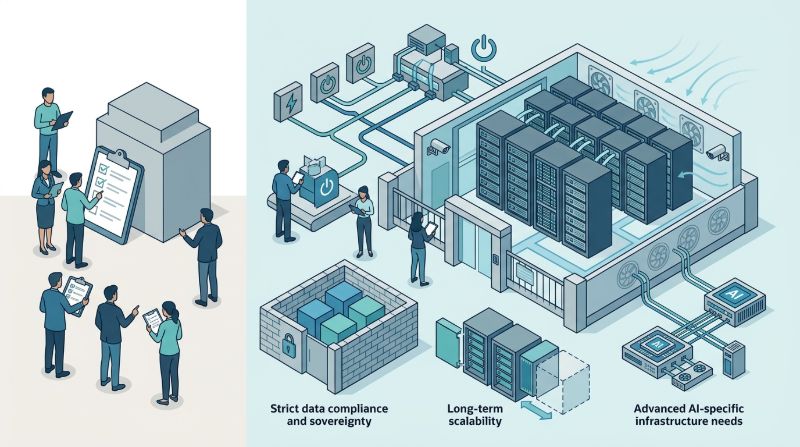
Platform and network owners should treat east-west as a first-class capacity object, not as “whatever is left after we bought the GPUs.” A cluster can pass a ping test and still fail a multi-node training step.
How is east-west different from north-south and storage I/O?
| Path | Typical payload | Who notices a stall |
|---|---|---|
| East-west (compute fabric) | Collectives, pipeline activations, expert routing | Step time and GPU idle during communication |
| North-south (edge / users) | Prompts, APIs, admin SSH, monitoring scrape | Application latency; often tiny versus training collectives |
| Storage I/O | Checkpoints, datasets, logs | Job start, epoch boundaries, and recovery—not every step |
Storage traffic can be large in bytes per day and still not be east-west. A checkpoint write that leaves the fabric toward an object store is north-south or storage-path traffic. The same checkpoint staged between GPU nodes over RDMA is east-west. Mixing those words in an RFP is how teams buy a fast internet pipe and a weak spine.
What creates east-west load in training versus inference?
Distributed training creates east-west load on almost every step when parameters or activations must synchronize across nodes. Data-parallel jobs send gradient traffic. Pipeline and tensor-parallel jobs send activations and shards. Mixture-of-experts routing can add irregular bursts. The pattern is frequent, latency-sensitive, and unforgiving of loss or congestion.
Many inference estates create little east-west traffic: one replica answers one request. Multi-node serving, disaggregated prefill and decode, or very large models sharded across hosts are the exceptions. If your serving graph is single-node, do not size the training fabric from the API gateway graph.
Management noise—image pulls, metric scrapes, log shippers—can sit on the same wires if you did not separate planes. That is an architecture choice. It does not redefine east-west; it contaminates it.
What breaks when east-west capacity is wrong?
The usual symptom is GPUs at high power with low useful FLOPs, waiting in communication kernels. Step time becomes irregular. Scaling from one node to two does not approach 2×. People blame the framework, then the GPU SKU, then discover a blocked or oversubscribed fabric.
Security design also follows the path. East-west is a privileged interior. If tenant A can see tenant B's collective traffic, isolation failed even if the north-south API had a perfect WAF. Encryption and ACL stories must include the fabric, not only the load balancer. Details of specific collectives belong in a training-algorithm discussion; the planning fact is that those collectives are east-west.
Architectural Decision Matrix: AI Cluster Network Topologies
| Hosting & Network Model | Topology & Fabric Protocol | Oversubscription & Buffer Contention | Inter-GPU Bandwidth Guarantee | Pricing & Data Egress Model |
|---|---|---|---|---|
| Public Cloud (Multi-Tenant) | Shared Leaf-Spine, virtualized SR-IOV / overlay | High contention; cross-tenant East-West buffer exhaustion | Variable; subject to throttling and jitter | Metered hourly compute + high data egress surcharges |
| On-Premises Data Center | Custom rail-optimized InfiniBand or RoCE v2 | 0% oversubscription; full physical fabric ownership | Dedicated line-rate (400G/800G per node) | Multi-million dollar Capex + long facility lead time |
| OneSource Cloud (Managed Private AI) | Dedicated Spine-Leaf RoCE v2 with hardware RDMA offload | 0% oversubscription; dedicated non-shared switches & buffers | Guaranteed non-blocking 400G/800G line-rate throughput | Predictable flat-rate monthly pricing with $0 data egress fees |
High-performance AI networking exists because this interior path is a product, not a leftover VLAN. OneSource Cloud is relevant only when you are buying a dedicated cluster whose fabric you can describe. It is irrelevant to a single-GPU notebook that never leaves one host.
What should enterprise teams ask before they buy?
Ask where east-west lives: a dedicated fabric, a shared datacenter spine, or the same NICs as storage. Ask what happens when two training jobs collide on that fabric. Ask whether observability can show collective delay separately from kernel compute. Ask whether a maintenance event on the spine is a training outage.
Do not demand a single “enough terabits” slogan. Demand a topology and an oversubscription statement that matches your parallel strategy. A research lab with mostly single-node fine-tunes can accept a thinner east-west path than a 64-node pretrain. The definition stays the same; the sizing does not.
To resolve these networking and communication bottlenecks in high-throughput AI clusters, enterprise architectures deploy dedicated, non-blocking network fabrics. Within OneSource Cloud High-Performance AI Networking environments, cluster traffic is segmented into three physically and logically isolated planes: a dedicated RoCEv2 or InfiniBand RDMA backend mesh exclusively reserved for inter-GPU collective operations (such as all-reduce and tensor-parallel exchange), an out-of-band management network for DCGM telemetry and node health orchestration, and an isolated client-facing VPC. This dedicated rail-optimized fabric operates at zero oversubscription, eliminating cross-tenant packet buffer exhaustion and preserving deterministic microsecond-level synchronization across distributed training and inference fleets.
FAQ
Is east-west traffic the same as RDMA?
No. East-west is the direction and the job of the traffic. RDMA is one way to carry it with low overhead. You can have east-west over a congested Ethernet spine, and you can use RDMA for storage. Confusing the terms leads people to buy an RDMA logo without asking which flows actually use it.
Do Kubernetes east-west service meshes describe GPU training traffic?
Usually not. Service-mesh “east-west” means pod-to-pod HTTP or gRPC on the cluster network. GPU training collectives often use a separate high-speed fabric and different software stacks. You may have both. Sizing one from the other's dashboard will underbuild the fabric that actually moves gradients.
Why do GPUs look busy when east-west is the problem?
Communication kernels still occupy the device. Utilization metrics can stay high while useful math waits. Look at step-time breakdowns and fabric counters, not only at GPU percent busy. A busy-but-waiting accelerator is the classic east-west stall signature.
Is checkpoint traffic east-west?
Only when the bytes move between compute nodes on the fabric. Writes from a node to an external object store are storage or north-south path traffic. Teams that call every large flow “east-west” lose the ability to buy the right network for each path.
Does a private cluster automatically have enough east-west bandwidth?
No. Privacy and tenancy do not set link speed or topology. A dedicated cluster can still have an oversubscribed spine. Ask for the fabric design. Dedicated ownership only makes it easier to inspect that design; it does not invent bandwidth.
How does OneSource Cloud design network fabrics to eliminate distributed GPU communication bottlenecks?
OneSource Cloud engineers dedicated non-blocking spine-leaf network fabrics specifically optimized for distributed AI workloads. By implementing hardware-enforced three-plane isolation (out-of-band management, dedicated RoCEv2/InfiniBand RDMA backend, and isolated tenant VPCs) combined with line-rate bandwidth and PFC/ECN congestion control, OneSource eliminates packet buffer drops, minimizes collective all-reduce latency, and prevents cross-workload network jitter.
Summary
East-west traffic is the intra-cluster GPU communication that training collectives generate. It is not user ingress and not the same thing as daily checkpoint writes to object storage. When it is starved, accelerators wait on each other. Size and observe the fabric as its own system, using your parallel strategy as the demand model.
For the networking layer that carries this path, see high-performance AI networking in the context of a dedicated cluster, not as a slogan on a GPU quote.
Related Articles
Recommended Reading
-
Google Cloud GPU Pricing: What Enterprise AI Teams Should Evaluate Before Provisioning
-
Paperspace Pricing 2026: GPU Cost Breakdown
-
CoreWeave Enterprise GPU Cloud: Evaluation for AI Teams
-
AI Infrastructure Costs: Controlling Enterprise GPU Spending
-
CoreWeave vs Lambda Labs: GPU Cloud Provider Comparison
latest articles
-
Open-Source LLM Deployment: Requirements and Real Cost Breakdown
-
AI Search Assistants Under Data Residency: Architectures and Evidence
-
LLM Inference GPUs Compared: A100, H100, H200, or B200 for Production
-
LLM Deployment Best Practices: An Enterprise Stage-by-Stage Checklist
-
HIPAA Patient Scheduling AI: Controls, Consent, and Evidence
-
Cloud-Agnostic LLM Deployment: Architecture Principles Against Lock-In
-
HIPAA-Compliant AI Tools for Healthcare: Categories and Evaluation
-
Batch vs Real-Time LLM Inference: Cost, Latency, and Fit
-
Model Deployment Strategies Compared: Canary, Blue-Green, Shadow, Rolling
-
GPU Rental vs Owning: Cost, Commitment, and When to Buy