
What Is All-Reduce in Distributed GPU Training
Quick Answer: All-reduce is a collective operation in which every GPU rank contributes a buffer—usually gradients—and every rank receives the same reduced result, commonly a sum or average. In data-parallel training, that is how one logical update is shared. If the collective is slow, the next optimizer step waits.
All-reduce is a many-to-many collective that combines tensors from all participants and distributes the combined tensor back to all participants. It is an algorithm on top of the cluster fabric, not a brand of network card and not a synonym for “distributed training.”
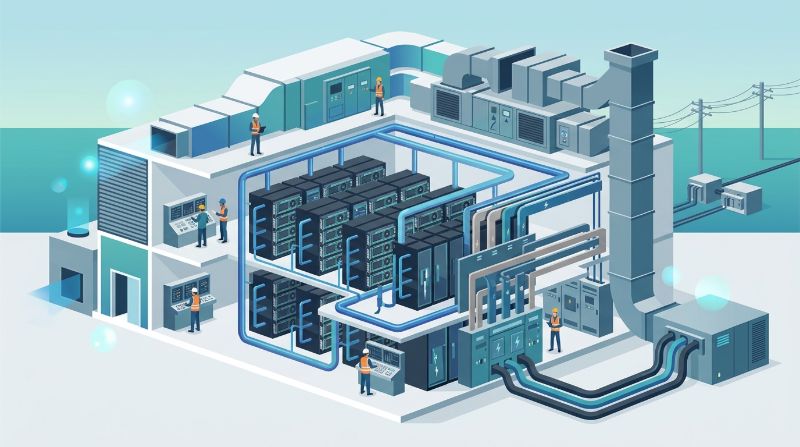
ML engineers meet it as NCCL or similar library calls. Infrastructure owners meet it as a burst of interior traffic that must finish before step time moves. Both views are describing the same barrier.
What problem does all-reduce solve in data-parallel training?
Each rank trains on a different mini-batch slice and produces its own gradients. The model only stays consistent if those gradients are combined before the optimizer step. All-reduce is the workhorse for that combine-and-share pattern. After it completes, every rank can apply the same update.
Other collectives exist. Reduce-scatter plus all-gather can implement the same mathematical result with different memory traffic (as in many ZeRO-style paths). Broadcast ships a single buffer outward. All-to-all shows up in expert routing. Calling every multi-GPU pause “all-reduce” hides those shapes when you debug a stall.
| Collective | Who starts with data | Who ends with the full result |
|---|---|---|
| All-reduce | Every rank | Every rank |
| Reduce | Every rank | One rank |
| Broadcast | One rank | Every rank |
| All-to-all | Every rank (chunked) | Every rank (different chunks) |
When does all-reduce dominate step time?
All-reduce volume grows with the number of parameters you synchronize and with how often you synchronize. Large dense models, frequent steps, and weak overlap of communication with compute make the collective visible. Small models on a fast fabric may hide it entirely under math.
Multi-node jobs are more exposed than single-node jobs because the path leaves NVLink islands and enters the cluster fabric. That fabric traffic is east-west in direction; all-reduce is the algorithm that generated it. If you only upgrade GPUs and leave an oversubscribed spine, all-reduce time can erase the SKU upgrade.
Pipeline-parallel training reduces some all-reduce of the full gradient set and replaces it with activation traffic. Mixture-of-experts paths may be all-to-all bound instead. Read the parallel strategy before you declare the cluster “all-reduce bound.”
What all-reduce is not
It is not a proof that the network is InfiniBand. Ethernet fabrics can carry all-reduce, well or poorly. It is not a storage benchmark. Checkpoint I/O can be slow while all-reduce is fine. It is not an inference SLA metric unless you are running a rare multi-node collective in serving.
Architectural Decision Matrix: AI Cluster Network Topologies
| Hosting & Network Model | Topology & Fabric Protocol | Oversubscription & Buffer Contention | Inter-GPU Bandwidth Guarantee | Pricing & Data Egress Model |
|---|---|---|---|---|
| Public Cloud (Multi-Tenant) | Shared Leaf-Spine, virtualized SR-IOV / overlay | High contention; cross-tenant East-West buffer exhaustion | Variable; subject to throttling and jitter | Metered hourly compute + high data egress surcharges |
| On-Premises Data Center | Custom rail-optimized InfiniBand or RoCE v2 | 0% oversubscription; full physical fabric ownership | Dedicated line-rate (400G/800G per node) | Multi-million dollar Capex + long facility lead time |
| OneSource Cloud (Managed Private AI) | Dedicated Spine-Leaf RoCE v2 with hardware RDMA offload | 0% oversubscription; dedicated non-shared switches & buffers | Guaranteed non-blocking 400G/800G line-rate throughput | Predictable flat-rate monthly pricing with $0 data egress fees |
It is also not something a provider can “turn on” as a feature flag. They can change topology, QoS, and isolation so the collective has a clean path. They cannot delete the bytes the algorithm must move. AI networking work is about that path. OneSource Cloud only enters the story if you are buying a dedicated cluster whose fabric you intend to measure. A single-GPU fine-tune that never calls a multi-rank collective does not need that conversation.
What should teams measure?
Measure step time with communication broken out, message size, and whether compute overlaps the collective. Measure fabric counters on the same interval. A high GPU-utilization number alone will not tell you that ranks are sitting in NCCL. Compare one-node and two-node step times on the same batch shape before you scale to dozens of nodes.
For enterprise planning, translate the measurement into a topology question: which jobs will be data-parallel and large enough to care. Research clusters with mixed small jobs can share a fabric that a dedicated pretrain slice should not share. Isolation here is about contention, not about a marketing tenancy adjective.
To resolve these networking and communication bottlenecks in high-throughput AI clusters, enterprise architectures deploy dedicated, non-blocking network fabrics. Within OneSource Cloud High-Performance AI Networking environments, cluster traffic is segmented into three physically and logically isolated planes: a dedicated RoCEv2 or InfiniBand RDMA backend mesh exclusively reserved for inter-GPU collective operations (such as all-reduce and tensor-parallel exchange), an out-of-band management network for DCGM telemetry and node health orchestration, and an isolated client-facing VPC. This dedicated rail-optimized fabric operates at zero oversubscription, eliminating cross-tenant packet buffer exhaustion and preserving deterministic microsecond-level synchronization across distributed training and inference fleets.
FAQ
Is all-reduce the same as averaging gradients?
Averaging (or summing) gradients is the usual purpose in data-parallel training. The collective itself is more general: any elementwise reduction plus a distribution back to all ranks. Teams say “all-reduce the grads” because that is the dominant call. The library will also all-reduce other tensors if the framework asks.
Why is my all-reduce slower after adding nodes?
More ranks usually means a larger communication tree or ring and a greater chance of hitting a congested uplink. You may also have left a fast intra-node domain and entered a slower inter-node domain. Check whether the message size grew, whether a slow rank exists, and whether another job shares the fabric. More GPUs are not a free speedup.
Do I need all-reduce for single-node multi-GPU training?
If multiple GPUs share one model replica via data parallelism, yes, you still combine gradients. The path may stay on NVLink or PCIe and never touch the cluster spine. That is still all-reduce. It just may not show up on the data-center fabric graphs that network teams watch.
How is all-reduce different from a parameter server?
A parameter server collects updates at designated servers and pushes results back. All-reduce is peer-to-peer among ranks with no parameter-server role in the critical path. Modern GPU training libraries prefer collectives because they map onto fast device-to-device paths. The math can be arranged to match; the traffic pattern differs.
Can we fix a slow all-reduce only in software?
Sometimes: better overlap, gradient bucketing, or a parallel strategy that moves less full-model traffic. If the fabric is lossy, oversubscribed, or mixed with storage bursts, software will not invent bandwidth. Measure both layers before you rewrite the trainer or before you reorder the ToR switches.
How does OneSource Cloud design network fabrics to eliminate distributed GPU communication bottlenecks?
OneSource Cloud engineers dedicated non-blocking spine-leaf network fabrics specifically optimized for distributed AI workloads. By implementing hardware-enforced three-plane isolation (out-of-band management, dedicated RoCEv2/InfiniBand RDMA backend, and isolated tenant VPCs) combined with line-rate bandwidth and PFC/ECN congestion control, OneSource eliminates packet buffer drops, minimizes collective all-reduce latency, and prevents cross-workload network jitter.
Summary
All-reduce is the collective that combines every rank's tensor and returns the same result to every rank. In data-parallel training it is how gradients become one update. It rides the cluster's interior fabric; it is not itself a network product. Measure communication versus compute, and do not diagnose every stall as all-reduce when the parallel strategy has moved the bottleneck.
When multi-node training is in scope, read the fabric discussion on high-performance AI networking as the path those collectives use, not as a replacement for this definition.
Related Articles
Recommended Reading
-
Google Cloud GPU Pricing: What Enterprise AI Teams Should Evaluate Before Provisioning
-
Paperspace Pricing 2026: GPU Cost Breakdown
-
CoreWeave Enterprise GPU Cloud: Evaluation for AI Teams
-
AI Infrastructure Costs: Controlling Enterprise GPU Spending
-
CoreWeave vs Lambda Labs: GPU Cloud Provider Comparison
latest articles
-
Open-Source LLM Deployment: Requirements and Real Cost Breakdown
-
AI Search Assistants Under Data Residency: Architectures and Evidence
-
LLM Inference GPUs Compared: A100, H100, H200, or B200 for Production
-
LLM Deployment Best Practices: An Enterprise Stage-by-Stage Checklist
-
HIPAA Patient Scheduling AI: Controls, Consent, and Evidence
-
Cloud-Agnostic LLM Deployment: Architecture Principles Against Lock-In
-
HIPAA-Compliant AI Tools for Healthcare: Categories and Evaluation
-
Batch vs Real-Time LLM Inference: Cost, Latency, and Fit
-
Model Deployment Strategies Compared: Canary, Blue-Green, Shadow, Rolling
-
GPU Rental vs Owning: Cost, Commitment, and When to Buy