
Does SOC 2 Replace FedRAMP for Enterprise AI Infrastructure?
As regulated enterprises and defense-adjacent technology companies accelerate the deployment of generative artificial intelligence and high-performance GPU infrastructure, compliance boundaries become high-stakes legal and operational battlegrounds. A pervasive misconception among commercial software leaders and procurement teams is that holding an active Service Organization Control 2 (SOC 2) Type II attestation satisfies federal procurement requirements. In reality, a commercial SOC 2 Type II report does not replace Federal Risk and Authorization Management Program (FedRAMP) authorization. Confusing these frameworks risks severe compliance rejections, disqualified government proposals, and millions in wasted architectural refactoring.
Scope: Trust Services Criteria vs Federal Authorization Baselines
A commercial SOC 2 Type II report does not replace FedRAMP authorization for enterprise AI workloads handling federal or defense sector data. While SOC 2 evaluates an organization's internal controls against AICPA Trust Services Criteria (Security, Availability, Confidentiality), FedRAMP is a rigorous statutory authorization program enforcing standardized NIST SP 800-53 Rev 5 control baselines audited by an accredited Third-Party Assessment Organization (3PAO) and authorized by a federal government agency.
The distinction between SOC 2 Type II and FedRAMP begins with legal authority and governance frameworks. SOC 2 is a voluntary commercial attestation standard developed by the American Institute of Certified Public Accountants (AICPA). It allows an organization to define its own control scope against five Trust Services Criteria (Security, Availability, Processing Integrity, Confidentiality, and Privacy), audited by an independent CPA firm over a defined observation window.
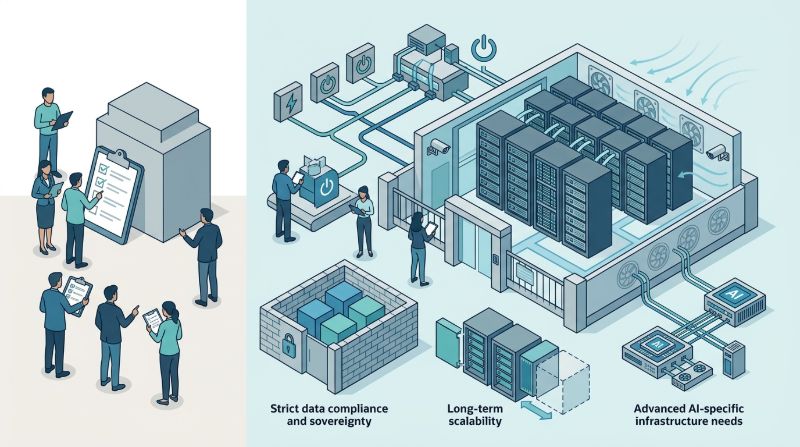
In stark contrast, FedRAMP is a mandatory federal statutory program established to standardize security assessment, authorization, and continuous monitoring for cloud products and services used by federal agencies. FedRAMP authorization is granted not by a CPA firm, but by the FedRAMP Program Management Office (PMO) and federal Authorizing Officials (AOs) following an extensive audit conducted by a specialized, accredited Third-Party Assessment Organization (3PAO).
Shared Responsibility: Control Baselines, Cryptography, and Personnel Constraints
The operational gap between frameworks spans hundreds of mandatory security controls. While a standard SOC 2 report evaluates approximately 60 to 100 provider-selected controls, FedRAMP Moderate enforces 325 strict controls and FedRAMP High mandates over 420 controls. Key differences include mandatory FIPS 140-3 validated cryptographic modules, continuous automated vulnerability monitoring (ConMon), US-soil citizen personnel restrictions, and 1-hour federal incident reporting SLAs.
The operational divide becomes stark when analyzing specific technical control requirements. A standard SOC 2 Type II report typically evaluates between 60 and 100 organization-defined control statements. In contrast, FedRAMP Moderate enforces 325 strict controls, and FedRAMP High mandates more than 420 controls drawn directly from NIST Special Publication 800-53 Revision 5.
Beyond sheer control volume, FedRAMP introduces non-negotiable technical mandates that commercial SOC 2 frameworks omit. These include FIPS 140-3 cryptographic validation for all data in transit and at rest, automated monthly continuous monitoring (ConMon) vulnerability reporting submitted directly to federal agencies, strict US-soil citizen personnel constraints for infrastructure operations, and mandatory reporting of security incidents to the federal government within 1 hour.
| Compliance Dimension | SOC 2 Type II | FedRAMP Moderate Baseline | FedRAMP High Baseline |
|---|---|---|---|
| Governing Standard | AICPA Trust Services Criteria | NIST SP 800-53 Rev 5 (~325 Controls) | NIST SP 800-53 Rev 5 (~420+ Controls) |
| Auditing Authority | Licensed Independent CPA Firm | Accredited 3PAO + FedRAMP PMO / Agency | Accredited 3PAO + Joint Authorization Board |
| Cryptographic Standard | Industry standard (TLS / AES) | FIPS 140-3 validated cryptographic modules | FIPS 140-3 Level 2/3 hardware modules |
| Personnel Requirements | Standard enterprise background checks | US Persons / US Citizenship requirements | Screened US Citizens / National Agency Checks |
| Incident Reporting SLA | Defined in commercial SLA (24-72h) | US-CERT reporting within 1 hour | US-CERT reporting within 1 hour mandatory |
Evidence Artifacts: Audit Documentation Required for AI Procurement
Enterprise buyers evaluating GPU infrastructure must collect a complete compliance evidence dossier: first, the official SOC 2 Type II report with auditor testing results; second, the System Security Plan (SSP) and FedRAMP Package ID if public sector data is processed; and third, third-party penetration testing summaries. Dedicated single-tenant infrastructure like OneSource Cloud streamlines audit documentation by delivering dedicated bare-metal GPU clusters that eliminate complex multi-tenant boundary disputes.
Enterprise procurement teams conducting technical due diligence on AI infrastructure vendors must request a comprehensive compliance dossier. For commercial B2B SaaS deployments, a current SOC 2 Type II report with zero qualified auditor opinions and an unredacted Section IV testing matrix is standard. However, if federal data or public sector contracts are involved, buyers must demand the vendor's System Security Plan (SSP) and FedRAMP Marketplace Package ID.
Dedicated single-tenant infrastructure platforms like OneSource Cloud streamline compliance verification. By delivering dedicated bare-metal GPU clusters that completely eliminate multi-tenant hypervisor sharing, OneSource Cloud provides clear physical boundaries audited under SOC 2 Type II and HIPAA standards, accelerating client-side audit readiness for both commercial enterprise and federal public sector pipelines.
Residual Risk: Managing the Phased Compliance Transition
Organizations deploying commercial AI under SOC 2 while planning federal expansion face residual risks around data boundary contamination and cryptographic refactoring. If model weights or training pipelines are initially deployed on shared multi-tenant infrastructure lacking FIPS encryption, retrofitting those clusters for FedRAMP authorization requires costly re-architecture. Deploying on sovereign dedicated bare-metal hardware from the outset minimizes residual compliance debt.
Organizations planning a phased transition from commercial enterprise to federal public sector markets must manage residual compliance risks proactively. If an AI training pipeline or inference cluster is initially architected on shared public cloud infrastructure using non-FIPS cryptographic libraries, retrofitting those clusters for FedRAMP authorization often requires total re-architecture.
By establishing dedicated physical bare-metal hardware baselines, enforcing client-managed FIPS 140-3 encryption keys, and maintaining continuous auditable access logs from day one, enterprise engineering teams minimize compliance debt and ensure a seamless pathway toward formal federal authorization.
Frequently Asked Questions
Can a commercial enterprise accept a SOC 2 Type II report instead of FedRAMP for non-governmental AI workloads?
Yes, private commercial enterprises and B2B SaaS buyers universally accept SOC 2 Type II reports as standard proof of security; FedRAMP is only mandatory when processing federal government data or servicing public sector contracts.
How does OneSource Cloud support compliance standards for regulated AI workloads?
OneSource Cloud provides dedicated single-tenant bare-metal GPU clusters audited under SOC 2 Type II and HIPAA standards, supporting client-side FIPS-compliant encryption and physical tenant isolation to accelerate enterprise and federal audit readiness.
Related Articles
Recommended Reading
latest articles
-
Running NCCL AllReduce Soak Tests During GPU Cluster Deployment
-
Mitigating Host RAM Swapping in Enterprise Async GPU Checkpoints
-
NVMe Sanitize vs Crypto Erase for Enterprise GPU Node Security
-
What Happens If You Break an Enterprise GPU Cloud Commitment?
-
Does SOC 2 Replace FedRAMP for Enterprise AI Infrastructure?
-
Direct-to-Chip Liquid Cooling vs Air Cooling for Enterprise PUE
-
Auditing Subservice Organizations in Enterprise GPU Cloud SOC 2
-
Detecting Silent Xid Errors and PCIe Drops in GPU Inference Nodes
-
Capping Peak GPU Power Draw in Enterprise Workload Scheduling
-
Tuning Chunked Prefill to Prevent TTFT Latency in Production