
Dedicated GPU Cloud TCO Factors: What Drives the Total Cost of Dedicated Capacity
Dedicated GPU cloud total cost of ownership is driven by capacity and accelerator choice, commitment term, data residency, operational scope, support level, and the internal costs the invoice hides, and understanding these factors is what turns a dedicated quote into a defensible total. The TCO is less a single number than the sum of several decisions, each of which moves the total predictably.
Quick Answer: The main TCO factors for dedicated GPU cloud are the GPU capacity itself, the commitment term, residency requirements, whether operations are managed or self-run, the support tier, and the internal staffing and integration costs outside the invoice. A workload-first TCO method, rather than the dedicated rate alone, is the reliable way to judge whether dedicated capacity is worth its premium.
For finance, procurement, and engineering leaders, the sections below name each TCO factor, explain how it moves the total, and lay out a method for calculating dedicated TCO honestly. The aim is a total-cost view that captures what dedicated actually costs, including what the invoice hides.
Why Dedicated TCO Is Not the Dedicated Rate
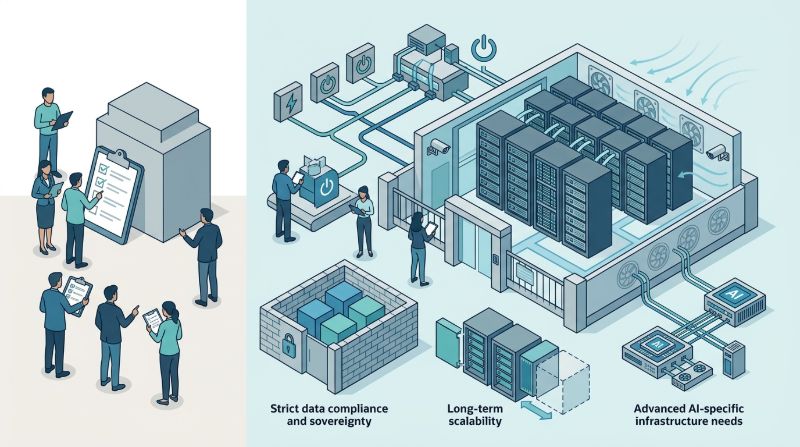
The most common dedicated cost mistake is treating the rate as the cost, which ignores every factor that determines what the team actually pays. Dedicated TCO includes several factors, and the rate is only one of them.
| TCO factor | How it moves the dedicated total |
|---|---|
| Capacity and accelerator choice | Denser GPUs cost more but may lower cost per unit of throughput |
| Commitment term | Longer terms usually lower the effective rate |
| Data residency | Defined, auditable residency adds cost over generic selection |
| Operational scope | Managed operations add invoice cost but reduce internal staffing |
| Support tier | Higher ownership levels increase price |
| Internal costs | Staffing, integration, and failure risk outside the invoice |
Each factor is a lever, and the TCO is the result of where each is set. A dedicated quote that shows only the rate is incomplete, which is why a factor-by-factor view is the starting point for honest budgeting.
The Core Dedicated TCO Factors Explained
Each factor deserves its own treatment, because each interacts with the dedicated model and the workload in a different way.
1. Capacity and accelerator choice
The GPU model and node density drive the largest share of dedicated cost. Denser, newer accelerators cost more per unit, but they often deliver more throughput per dollar for workloads that can use them. The relevant measure for TCO is cost per unit of sustained throughput, since a cheaper GPU that idles waiting for data raises the effective cost.
2. Commitment term
The length of the commitment usually lowers the effective rate, because it lets the provider plan capacity. The TCO trade-off is flexibility: a longer term that lowers the rate may leave the team carrying capacity it no longer needs, so the term should match the workload's expected duration rather than maximizing the discount.
3. Data residency
Defined, auditable residency costs more than generic selection, because it requires isolated data paths and documented location. Private AI infrastructure from OneSource Cloud carries this cost as part of its boundary, and for regulated workloads it is not optional, since residency is a requirement rather than a preference.
4. Operational scope
Managed operations add cost to the dedicated invoice but reduce the need for internal operations staffing, which is often the larger expense. Managed AI infrastructure shifts cost from headcount to the provider, and for teams without round-the-clock GPU operations depth, the trade is usually favorable on a TCO basis.
5. Support tier
Support levels that own incidents, with measurable response and restoration objectives, cost more than best-effort support. The TCO question is what a failure costs the business: for critical workloads, a higher support tier that owns incidents can be cheaper than a lower tier that hands failures back at the worst moment.
6. Internal costs
The costs the dedicated invoice hides: internal operations staffing, integration effort, and the failure risk the team carries. These are the factors most often missed in dedicated TCO, and they can be the largest part of the total, which is why excluding them makes dedicated look cheaper than it is.
A Workload-First Dedicated TCO Method
Calculating dedicated TCO requires a method that captures all the factors, not just the rate. The sequence below produces a total that survives scrutiny.
- Profile the workload: Document the model, data volume, throughput need, duration, and residency constraints.
- Set each factor: Decide capacity, term, residency, operations, and support based on the workload, not on the quote.
- Collect factor-level quotes: Ask the provider to price each factor explicitly, so hidden assumptions surface.
- Add internal costs: Include internal staffing, integration, and failure-risk costs, not just the invoice.
- Model over the full term: Project cost across the commitment, including scaling and any term-end effects.
- Sensitivity-check: Vary the workload assumptions to see which factors move the total most.
This method turns dedicated TCO into a defensible exercise, because each number traces back to a workload decision rather than a vendor assertion.
How Dedicated TCO Compares to Alternatives
Dedicated TCO is best understood in comparison to the alternatives, because the premium dedicated carries is justified only against what the team would otherwise pay.
Dedicated vs shared cloud TCO
Shared cloud has a lower rate but higher volatility and failure risk for sustained workloads, which can make its TCO higher in practice. Dedicated capacity from a provider such as OneSource Cloud carries a higher rate but lower volatility and restart cost, which often lowers TCO for sustained workloads despite the premium.
Dedicated vs on-premises TCO
On-premises hardware has a lower ongoing rate but carries the full operations, refresh, and facility burden, which dedicated cloud removes. For teams that want dedicated performance without the hardware lifecycle, dedicated cloud's TCO is often lower once internal costs are included, even though its rate is higher.
How to Reduce Dedicated TCO Without Losing Value
Reducing dedicated TCO is about removing waste, not cutting properties the workload needs. The levers below lower cost while preserving value.
- Match capacity to the workload: Avoid over-provisioning capacity the workload will not use, which is the most common dedicated waste.
- Right-size the term: Choose a term that matches the workload's duration, avoiding both short-term premiums and long-term idle capacity.
- Include operations wisely: Add managed operations when they reduce internal staffing more than they cost, which is common for teams without operations depth.
- Balance the system: Ensure storage and networking keep pace with compute, since imbalance wastes the dedicated spend on idle GPUs.
Each lever reduces TCO without removing a property the workload needs, which is the difference between cost reduction and value destruction.
Common Dedicated TCO Mistakes
Dedicated TCO calculations go wrong in specific ways, and each maps to a factor that was ignored.
- Rate-as-cost: Treating the dedicated rate as the total cost while term, residency, and internal costs remain hidden.
- Ignoring internal cost: Counting only the invoice while internal staffing and failure risk inflate the true total.
- Over-committing for discount: Choosing the longest term for the lowest rate, then carrying idle capacity.
- Cutting operations to save rate: Removing managed operations to lower the invoice, then paying in internal staffing or unattended failures.
Each mistake is avoidable by applying the TCO method, which is why the method matters more than any single factor.
FAQ
What are the main TCO factors for dedicated GPU cloud?
The main factors are capacity and accelerator choice, commitment term, data residency, operational scope, support tier, and internal costs. Each is a lever that moves the total, and a defensible TCO comes from setting each based on the workload rather than accepting the dedicated rate as the cost.
How do I calculate dedicated GPU cloud TCO?
Profile the workload, set each factor based on its requirements, collect factor-level quotes, add internal staffing and failure-risk costs, model cost over the full term, and sensitivity-check the assumptions. This workload-first method is more reliable than comparing the dedicated rate alone.
Is dedicated GPU cloud TCO higher than shared cloud?
It has a higher rate but can have lower TCO for sustained workloads, because dedicated capacity reduces the volatility, restart cost, and failure risk that make shared cloud expensive in practice. The comparison must include internal costs and failure risk, not just the rate.
Does managed operations increase or decrease dedicated TCO?
It increases the invoice but often decreases TCO, because it reduces the internal operations staffing that self-operation requires. For teams without round-the-clock GPU operations depth, managed operations such as OneSource Cloud's usually lower the total cost when internal headcount is included.
How can I reduce dedicated GPU cloud TCO without losing value?
Match capacity to the workload, right-size the commitment term, include managed operations when they reduce internal staffing, and balance the system so storage and networking keep pace with compute. Each lever reduces cost without removing a property the workload needs.
Summary
Dedicated GPU cloud TCO is driven by capacity, commitment term, residency, operations, support, and the internal costs the invoice hides, and understanding these factors turns a dedicated quote into a defensible total. A workload-first TCO method that includes internal costs and models the full term is the reliable way to judge whether dedicated capacity is worth its premium, and the right total comes from setting each factor based on the workload rather than treating the rate as the cost. For sustained workloads, dedicated TCO is often lower than it appears once volatility and failure risk are included, which is why honest TCO comparison favors dedicated for the workloads that need its properties.
Next step: Apply this TCO method to your workload against OneSource Cloud's private AI infrastructure to see which factor settings would deliver the lowest total cost for your dedicated requirements.
Related Articles
Recommended Reading
-
Google Cloud GPU Pricing: What Enterprise AI Teams Should Evaluate Before Provisioning
-
Paperspace Pricing 2026: GPU Cost Breakdown
-
CoreWeave Enterprise GPU Cloud: Evaluation for AI Teams
-
AI Infrastructure Costs: Controlling Enterprise GPU Spending
-
CoreWeave vs Lambda Labs: GPU Cloud Provider Comparison
latest articles
-
Open-Source LLM Deployment: Requirements and Real Cost Breakdown
-
AI Search Assistants Under Data Residency: Architectures and Evidence
-
LLM Inference GPUs Compared: A100, H100, H200, or B200 for Production
-
LLM Deployment Best Practices: An Enterprise Stage-by-Stage Checklist
-
HIPAA Patient Scheduling AI: Controls, Consent, and Evidence
-
Cloud-Agnostic LLM Deployment: Architecture Principles Against Lock-In
-
HIPAA-Compliant AI Tools for Healthcare: Categories and Evaluation
-
Batch vs Real-Time LLM Inference: Cost, Latency, and Fit
-
Model Deployment Strategies Compared: Canary, Blue-Green, Shadow, Rolling
-
GPU Rental vs Owning: Cost, Commitment, and When to Buy