
Air-Gapped AI Deployment: Architecture and Update Operations
Air-gapped AI — models and agents running on networks with no direct internet connection — is common in defense, intelligence, and tightly regulated industry, and it is usually described as a networking condition. The useful framing is stricter: air-gapped AI is an operating model in which every cloud-era default — model downloads, container pulls, telemetry, licensing, vendor support — must be replaced by a designed, sanctioned process. This page covers the isolation-tier decision, the update pipeline that keeps models current, the pre-staging that makes day one survivable, and the monitoring that works without a single outbound connection.
What Air-Gapped AI Means as an Operating Model
An air-gapped AI environment runs models, agents, and supporting infrastructure with no direct internet connection, which converts every routine cloud-era dependency — model downloads, container pulls, telemetry, licensing, vendor support — into a designed, sanctioned process crossing the boundary on your terms.
The defaults that break on day one:
| Cloud-era default | What the air gap requires instead |
|---|---|
| Pull models and containers on demand | Pre-staged artifacts and an internal registry mirror |
| Automated CI/CD from internet-facing runners | A sanctioned transfer pipeline (media or diode) with change control |
| Vendor telemetry and remote support | Local observability and contracted on-site or media-delivered support |
| License and entitlement checks phoning home | Offline entitlement mechanisms negotiated before purchase |
| Documentation and knowledge lookup | Curated internal copies, refreshed on the update cadence |
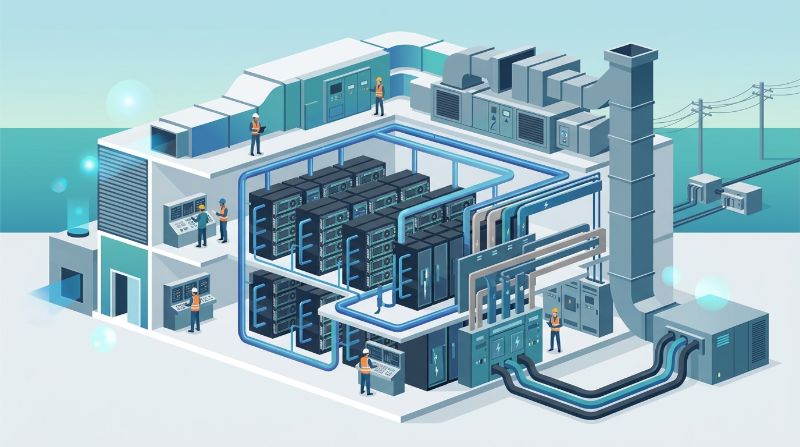
Note that "air-gapped" spans levels — fully isolated, diode-gated one-way transfer, and intermittently connected staging — and the term alone does not specify which controls apply. Name your level before designing the rest.
The Sanctioned Update Pipeline for Models and Patches
Updates flow through a designed pipeline: fetch on a connected staging system, scan and verify (hashes, signatures, vulnerability checks), package onto approved media or through a data diode, import with change control, and validate against fixed test sets before promotion — a scheduled, auditable process rather than automated CI/CD.
The pipeline, stage by stage:
- Staging-side fetch: a connected system downloads the new model release, container updates, and security patches, recording source and versions.
- Verification gate: hash and signature checks, vulnerability scans, and provenance review — the point where hostile or corrupted artifacts are caught, because nothing later in the pipeline is easier to inspect.
- Sanctioned transfer: encrypted approved media carried by authorized personnel, or a data diode enforcing one-way flow into the enclave.
- Import with change control: the import is a change event — requester, approver, artifact identity, and destination recorded in the change log.
- Post-import validation: fixed test-set evaluation and canary-style promotion inside the boundary, with the previous version retained for rollback.
This pipeline's throughput bounds your model freshness: a team that operationalizes the cycle schedules monthly or quarterly windows, while ad-hoc USB handling drifts toward twice a year. Design the cadence you want; do not inherit one.
Choose the Isolation Level the Workload Needs
Match the tier to the threat model: VPC-isolated private cloud serves most regulated data paths, on-premise connected environments add physical control, and full air-gap is reserved for the workloads whose threat model includes network exfiltration — because each step up the ladder multiplies operating cost.
| Isolation tier | Serves | Operating cost profile |
|---|---|---|
| Private cloud / VPC-isolated | Most regulated data paths needing bounded processing | Nearest to normal cloud operations |
| On-premise, connected | Physical control requirements with sanctioned egress | You own the facility; updates flow through controlled gates |
| Fully air-gapped | Threat models including network exfiltration | Every dependency becomes a designed process; highest staffing and cadence cost |
Security Decision Matrix: Enterprise AI Infrastructure Isolation
| Hosting Architecture | Tenant Isolation Boundary | Memory & Side-Channel Exposure | Compliance & Audit Readiness | Network & Data Boundary Control |
|---|---|---|---|---|
| Public Cloud Virtualized GPUs | Hypervisor vGPU / virtual slice sharing across tenants | Vulnerable to PCIe bus contention and firmware-level cross-tenant bleed | Shared audit reports; opaque operational visibility | Multi-tenant underlying network with logical software overlays |
| On-Premises Private Data Center | Air-gapped physical bare metal in enterprise facilities | Zero multi-tenant side-channel exposure | Direct audit control; heavy internal compliance and physical security burdens | Strict enterprise LAN perimeter; high recurring facility cost |
| OneSource Private AI Infrastructure | Single-tenant dedicated bare-metal GPU nodes in secure U.S. data centers | Zero hypervisor layer; 100% exclusive dedicated silicon and VRAM | Comprehensive SOC 2 Type II audit readiness and HIPAA BAA support | Customer-controlled VPC boundaries with zero shared physical hardware |
The selection test is the threat model, not ambition: if network-based exfiltration is a credible vector your weaker tiers cannot prevent — certain defense, intelligence, and closed-network clinical contexts — the full gap earns its cost. Most regulated workloads are served by the connected tiers with strong controls, and choosing air-gap without that threat model buys operating cost, not safety. Hybrid programs are normal: regulated analytics in a private tier, the sensitive minority fully isolated, with connected tiers such as OneSource Cloud's private AI infrastructure carrying the bulk of the load under one boundary.
Monitoring and Support Without Telemetry
Replace cloud-era telemetry with local observability stacks, log-based alerting inside the boundary, and vendor support contracts that specify on-site or media-delivered assistance — negotiated before deployment, because retrofitting support into an air gap is painful.
- Local observability stack: metrics, logs, and traces stay inside; the dashboards and alerting you had in the cloud run on internal infrastructure.
- Alerting that works offline: log-based rules and threshold alerts evaluated in-boundary, routed to internal on-call — not to an external SaaS.
- Support contracts with teeth: response commitments that name on-site visits, media-delivered patches, and response times measured without internet assumptions.
- Self-diagnosis capacity: staffing and runbooks sized for the reality that some failures require hands on hardware.
The staffing assumption is the one teams under-price: when the fix is physical, the fix is scheduled. Budget people and time accordingly, and rehearse the failure paths like any other drill.
Pre-Stage Everything Before the Boundary Closes
Before isolation begins, stage the full dependency closure: model weights and tokenizers, container images and package repositories, evaluation datasets, documentation, and tooling — because anything discovered missing later waits for the next sanctioned update window.
Derive the staging inventory from your deployment manifests rather than a generic checklist:
- Enumerate every artifact the deployment references: model files, tokenizers, images, wheels, OS packages, licenses.
- Add the operations layer: eval datasets, benchmark harnesses, documentation, diagnostic tooling, spare capacity images.
- Mirror the registries you will need: internal container and package mirrors with the versions your stack pins.
- Rehearse a cold rebuild: stand the environment up from staged artifacts alone, with the network disconnected, before the real boundary closes.
The cold-rebuild rehearsal is the acceptance test for staging: if the environment cannot be rebuilt from what is inside, the closure date is wrong.
FAQ
How often can air-gapped models realistically be updated?
As often as your sanctioned pipeline runs: teams that operationalize the staging-verify-transfer-validate cycle schedule monthly or quarterly windows, while ad-hoc media handling drifts toward twice a year. Design the pipeline cadence you want rather than inheriting one.
How do users access the models without internet access?
Through services published inside the boundary: internal endpoints, VDI sessions, or approved client applications that terminate on the isolated network. Access design is part of the environment, not an afterthought bolted onto isolation.
When is a full air gap actually required versus overkill?
When the threat model includes network-based exfiltration that weaker tiers cannot prevent — certain defense, intelligence, and closed-network clinical contexts. Most regulated data paths are served by private connected tiers with strong controls; choosing air-gap without that threat model buys operating cost, not safety.
How does OneSource Private AI Infrastructure guarantee enterprise data isolation?
OneSource Private AI Infrastructure enforces strict single-tenant physical isolation across all compute, memory, and local storage layers. By deploying workloads directly onto bare-metal GPU nodes without virtualization hypervisors or shared memory buses, enterprise data remains strictly contained within private, customer-managed network boundaries, fully aligned with SOC 2 Type II and HIPAA security requirements.
Related Articles
Recommended Reading
-
Google Cloud GPU Pricing: What Enterprise AI Teams Should Evaluate Before Provisioning
-
Paperspace Pricing 2026: GPU Cost Breakdown
-
CoreWeave Enterprise GPU Cloud: Evaluation for AI Teams
-
AI Infrastructure Costs: Controlling Enterprise GPU Spending
-
CoreWeave vs Lambda Labs: GPU Cloud Provider Comparison
latest articles
-
Open-Source LLM Deployment: Requirements and Real Cost Breakdown
-
AI Search Assistants Under Data Residency: Architectures and Evidence
-
LLM Inference GPUs Compared: A100, H100, H200, or B200 for Production
-
LLM Deployment Best Practices: An Enterprise Stage-by-Stage Checklist
-
HIPAA Patient Scheduling AI: Controls, Consent, and Evidence
-
Cloud-Agnostic LLM Deployment: Architecture Principles Against Lock-In
-
HIPAA-Compliant AI Tools for Healthcare: Categories and Evaluation
-
Batch vs Real-Time LLM Inference: Cost, Latency, and Fit
-
Model Deployment Strategies Compared: Canary, Blue-Green, Shadow, Rolling
-
GPU Rental vs Owning: Cost, Commitment, and When to Buy