
How to Compare AI Provider Security for Enterprise AI Teams
AI infrastructure provider security is the set of isolation, identity, encryption, residency, and audit controls that determine whether an enterprise can run sensitive models and data on a GPU provider's environment without weakening its own security posture. For most teams the decision is not whether to use a provider but how to judge whether a given provider's controls match the workload's sensitivity.
This article gives evaluation teams a structured checklist, the evidence to request, and the red flags that indicate weak controls. The goal is a defensible decision, not a marketing comparison.
Define the Security Boundary of the Contract
Before reviewing any control, the evaluation team must decide which security obligations belong to the provider and which remain with the customer. In a private AI environment the boundary is narrower than in public multi-tenant clouds because compute, storage, and networking are dedicated. Still, the provider owns physical security, hardware integrity, patching, and parts of identity and encryption; the customer owns access policy, model governance, and data classification.
Map the shared-responsibility line in writing and confirm the provider can articulate where its responsibility ends. A provider that cannot describe this boundary is a red flag today and a source of disputes later.
Isolation, Identity, and Data Protection Controls
Evaluate Data and Workload Isolation First
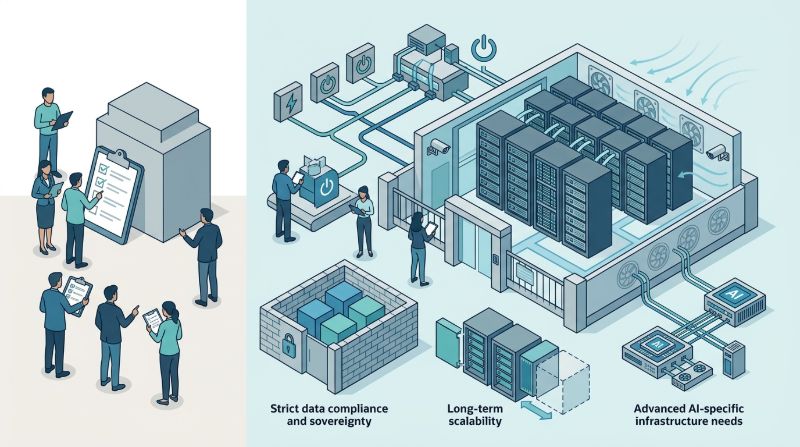
Isolation determines whether one customer's activity can affect another's data, performance, or security. Ask whether compute, storage, and networking are single-tenant or shared. Single-tenant dedicated GPU infrastructure lowers the risk of cross-customer interference, but the controls that enforce isolation — network segmentation, storage tenancy, and hypervisor or container boundaries — must still be implemented correctly regardless of hardware sharing.
Request a description of the isolation model and verify it with an architecture review rather than accepting a verbal claim. Confirm that storage volumes, virtual networks, and management planes are separated by enforceable policy, not just by convention.
Inspect the Identity and Access Controls
Ask how provider staff access the environment and whether the customer can audit that access. Look for least-privilege roles, short-lived credentials for administrator tasks, and a clear separation between support access and customer-owned data. Confirm the provider can show which of their staff touched what, when, and why, and that access does not bypass the customer's own controls.
The customer should be able to assign granular roles to its own teams — model developers, platform operators, data engineers, compliance officers — rather than being limited to one or two coarse roles. Review who can promote data to production and who can grant elevated permissions.
Verify Encryption, Key Management, and Data Paths
Encryption at rest and in transit is necessary but not sufficient. The evaluation should cover where encryption keys live, who administers them, how rotation works, and whether the provider can ever access plaintext. Understand the data path from ingestion to deletion: which protocols carry sensitive data, which service accounts can read it, and where backups and replicates reside.
Document which keys are customer-managed, which the provider holds, and what happens to keys and data during an outage or contract termination. A control set that separates key administration from data administration is stronger than one where a single party holds both.
Audit Evidence and Compliance Posture
Ask for third-party audit evidence such as SOC 2 Type II reports, independent penetration test summaries, and the scope statements for those assessments. Verify that the evidence covers the specific services the customer intends to use, not just the provider's corporate marketing. Confirm any claims about HIPAA-readiness, data residency, or regional availability with the evidence that backs them.
Data residency matters for regulated teams. If the workload must stay within the United States or a specific region, confirm the physical data center locations and the storage, backup, and support paths that could move data across a border. For healthcare or financial workloads, review the residency and retention controls directly rather than relying on a generic compliance page.
Review Physical Security and Operational Practices
Physical security protects the hardware that hosts the models. Evaluate the data center's access controls, monitoring, certifications, and the provider's incident response plan. Confirm who is notified during a breach or outage, how the customer learns about a security event, and whether the provider commits to a defined notification window.
Operational hygiene is as important as perimeter controls. Ask how patching is scheduled, how configuration drift is detected, how secrets are stored, and how a compromised administrator could alter logs or backups. A provider with tested recovery and immutable backlogs is materially safer than one with good perimeter marketing.
Security Evaluation Checklist
- Shared responsibility: provider can state the boundary in writing and the customer agrees with it.
- Isolation model: compute, storage, and network tenancy is documented and enforceable.
- Identity controls: least-privilege roles, short-lived credentials, and auditability for provider staff.
- Key management: key ownership, rotation, and plaintext access are defined and documented.
- Encryption coverage: at-rest and in-transit encryption scope matches the data sensitivity.
- Data paths: ingestion, processing, backup, and deletion paths are mapped and controlled.
- Audit evidence: SOC 2 Type II, penetration tests, and scope statements are current and relevant.
- Residency: data center locations and border-crossing paths match regulatory needs.
- Physical security: data center access, monitoring, and certifications are verified.
- Incident response: notification window, recovery testing, and log immutability are defined.
OneSource Cloud private AI infrastructure is designed around dedicated, single-tenant GPU environments in U.S. data centers, which can simplify the isolation and residency controls described here. Teams that prefer not to operate continuous security and patching themselves can evaluate managed AI infrastructure for the same control set with 24/7 operations ownership.
FAQ
What is the difference between security controls and compliance evidence?
Security controls are the technical and operational measures that protect data, while compliance evidence is the independent documentation that those measures exist and are tested. A provider can have strong controls and weak evidence or the reverse. Evaluate both: confirm the controls are implemented and confirm the evidence is current, in scope, and produced by an independent assessor.
Will a provider give me their full security documentation?
Most providers share redacted or NDA-gated security documentation with qualified enterprise customers during due diligence. Expect to sign a confidentiality agreement and to review the documentation in scope for the services you will actually use. A provider that consistently withholds reasonable evidence during evaluation may also be opaque during an incident.
Is single-tenant GPU infrastructure inherently more secure than shared?
Single-tenant infrastructure reduces the surface for cross-customer interference, but security depends on correctly implemented controls, not on hardware tenancy alone. A well-configured shared environment with strong isolation can be secure, and a poorly configured dedicated environment can still be risky. Evaluate the isolation model, identity controls, and audit evidence rather than assuming tenancy equals safety.
What are the main red flags when evaluating an AI infrastructure provider?
Look for an unclear shared-responsibility boundary, no third-party audit evidence, vague residency or compliance claims without backing, weak or unauditable administrator access, and an inability to describe the isolation model. Also treat marketing superlatives such as "100% secure" or "fully compliant" as a signal to request specific evidence rather than a reason to trust the claim.
Summary
Evaluating an AI infrastructure provider's security is a structured due-diligence task: define the boundary, verify isolation and identity, review encryption and key management, confirm audit evidence and residency, and inspect operational practices. A defensible evaluation ends with documented evidence behind each control, not with a vendor pitch. Teams that need a dedicated, U.S.-based, security-conscious environment can start with an OneSource Cloud architecture review to test whether their workload fits a private AI infrastructure model.
Related Articles
Recommended Reading
-
Google Cloud GPU Pricing: What Enterprise AI Teams Should Evaluate Before Provisioning
-
Paperspace Pricing 2026: GPU Cost Breakdown
-
CoreWeave Enterprise GPU Cloud: Evaluation for AI Teams
-
AI Infrastructure Costs: Controlling Enterprise GPU Spending
-
CoreWeave vs Lambda Labs: GPU Cloud Provider Comparison
latest articles
-
Open-Source LLM Deployment: Requirements and Real Cost Breakdown
-
AI Search Assistants Under Data Residency: Architectures and Evidence
-
LLM Inference GPUs Compared: A100, H100, H200, or B200 for Production
-
LLM Deployment Best Practices: An Enterprise Stage-by-Stage Checklist
-
HIPAA Patient Scheduling AI: Controls, Consent, and Evidence
-
Cloud-Agnostic LLM Deployment: Architecture Principles Against Lock-In
-
HIPAA-Compliant AI Tools for Healthcare: Categories and Evaluation
-
Batch vs Real-Time LLM Inference: Cost, Latency, and Fit
-
Model Deployment Strategies Compared: Canary, Blue-Green, Shadow, Rolling
-
GPU Rental vs Owning: Cost, Commitment, and When to Buy