
AI Data Center Infrastructure Services: Scope and Limits
AI workloads have reshaped what infrastructure teams expect from a data center. Training large models and running inference at scale demand dense power, precise cooling, and high-bandwidth connectivity that traditional colocation was never designed to deliver. For infrastructure leads, the challenge is not just finding a facility; it is understanding exactly what the facility service layer covers and where its responsibilities end.
AI data center infrastructure services refer to the facility-level capabilities a provider delivers to keep compute hardware running reliably. This includes power delivery, cooling, physical security, network interconnection, and on-site support. These services sit beneath the operations layer, which covers workload orchestration, patching, and performance tuning.
Knowing this boundary helps teams avoid costly misunderstandings. A provider may excel at keeping racks powered and cool but offer little help when a training job stalls or a GPU driver needs attention. This article defines the scope, outlines the limits, and gives infra teams a framework for evaluating what a facility partner can and cannot deliver.
What AI Data Center Infrastructure Services Include
The service scope of an AI data center spans five core areas. Each supports the physical and environmental conditions that dense GPU clusters require to operate without interruption.
1. Power Delivery and Redundancy
AI clusters draw far more power per rack than standard enterprise servers, often 40 to 100 kW per rack or higher. Facility services include high-density power feeds, UPS backup, generator capacity, and distribution paths designed for redundant delivery. The provider is responsible for keeping power flowing at the contracted density, but the customer remains responsible for how that power is consumed by workloads.
2. Cooling Systems
High-density GPU racks generate heat that conventional air cooling cannot manage alone. Modern AI facilities offer liquid cooling, rear-door heat exchangers, or hybrid systems. Cooling service scope covers maintaining inlet temperatures within an agreed band and handling condensate or coolant loops. It does not extend to workload-level thermal throttling, which is an operating-system or platform concern.
3. Physical Security
Facilities provide layered physical security: perimeter access, badge-controlled entry, biometric readers, CCTV monitoring, and locked cabinets or cages. These controls protect hardware from unauthorized access and support compliance frameworks such as SOC 2 and HIPAA readiness. Logical access, identity management, and data encryption remain customer responsibilities.
4. Network Interconnection
Most AI workloads need low-latency links to storage, cloud providers, peering exchanges, and research networks. Data centers offer cross-connects, direct cloud on-ramps, and carrier-neutral meet-me rooms. Interconnection services deliver the physical paths, while routing, firewalling, and bandwidth management fall to the customer or a managed services partner.
5. Remote Hands and On-Site Support
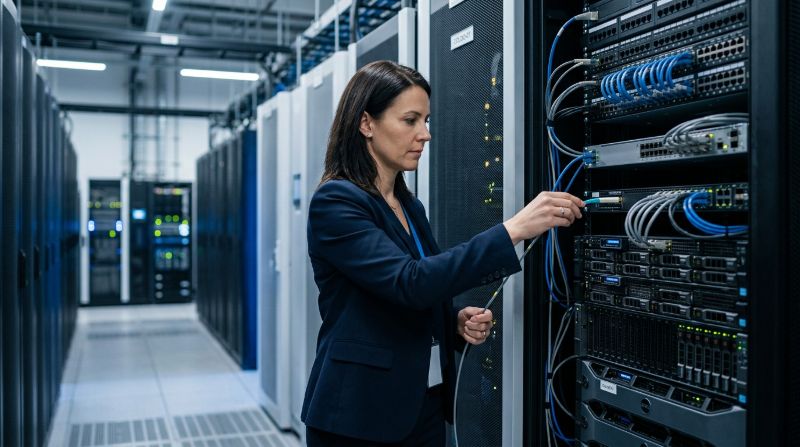
Remote hands technicians perform physical tasks: rebooting unresponsive servers, swapping failed drives, checking cable connections, and reporting hardware status. This service reduces the need for customer staff on site, but it is reactive by nature. It does not include application debugging, model optimization, or proactive capacity planning.
Facility Services vs Managed AI Infrastructure
A common point of confusion is the line between facility services and managed AI infrastructure. The table below clarifies the split so infra teams can scope contracts correctly.
| Responsibility | Facility Services | Managed AI Infrastructure |
|---|---|---|
| Power, cooling, physical security | Provider | Provider (via facility) |
| Network cross-connects | Provider | Provider or partner |
| Hardware replacement | Remote hands assist | Coordinated by operator |
| OS, drivers, scheduling | Customer | Provider |
| Workload tuning, monitoring | Customer | Provider |
For teams that want a single throat to choke across both layers, a managed AI infrastructure offering can bridge the gap, combining facility services with operational oversight.
The Limits of Facility Services
Understanding the limits is as important as knowing the scope. Facilities excel at environmental stability but do not solve application-level problems. Below are the boundaries infra teams should set expectations against.
Workload Performance Is Not Guaranteed
A provider can keep a rack cool and powered, but it cannot ensure a training job converges or that inference latency stays within target. Performance tuning, batch sizing, and model optimization live outside the facility service contract. Teams should pair facility services with monitoring tools or a platform layer that surfaces workload metrics.
Logical Security Stays With the Customer
Physical controls prevent someone from walking up to a server, but they do not enforce identity policies, encrypt data in transit, or audit API calls. For regulated workloads, customers must layer their own identity, encryption, and logging controls on top of the facility's physical protections.
Capacity Planning Requires Coordination
Facilities provision power and cooling to a contracted density. If a team later adds GPUs beyond that envelope, the provider cannot always accommodate the spike on short notice. Growth requires lead time and joint planning between the infra team and the provider.
What to Look for When Evaluating a Provider
Infra leads evaluating facility partners should focus on items that directly affect workload reliability. The following checklist captures the essentials.
- Power density per rack - confirm the facility can support your current and projected GPU deployment, not just today's load.
- Cooling approach - verify whether air, liquid, or hybrid cooling matches your hardware and thermal profile.
- SLA structure - review uptime guarantees, response times for remote hands, and remediation credits.
- Interconnection options - check available cloud on-ramps, peering, and cross-connect turnaround times.
- Compliance posture - request evidence for SOC 2, HIPAA readiness, or other frameworks relevant to your data.
Serving Decision Matrix: Enterprise LLM Inference Infrastructure
| Serving Infrastructure Model | Compute & Memory Contention | P99 Tail Latency Predictability | Multi-GPU Tensor Parallelism Support | Optimal Enterprise Workload Fit |
|---|---|---|---|---|
| Shared Multi-Tenant Model APIs | Multi-tenant shared workers; opaque resource pooling | Severe tail latency jitter during peak concurrency spikes | Black-box; no control over model parallelism or KV cache sizing | Low-volume prototyping or asynchronous background tasks |
| Virtualized Cloud GPU Instances | Hypervisor vGPU slices subject to CPU/PCIe interrupts | Moderate jitter caused by neighboring tenant network bursts | High inter-node latency limits multi-GPU tensor scaling (TP=4/TP=8) | General internal apps with modest throughput requirements |
| OneSource Dedicated Private GPUs | Dedicated bare-metal hardware with 100% VRAM & compute reservation | Deterministic microsecond P99 response times under peak load | Dedicated RoCE v2 RDMA fabric enables low-latency TP=4/TP=8 scaling | Mission-critical, low-latency, regulated enterprise production serving |
Pairing a strong facility with a private AI infrastructure strategy helps teams retain control while leaning on the provider for the environmental layer.
Frequently Asked Questions
What is the difference between colocation and AI data center infrastructure services?
Colocation typically provides space, power, and cooling for standard server racks. AI data center infrastructure services extend this with higher power density, specialized cooling such as liquid systems, and interconnection designed for GPU-heavy workloads. The focus shifts from generic hosting to supporting the thermal and bandwidth demands of AI training and inference.
Do facility services include workload monitoring?
No. Facility services cover environmental monitoring such as temperature, humidity, and power usage. They do not track GPU utilization, job throughput, or model performance. Workload monitoring requires a separate platform or operations layer, often delivered through a managed services partner.
Can a data center guarantee compliance for my AI workload?
A facility can support compliance by providing physical controls and evidence for frameworks like SOC 2 or HIPAA readiness, but it cannot guarantee your workload is compliant. Logical controls, data handling, encryption, and audit practices remain the customer's responsibility and must be layered on top of facility protections.
How quickly do remote hands respond?
Response times vary by provider and contract tier. Many facilities offer tiered SLAs, with faster response for critical issues and standard windows for routine tasks. Infra teams should review the SLA structure and confirm whether response guarantees apply during nights, weekends, and holidays.
Are network cross-connects included in facility services?
Cross-connects are typically offered as an interconnection service within the facility scope, but they may carry separate fees and installation lead times. The provider supplies the physical path, while routing, bandwidth management, and security policies are usually handled by the customer or a network partner.
Summary
AI data center infrastructure services define the facility layer that keeps GPU clusters powered, cooled, secured, and connected. The scope includes power delivery, cooling systems, physical security, network interconnection, and remote hands. The limits begin where workload performance, logical security, and capacity growth planning take over, since those require a platform or operations layer to manage effectively.
Infra teams that clearly map scope and limits avoid mismatched expectations and can pair facility partners with the right managed services or platform. If your team needs a partner that spans both layers, explore the OneSource Cloud approach to private AI infrastructure and request a consultation to align facility services with your workload roadmap.
FAQ
What is the primary operational trade-off in this architecture?
The primary trade-off balances initial infrastructure dedication against runtime latency predictability and security isolation. While shared public cloud services offer rapid provisioning, dedicated private environments eliminate cross-tenant contention and provide deterministic performance for continuous workloads.
Why deploy latency-sensitive LLM inference on OneSource private GPUs?
OneSource private GPU infrastructure delivers 100% dedicated bare-metal compute and VRAM, completely isolated from cross-tenant contention. This eliminates hypervisor scheduling jitter and shared-network packet collisions, ensuring deterministic P99 tail latency, sustained token throughput, and optimal tensor parallel scaling for production enterprise LLM serving.
Related Articles
Recommended Reading
latest articles
-
Thermal Soak and Rack Burn-In Protocols for Enterprise AI Racks
-
Sizing 3-Phase 415V Power Drops for 80kW Enterprise GPU Racks
-
When Is a BAA Required for Enterprise Healthcare AI Hosting?
-
AI Platform Scheduler Selection Criteria for Enterprise Training
-
Preventing Preemption Thrashing in Enterprise Multi-Tenant AI
-
Why Larger Batches Increase TTFT in Enterprise LLM Serving
-
Tokens Per Second vs User Latency in Enterprise LLM Serving
-
When Are Async Checkpoints Unsafe in Enterprise Model Training?
-
Should Checkpoint and Dataset I/O Share Enterprise AI Storage?
-
InfiniBand vs RoCE v2 for AI Training Gradient Synchronization