
AI Coding Agent Compliance for Enterprise Teams
AI coding agents earn their keep inside engineering teams and earn their scrutiny inside compliance programs. An agent that reads code, calls tools, and proposes changes introduces surfaces a conventional SDLC never had: credential reach, prompt telemetry, machine-authored changes, and an audit trail that must reconstruct decisions months later. This guide defines the compliance scope for coding agents, assigns every control to an owning party, lists the evidence that proves the controls work, and names the residual risk someone must formally accept.
What Compliance Covers When Coding Agents Touch Enterprise Code
A coding agent introduces four compliance surfaces: the code and secrets it can reach through repository access, the prompts and telemetry it sends to model inference, the changes it proposes into review pipelines, and the audit trail that must reconstruct every action afterward. Scope the program by naming, for each surface, the data classification, the allowed flows, and the log that proves the boundary held.
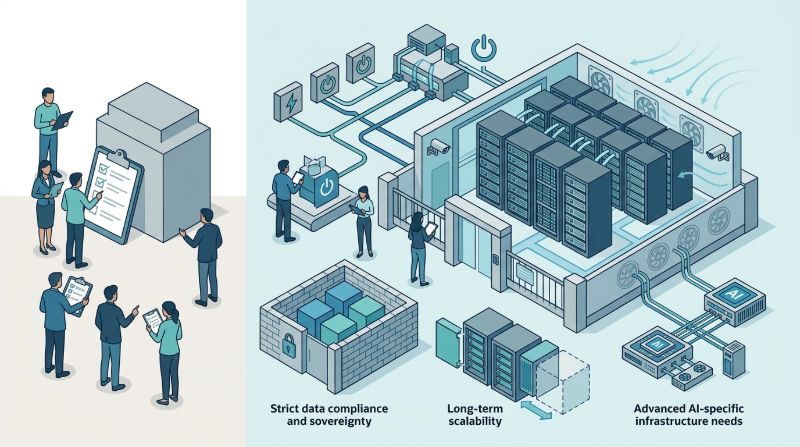
Each surface maps to a different control family, and each one has failed audits when treated casually:
- Repository reach: agents inherit whatever credentials and scope you give them, so reach is a data-classification question first and a tooling question second.
- Prompt and telemetry flows: code snippets, error messages, and secrets travel to model inference; the flow defines where your data-processing obligations follow.
- Change provenance: agent-proposed changes must remain distinguishable from human changes all the way through review gates.
- Audit reconstruction: after an incident, you must be able to reconstruct which agent ran, with what permissions, producing which change from which prompt.
Enterprise deployment guidance converges on the same baseline controls for these surfaces: sandbox isolation for execution, audit logging for reconstruction, SSO and RBAC for identity, and deployment-model controls that keep data inside your chosen boundary.
Shared Responsibility: Vendor, Model Host, and Enterprise
Split ownership into three layers: the agent vendor owns product controls such as sandboxing, permission scoping, and approval gates; the model host owns the inference boundary, including the physical and logical isolation of the serving environment; the enterprise owns identity, data classification, repository policy, and the decision inventory of where agents may operate. Nothing in a vendor feature list transfers the enterprise obligations to classify data and approve operating boundaries.
| Layer | Owns | Cannot Delegate |
|---|---|---|
| Agent vendor | Sandbox isolation, permission scoping, review gates, product audit logs | Your data classification and operating-boundary approval |
| Model host | The inference boundary: physical and logical isolation of serving, hosting location, infrastructure attestations | Your decision that a given workload may use this boundary |
| Enterprise | Identity (SSO, RBAC), data classification, repository policy, agent inventory, approval of operating boundaries | Nothing; obligations start and end here |
Governance analyses consistently put agent discovery and inventory first: you cannot govern agents you have not enumerated. Inventory feeds the boundary decision, the boundary decision drives the responsibility split above, and the split drives which evidence each party owes you. Where the model host layer matters most, dedicated single-tenant infrastructure such as OneSource Cloud keeps agent inference inside a physically isolated serving boundary in secure U.S. data centers rather than a shared virtualized estate, which is the host-layer equivalent of a clean room.
Evidence Artifacts That Prove the Controls Work
Four artifact classes make agent operations auditable: immutable audit logs capturing agent actions, prompts sent, and outputs produced; approval records linking each merged agent change to a human review gate; data-flow documentation showing where code, prompts, and telemetry are stored and processed; and the infrastructure attestation for the inference boundary, such as single-tenant isolation and hosting location. Collect them continuously, not at audit time.
Four artifact classes make the program auditable end to end:
- Immutable action logs: agent identity, permissions exercised, prompts sent, outputs produced, with tamper-evident retention.
- Approval linkage: each merged agent change traceable to a human review gate record.
- Data-flow documentation: where code, prompts, and telemetry are stored and processed, including the hosting region of model inference.
- Boundary attestation: evidence for the inference environment itself, such as single-tenant isolation, SOC 2 Type II audit readiness, and hosting location.
Collect continuously, not at audit time. Retroactive reconstruction from chat threads and ticket comments fails audits predictably; pipeline-native evidence passes them.
Residual Risk and the Review Cadence
Three risks survive good controls: prompt-injection paths that manipulate agent behavior inside the permission boundary, silent scope creep as repositories and permissions accumulate, and vendor or model changes that alter data flows after approval. Mitigate with periodic re-review tied to triggers (new agent version, new repository class, vendor model change), spot checks of approval-gate integrity, and a documented acceptance of the residual risk by the accountable owner.
Three risks survive good controls, and each has a practical mitigation:
| Residual Risk | Mitigation | Trigger for Re-Review |
|---|---|---|
| Prompt injection inside the permission boundary | Scoped permissions, sandboxing, injection testing in review | New agent version or new tool integration |
| Scope creep in repositories and permissions | Quarterly entitlement review against the inventory | New repository class or team onboarded |
| Vendor or model changes altering data flows | Change-notification terms and re-approval for flow changes | Vendor model update or deployment-model change |
Close the loop by naming the accountable owner who formally accepts the residual risk after each re-review. An accepted risk with an owner is a governance position; an unowned one is a future incident report.
FAQ
Do AI coding agents need a compliance review separate from the model they use?
Yes. The model review covers weights, hosting, and data flows of inference; the agent adds repository and secret reach, tool permissions, change provenance into review gates, and its own telemetry. Agent operations need their own inventory, boundary decision, and evidence chain even when the underlying model passed review, because the agent is the actor your controls must govern.
Why run coding-agent models on single-tenant infrastructure?
OneSource provides single-tenant bare-metal GPU capacity in secure U.S. data centers, so agent prompts, model inference, and logs remain inside one physically isolated environment. That makes the inference boundary enforceable by hardware allocation rather than configuration alone, and auditable end to end by your compliance team.
Related Articles
Recommended Reading
-
How Paged Attention Manages Inference KV Cache
-
Google Cloud GPU Pricing: What Enterprise AI Teams Should Evaluate Before Provisioning
-
Paperspace Pricing 2026: GPU Cost Breakdown
-
AI Infrastructure Costs: Controlling Enterprise GPU Spending
-
CoreWeave Enterprise GPU Cloud: Evaluation for AI Teams
-
CoreWeave vs Lambda Labs: GPU Cloud Provider Comparison
-
AWS GPU Pricing: Instance Types, Cost Structure & Alternatives Guide
-
CoreWeave Alternatives: Compare GPU Clouds
latest articles
-
Which GPU Quote Terms Break at Renewal: Price and Capacity Fixes
-
Biotech GPU Computing Requirements: Genomics and Drug Discovery
-
Training Network Encryption: Requirements and Throughput Costs
-
GPU Depreciation Schedule and Monthly Cost at 3, 5, and 6 Years
-
Inference vs Training Storage Requirements for AI Clusters
-
GB200 NVL72 Rack Power Requirements for Facility Planning
-
How to Verify Data-Center GPU Firmware Measurement and Security
-
Why GPUs Stall on NFS During Training: Diagnosis and Fixes
-
GPU Driver and Firmware Pairing Without Deployment Delays
-
Measuring CUDA Graph Impact on LLM Inference Response Times