
What Is AI Infrastructure? Core Components and Deployment Models
Quick Answer: AI infrastructure is the integrated hardware and software environment that enterprises use to develop, train, deploy, and serve AI models at scale. It combines GPU compute, high-throughput storage, low-latency networking, orchestration software, and the security and operations practices that keep model workloads running reliably.
For enterprises, AI infrastructure determines how quickly models train, how much inference serving costs, and whether AI features reach production on time. The gap between generic IT infrastructure and infrastructure built for AI is not hardware alone: it is how compute is organized for parallel execution, how data moves, and how workloads are scheduled, monitored, and protected.
Understanding AI infrastructure begins with its building blocks: GPU compute, high-performance storage, networking, orchestration, and operations. These components serve two workload types, training and inference, with different demands. Deployment choices, from public cloud to private and fully managed environments, then shape cost, control, and security.
What Does AI Infrastructure Include?
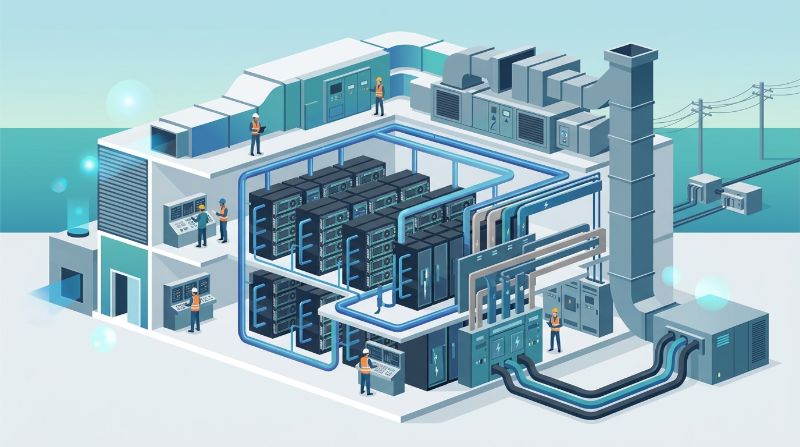
AI infrastructure is assembled from five interdependent layers, each of which becomes a bottleneck if sized or designed poorly. The table below summarizes what each layer handles and where problems typically surface.
| Layer | What It Handles | Where Problems Surface |
|---|---|---|
| GPU compute | The parallel math behind model training and inference | Insufficient capacity, idle GPUs, uneven utilization |
| Storage | Datasets, checkpoints, model weights, retrieval corpora | Slow data access that starves GPU utilization |
| Networking | Node-to-node communication in distributed workloads | Interconnect bandwidth and latency limits |
| Orchestration | Scheduling, quotas, and environment management | Fragmented environments, contested GPU access |
| Security and operations | Access control, monitoring, lifecycle management | Compliance gaps, unplanned downtime |
GPU Compute: The Core of AI Processing
GPU compute is the processing backbone of AI infrastructure. GPUs execute the matrix and tensor operations that make modern model training and inference practical, and production clusters scale from a handful of GPUs to thousands of interconnected nodes. Capacity planning is a constant negotiation between model size, training time, and budget, which is why teams running sustained workloads often prefer private AI infrastructure with dedicated, non-shared capacity over shared on-demand pools that introduce performance variability and quota uncertainty.
Storage: Feeding Models and Retrieval Systems
Storage in an AI stack feeds training jobs, checkpoints, and retrieval pipelines. Training datasets are measured in terabytes to petabytes, and models read from storage continuously between compute steps, so an under-provisioned storage layer leaves expensive GPUs idle while they wait for data. Inference and retrieval-augmented generation add latency sensitivity: systems need fast access to embeddings, indexes, and cached model state. An AI storage architecture tuned for the workload, rather than general-purpose file storage, is what keeps data movement from becoming the bottleneck.
Networking: The Scaling Boundary
Networking determines how fast GPUs communicate, and for distributed training it is often the real performance ceiling. When a model spans many nodes, every training step exchanges gradients across the cluster; if the network cannot keep up, GPUs spend more time waiting than computing. Low-latency, high-bandwidth fabrics and congestion management matter more as cluster size grows. High-performance AI networking design treats inter-node communication as a first-class constraint, which is why it belongs in the architecture conversation before nodes are ordered, not after performance problems appear.
Orchestration, Security, and Operations
Orchestration software sits between the hardware and the models. It schedules training jobs, enforces GPU quotas across teams, manages development environments, and exposes utilization metrics. Without it, research, engineering, and product teams compete for GPUs with little visibility, and clusters sit idle while queues grow. OnePlus Platform, OneSource Cloud's AI orchestration platform, gives multi-team GPU clusters a single scheduling, quota, and observability layer.
Security and operations are the least visible layer and the most common source of production incidents. Access control, encryption, monitoring, patching, and lifecycle management determine whether a cluster stays healthy through long training runs and whether sensitive data paths satisfy compliance requirements. Enterprises without the in-house team to run these functions often turn to fully managed services that bundle operations with dedicated hardware.
How AI Infrastructure Differs from Traditional IT Infrastructure
Traditional IT infrastructure is built around serial, latency-tolerant workloads: web servers, databases, and business applications that process discrete requests. AI infrastructure is built around parallel, data-intensive workloads that continuously move large volumes of data through the system. That difference changes what matters most: utilization of every compute second, aggregate throughput rather than per-request latency, and failure handling for jobs that run for days.
The consequences show up in hardware choices and operating patterns. AI systems need GPU-accelerated compute instead of CPU-centric servers, storage tiers that sustain high bandwidth, and network fabrics with low latency and no packet loss under load. They also fail differently: a failed transaction can be retried in seconds, while a failed training run can lose days of progress unless checkpointing and job recovery are designed in from the start.
| Dimension | Traditional IT Infrastructure | AI Infrastructure |
|---|---|---|
| Workload type | Discrete, serial requests | Long-running, parallel jobs |
| Compute | CPU-centric servers | GPU-accelerated clusters |
| Data patterns | Small requests, moderate volumes | Terabyte-scale datasets, continuous movement |
| Performance focus | Per-request latency | Throughput and cluster utilization |
| Failure handling | Retry in seconds | Checkpointing and resumable jobs |
| Bottleneck location | CPU, memory, disk I/O | GPU utilization, network, storage bandwidth |
Training vs Inference: Different Demands on the Same Stack
Training builds a model by processing large datasets in repeated passes, and its infrastructure demand is throughput: how many compute operations can be executed per hour and how fast data can be fed to the GPUs. Training clusters are organized as tightly connected nodes, where low-latency networking between GPUs determines scaling efficiency. Interruptions are tolerable in principle but expensive, so checkpointing and job resilience are core design requirements.
Inference runs trained models to answer live requests, and its demand is latency: responses must return quickly and consistently under unpredictable load. Inference infrastructure emphasizes serving concurrency, model batching, and the ability to scale capacity with request volume. Storage plays a different role, supporting retrieval-augmented generation and cached model state rather than bulk data streaming.
| Dimension | Training | Inference |
|---|---|---|
| Primary metric | Throughput and job completion | Latency and consistency |
| Workload profile | Long-running batch jobs | Short, high-concurrency requests |
| Network role | High bandwidth between nodes | Low latency on serving paths |
| Storage role | Streaming datasets, checkpoints | RAG indexes, embeddings, cached state |
| Scaling pattern | Add nodes for larger models | Scale with request load |
Most enterprises run both workload types, which is why a single infrastructure environment must support conflicting priorities: maximizing utilization for training while protecting latency for serving. This is the design problem an orchestration layer solves by separating, scheduling, and prioritizing the two workload classes on shared hardware.
AI Infrastructure Deployment Models: Public Cloud, Private, and Managed
Public cloud is the default starting point for many AI teams because it offers on-demand GPU capacity, a broad service catalog, and no upfront hardware investment. The trade-offs appear at scale: per-hour GPU pricing fluctuates with demand, capacity quotas can stall training runs, and sensitive datasets may not qualify for public cloud residency. For exploratory work and variable workloads, public cloud remains a natural fit.
Private AI infrastructure gives an organization exclusive access to its own GPU cluster, deployed in its own facility or in a provider's dedicated environment. The benefits are control over performance, data isolation, and predictable cost; the requirements are capital commitment, hardware planning, and the operational team to keep the cluster healthy. Organizations with sustained training demand, sensitive data, or compliance constraints often conclude that dedicated infrastructure is the lower-risk choice over the long term.
Managed models combine the control of dedicated infrastructure with outsourced operations. The provider owns the hardware and handles the day-to-day work, including 24/7 monitoring, patching, capacity planning, and performance validation, while the customer's teams focus on model development. Managed AI infrastructure is the middle path for enterprises that need dedicated capacity and data control without building an in-house GPU operations organization.
Why Enterprises Need Dedicated AI Infrastructure Now
The current wave of investment is driven by two structural changes. First, large language models shifted training from experimental clusters to industrial-scale compute: model parameters grew by orders of magnitude, and training runs now span hundreds or thousands of GPUs, making network and storage design as important as raw chip count. Second, inference moved from batch scoring to real-time product features, raising the bar for latency, availability, and cost discipline.
These changes land in concrete ways across the organization. AI teams outgrow shared infrastructure, finance teams need predictable budgets, security and legal teams need clarity on where data resides, and operations teams need tooling that keeps clusters productive. The result is that infrastructure decisions now involve executives, finance, and compliance alongside ML engineers, and providers increasingly offer private, managed, and orchestrated options tailored to each of these demands.
FAQ
What is AI infrastructure in simple terms?
AI infrastructure is the collection of hardware and software that supports AI models: GPU servers for compute, storage systems for datasets, networking for communication between nodes, and orchestration tools that schedule and manage workloads. In simple terms, it is the system underneath a model that makes training and serving possible, the way a database and application servers sit beneath a business application.
What drives the cost of AI infrastructure?
Three cost drivers dominate: compute, data movement, and operations. GPU capacity is the largest line item, and its cost depends on hardware generation, utilization, and whether pricing is per-hour or fixed monthly. Storage and network costs grow with dataset size and cluster scale. Operations add another layer: staff time for monitoring, patching, and troubleshooting, which is why managed services often change the total-cost equation.
Do companies need to build their own AI infrastructure?
Not always. Many teams start with public cloud GPUs or managed services and never own hardware. Building your own infrastructure makes sense when workloads are sustained and predictable, when data sensitivity rules out public cloud, or when control over performance and cost matters more than flexibility. The decision should weigh utilization, in-house operational capacity, and compliance requirements before committing capital to dedicated hardware.
Is public cloud enough for enterprise AI workloads?
Public cloud works well for experimentation, variable workloads, and teams that value flexibility over control. It becomes limiting when GPU demand is sustained, because per-hour pricing and capacity quotas make cost and availability harder to predict; when datasets are regulated; and when organizations need consistent performance for production inference. Enterprises with these constraints typically evaluate private or managed environments as complements or replacements for public cloud.
What skills and staff does AI infrastructure require?
Operating AI infrastructure needs expertise across several areas: GPU cluster administration, networking and storage tuning, orchestration platform management, and security compliance. A small cluster can be run by one or two platform engineers, but teams running long training cycles or regulated workloads often need dedicated operations coverage with monitoring, incident response, and capacity planning. Organizations without this headcount typically prefer fully managed infrastructure providers that operate the stack on their behalf.
Summary
AI infrastructure is the compute, storage, networking, orchestration, and operations layer that determines how fast models train, how consistently they serve, and how much they cost to run. It differs from traditional IT in its reliance on parallel GPU compute, high-throughput data movement, and long-running job resilience. Training and inference place different demands on the same stack, and deployment choices range from public cloud to private and fully managed environments. Understanding these fundamentals gives enterprise teams the framework to evaluate infrastructure decisions as their AI initiatives grow.
Next step: See how OneSource Cloud builds, orchestrates, and manages enterprise AI infrastructure →
Related Articles
Recommended Reading
latest articles
-
GPU Hardware Spares and RMA: Fleet Logistics and Downtime Risk
-
AI Infrastructure Energy Reporting: What Enterprises Should Measure
-
Balanced Bandwidth per GPU: Sizing Cluster Networks for LLM Training
-
Model Flops Utilization: Why Training Efficiency Collapses and How to Fix It
-
How Much Spare GPU Capacity Inference Needs for Failover
-
Multi-Cloud GPU Management Overhead: The Hidden Cost of Split Estates
-
ITAR vs CUI for GPU Hosting: Controls That Actually Differ
-
RAG Corpus Refresh: Reindexing, Re-Embedding, and Freshness Operations
-
How to Cut LLM Latency Without Buying More GPUs
-
Batch vs Real-Time LLM Inference: When to Batch and What It Saves