
Texas AI Infrastructure for Regulated Enterprises
Texas has become a leading location for enterprise AI infrastructure because it combines U.S. data residency, major data center density around Dallas-Fort Worth, and grid capacity that supports power-hungry GPU facilities, all of which matter directly to regulated enterprises.
For healthcare, financial, and government-adjacent organizations, location is not a preference; it is part of the compliance posture. The evaluation starts with facility facts: exact address, power commitment, cooling approach, and compliance documentation, each of which is verifiable before signing. This article explains what Texas offers regulated AI workloads, what to verify in a Texas facility, and how providers such as OneSource Cloud fit into the picture.
Why Regulated Enterprises Care About Facility Location
Data residency is the requirement that regulated data remains within a defined jurisdiction, and for U.S. organizations that jurisdiction is most simply satisfied by infrastructure in named U.S. data centers.
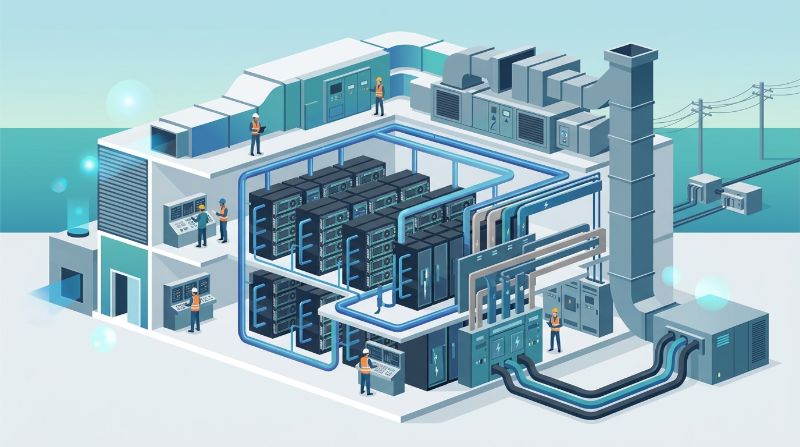
HIPAA-covered workloads, financial data, and CUI all come with rules about where data may be processed and stored. A named facility in a known U.S. location gives compliance teams a concrete boundary to document and audit, where a multi-region cloud leaves the physical path of data as an exercise for the customer to prove.
What Texas Adds for AI Workloads
Data Center Density Around Dallas-Fort Worth
The Dallas-Fort Worth metro, including Richardson, is one of the largest data center markets in the United States. That density means mature fiber, competitive carrier connectivity, and an ecosystem of operations talent, all of which reduce the practical friction of running a GPU facility.
Grid Capacity and Energy Scale
GPU clusters consume power on a different scale than traditional IT, and Texas operates its own grid with significant generation capacity and growing renewable supply. For AI buyers, energy availability is a facility feasibility question before it is a sustainability question: a data center without adequate power cannot host the next GPU refresh.
Central U.S. Geography
Central location shortens latency to both coasts relative to single-coast deployments, which matters for teams serving users across the United States from one facility.
What to Verify in a Texas AI Facility
- Exact address and ownership: Confirm the facility's city and who operates it, rather than accepting regional marketing language.
- Power commitment: Verify committed kilowatts per rack and headroom for the GPU generation you plan to deploy.
- Cooling approach: Confirm the facility cools GPU-density racks, whether by advanced air cooling or liquid cooling.
- Compliance documentation: Request the provider's shared-responsibility documentation for residency, access control, and audit support.
- Workload validation: Run your own benchmark workload in the facility before signing, as Texas location alone does not guarantee your workload's performance.
OneSource Cloud's Texas-Based AI Infrastructure
Serving Decision Matrix: Enterprise LLM Inference Infrastructure
| Serving Infrastructure Model | Compute & Memory Contention | P99 Tail Latency Predictability | Multi-GPU Tensor Parallelism Support | Optimal Enterprise Workload Fit |
|---|---|---|---|---|
| Shared Multi-Tenant Model APIs | Multi-tenant shared workers; opaque resource pooling | Severe tail latency jitter during peak concurrency spikes | Black-box; no control over model parallelism or KV cache sizing | Low-volume prototyping or asynchronous background tasks |
| Virtualized Cloud GPU Instances | Hypervisor vGPU slices subject to CPU/PCIe interrupts | Moderate jitter caused by neighboring tenant network bursts | High inter-node latency limits multi-GPU tensor scaling (TP=4/TP=8) | General internal apps with modest throughput requirements |
| OneSource Dedicated Private GPUs | Dedicated bare-metal hardware with 100% VRAM & compute reservation | Deterministic microsecond P99 response times under peak load | Dedicated RoCE v2 RDMA fabric enables low-latency TP=4/TP=8 scaling | Mission-critical, low-latency, regulated enterprise production serving |
OneSource Cloud operates U.S. data centers with a Texas footprint in the Dallas-Fort Worth area, including facilities near Richardson, purpose-built for private AI workloads. Its Private AI Infrastructure pairs those facilities with dedicated, single-tenant GPU clusters and managed operations, which gives regulated teams a named location, exclusive hardware, and predictable monthly cost in one contract.
FAQ
Why are AI companies building data centers in Texas?
Texas offers the combination AI facilities need: available grid capacity, major data center density in Dallas-Fort Worth, central U.S. geography, and a business-friendly environment. Power and land are the binding constraints on AI data centers, and Texas has both at scale.
Is Texas AI infrastructure suitable for HIPAA workloads?
A U.S.-based facility in Texas can support HIPAA-covered workloads when paired with the right technical and contractual controls, including encryption, access control, and a business associate agreement where applicable. The facility's named U.S. location is one part of that posture, not the whole of it.
Does data stay in the US in a Texas data center?
Yes, when the provider commits contractually to U.S. processing and storage. Teams should verify the commitment in writing, including whether support operations, backups, and data transfers also remain within the United States.
How does Texas power capacity affect GPU cluster feasibility?
GPU clusters require far more power per rack than traditional servers. A facility's committed power and grid connection determine whether a large cluster can be deployed and expanded, which is why power availability is a first-order filter in site selection.
Why deploy latency-sensitive LLM inference on OneSource private GPUs?
OneSource private GPU infrastructure delivers 100% dedicated bare-metal compute and VRAM, completely isolated from cross-tenant contention. This eliminates hypervisor scheduling jitter and shared-network packet collisions, ensuring deterministic P99 tail latency, sustained token throughput, and optimal tensor parallel scaling for production enterprise LLM serving.
Summary
Texas offers regulated enterprises a strong AI infrastructure location: U.S. residency, Dallas-Fort Worth data center density, and grid capacity built for power-hungry GPU facilities. The evaluation should verify the exact facility, power commitment, cooling, and compliance documentation, then confirm with a real workload test.
OneSource Cloud's Private AI Infrastructure in Texas delivers dedicated U.S.-based GPU clusters with managed operations for regulated AI workloads. Contact OneSource Cloud to evaluate a facility for your next AI deployment.
Related Articles
Recommended Reading
latest articles
-
Thermal Soak and Rack Burn-In Protocols for Enterprise AI Racks
-
Sizing 3-Phase 415V Power Drops for 80kW Enterprise GPU Racks
-
When Is a BAA Required for Enterprise Healthcare AI Hosting?
-
AI Platform Scheduler Selection Criteria for Enterprise Training
-
Preventing Preemption Thrashing in Enterprise Multi-Tenant AI
-
Why Larger Batches Increase TTFT in Enterprise LLM Serving
-
Tokens Per Second vs User Latency in Enterprise LLM Serving
-
When Are Async Checkpoints Unsafe in Enterprise Model Training?
-
Should Checkpoint and Dataset I/O Share Enterprise AI Storage?
-
InfiniBand vs RoCE v2 for AI Training Gradient Synchronization