
Private GPU Cloud for Training and Inference: Sizing Both Halves
A private GPU cloud for training and inference is a single-tenant accelerator environment sized, partitioned, and operated to serve both compute-heavy training jobs and latency-sensitive inference workloads without either half starving the other. The hard part is not buying GPUs; it is designing the cluster so training bursts do not break inference SLAs.
Training and inference look like similar workloads from a distance. Up close they stress the stack in opposite ways. Training wants sustained throughput across many nodes for hours or days. Inference wants low-latency responses on a smaller number of accelerators, all the time. A cluster built for one will underperform on the other unless the design accounts for both from the start.
This guide covers how to size, partition, and operate a private GPU cloud that serves both training and inference well. It is written for platform engineers, MLOps teams, and AI infrastructure leads responsible for clusters that must do both jobs.
Why Training and Inference Stress the Stack Differently
Understanding the difference is the foundation for every other design decision. The table below maps how each workload type stresses compute, storage, networking, and operations.
| Dimension | Training | Inference |
|---|---|---|
| GPU profile | Multi-node, sustained hours to weeks | Smaller footprint, always-on |
| Primary constraint | Throughput across collective operations | Latency on token generation and time-to-first-token |
| Storage | High-throughput training data and checkpoint writes | Low-latency model loading and vector store for RAG |
| Networking | Inter-node bandwidth for distributed training | East-west traffic for serving and autoscaling |
| Operational focus | Job scheduling, checkpoint reliability | SLA uptime, autoscaling, graceful degradation |
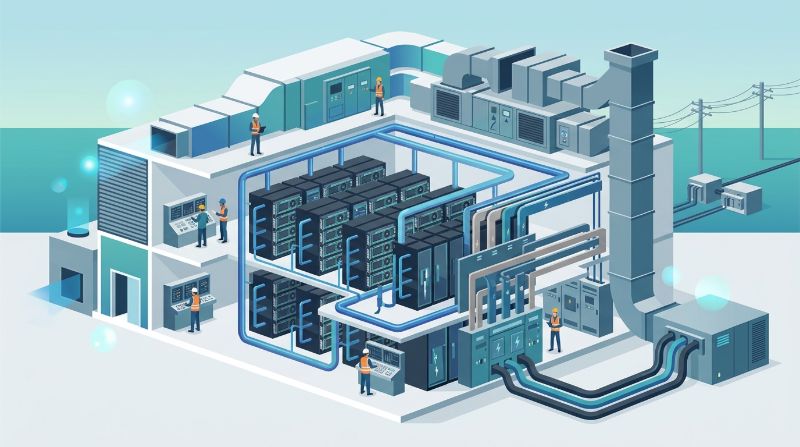
The differences compound when both workloads share a cluster. Training bursts consume capacity that inference needs for SLA headroom. Checkpoint writes saturate storage that inference needs for low-latency model loading. Collective operations saturate networking that inference needs for serving. Each contention point requires explicit design rather than hope.
Sizing a Cluster for Both Workloads
Sizing starts from workload profiles and works outward to GPU count, partitioning, and headroom. The workflow below converts workload characteristics into infrastructure requirements.
Step 1: Separate Steady-State Inference Demand
Online inference has predictable steady-state demand plus a peak multiplier. Size the inference partition to serve expected steady-state demand plus peak headroom, typically 20 to 30 percent above expected peak. This partition must be available all the time, which means it cannot be borrowed for training without breaking inference SLAs.
Step 2: Map Training Demand Cycles
Training demand is bursty and scheduled. Pre-training runs are large and multi-week. Fine-tuning jobs are smaller and more frequent. Evaluation pipelines run on predictable cycles. Mapping these cycles against the inference partition's steady-state demand identifies when training capacity is available without compromising inference.
Step 3: Decide Partitioning Model
Three partitioning models cover most cases. Each trades flexibility for SLA protection differently.
| Partitioning Model | How It Works | Tradeoff |
|---|---|---|
| Physical partition | Dedicated nodes for training and inference | Strongest SLA protection, lowest utilization |
| Logical partition | Same hardware, quota-enforced separation | Higher utilization, weaker isolation |
| Borrow-and-return | Inference partition lends capacity to training off-peak | Highest utilization, requires strict scheduling |
The physical partition suits workloads with strict inference SLAs and sufficient budget. The logical partition suits workloads with moderate SLA requirements and utilization pressure. The borrow-and-return model suits workloads with predictable off-peak windows where inference demand drops reliably.
Step 4: Size Headroom for Failure
Both partitions need failover capacity. Inference partitions need failover for node failures within the inference SLA. Training partitions need failover for node failures that would otherwise force job restart from checkpoint. Sizing to exactly peak load on either side leaves no room for graceful degradation.
Storage Design for Mixed Workloads
Storage is where mixed training and inference clusters most often fail. The two workloads want different storage characteristics, and a single tier cannot satisfy both well.
Tiered Storage for Mixed Workloads
AI storage architecture for mixed workloads separates hot and cold paths. High-throughput parallel filesystems serve active training data and checkpoint writes. Hot object stores serve inference model loading and RAG vector indexes with low latency. Capacity archives hold cold training data and model version history. Each tier is sized for its workload rather than paying for performance the workload does not use.
Checkpoint Bandwidth and Inference Latency
Checkpoint writes during training can saturate storage that inference needs for low-latency reads. The fix is either storage tiering that separates checkpoint writes from inference reads, or scheduling that batches checkpoint writes outside inference peak windows. Both approaches require explicit design rather than default configuration.
Networking Design for Mixed Workloads
Networking topology must support both training collective operations and inference serving traffic. High-performance AI networking decisions determine whether both workloads can coexist without contention.
Training Networking Requirements
Distributed training generates large collective operations that consume inter-node bandwidth. Undersized fabrics throttle collective operations, which prevents training from scaling linearly across nodes. RDMA fabrics or equivalent high-bandwidth, low-latency interconnects are typical for training-heavy partitions.
Inference Networking Requirements
Inference serving generates east-west traffic between serving workers, autoscalers, and front-end proxies. Undersized east-west capacity creates latency spikes under load. For tensor-parallel inference, the inter-GPU networking requirements approach training-like characteristics, which is why large-model inference and training often share networking design.
Orchestration for Mixed Workloads
Orchestration is what makes mixed workloads actually work in production. Without quota-aware scheduling, training jobs will consume capacity that inference needs for SLA headroom.
Quota-Aware Scheduling
The orchestration layer must enforce quotas that protect inference capacity from training bursts. AI orchestration platforms provide quota enforcement, priority scheduling, and preemption policies that allow training to use available capacity without breaking inference SLAs.
Preemption and Priority
When demand exceeds capacity, preemption policies determine which jobs yield. Inference workloads should typically run at higher priority than training jobs, because inference SLA violations affect users directly while training delays affect internal schedules. Preemption policies must account for checkpoint recovery so training jobs can resume rather than restart.
Autoscaling for Inference
Inference partitions need autoscaling that responds to traffic changes within the SLA. Autoscaling against the inference partition's allocated capacity is straightforward; autoscaling that borrows from the training partition requires explicit scheduling rules.
Operational Practices for Mixed Workloads
Mixed workloads generate operational complexity that single-workload clusters do not. Three practices sustain production reliability.
Continuous SLA Monitoring
Track inference latency, error rates, and uptime separately from training throughput and utilization. Managed AI infrastructure services provide this monitoring as a core capability; self-operated clusters must build it.
Planned Maintenance Windows
Patching, upgrades, and capacity changes affect both partitions. Planned maintenance windows must account for inference SLA requirements (changes during low-traffic windows) and training schedule requirements (changes between checkpoint cycles rather than mid-run).
Failure Injection Testing
Mixed-workload clusters degrade in non-obvious ways under failure. Injecting node failures, network partitions, and storage incidents during testing verifies that both partitions degrade gracefully rather than catastrophically.
Cost Considerations for Mixed Workload Clusters
Mixed workload clusters carry cost considerations that single-workload clusters do not. Three factors move the economics.
- Partitioning overhead. Physical partitions carry lower utilization than logical partitions or borrow-and-return models, which raises unit cost.
- Storage tiering cost. Tiered storage costs more than single-tier storage but prevents the GPU starvation that single-tier designs cause.
- Operational complexity. Mixed workload operations are more complex than single-workload operations, which raises the case for managed services.
The right balance matches the workload's SLA requirements, utilization pressure, and operational capacity. Cost optimization comes from matching configuration to workload, not from buying the cheapest hardware.
FAQ
Can a private GPU cloud serve both training and inference?
Yes, with deliberate partitioning and quota-aware orchestration. Training and inference stress the stack differently, and running both on the same cluster without isolation creates contention. Physical, logical, or borrow-and-return partitioning models each trade flexibility for SLA protection differently.
How do I size a GPU cluster for training and inference?
Separate steady-state inference demand with peak headroom first, then map training demand cycles against the inference partition, then decide partitioning model, then size failover headroom for both partitions. Sizing to exactly peak load on either side leaves no room for graceful degradation.
What storage does a mixed training and inference cluster need?
Tiered storage that separates high-throughput parallel filesystems for training data and checkpoint writes from hot object stores for inference model loading and RAG vector indexes. Single-tier storage cannot satisfy both workloads without either starving training throughput or degrading inference latency.
How do I prevent training bursts from breaking inference SLAs?
Through quota-aware orchestration that protects inference capacity, preemption policies that prioritize inference over training, and partitioning models that physically or logically separate the two workloads. Without these controls, training bursts will consume capacity inference needs for SLA headroom.
Does mixed workload clustering cost more than single-workload clustering?
Usually yes, because partitioning overhead, storage tiering, and operational complexity all add cost. The premium buys the ability to serve both workloads on one cluster rather than maintaining separate training and inference environments, which can be more expensive overall despite higher unit cost.
Should I operate a mixed workload cluster myself or use managed services?
Teams with deep platform engineering and operations expertise can self-operate. Teams without that capacity usually benefit from managed services, because mixed workload operations are more complex than single-workload operations and the operational burden scales faster than the cluster size.
Summary
A private GPU cloud that serves both training and inference succeeds or fails on partitioning, storage tiering, networking topology, and orchestration. Training and inference stress the stack differently, and a cluster built for one will underperform on the other unless the design accounts for both from the start.
Sizing separates steady-state inference demand from training demand cycles, partitioning protects inference SLAs from training bursts, storage tiering prevents checkpoint writes from degrading inference latency, and quota-aware orchestration enforces the boundaries. Mixed workload operations are more complex than single-workload operations, which raises the case for managed services when internal operations capacity is limited.
Next step: Explore OneSource Cloud's private GPU cloud for training and inference →
Related Articles
Recommended Reading
-
Google Cloud GPU Pricing: What Enterprise AI Teams Should Evaluate Before Provisioning
-
Paperspace Pricing 2026: GPU Cost Breakdown
-
AI Infrastructure Costs: Controlling Enterprise GPU Spending
-
CoreWeave Enterprise GPU Cloud: Evaluation for AI Teams
-
CoreWeave vs Lambda Labs: GPU Cloud Provider Comparison
latest articles
-
Open-Source LLM Deployment: Requirements and Real Cost Breakdown
-
AI Search Assistants Under Data Residency: Architectures and Evidence
-
LLM Inference GPUs Compared: A100, H100, H200, or B200 for Production
-
LLM Deployment Best Practices: An Enterprise Stage-by-Stage Checklist
-
HIPAA Patient Scheduling AI: Controls, Consent, and Evidence
-
Cloud-Agnostic LLM Deployment: Architecture Principles Against Lock-In
-
HIPAA-Compliant AI Tools for Healthcare: Categories and Evaluation
-
Batch vs Real-Time LLM Inference: Cost, Latency, and Fit
-
Model Deployment Strategies Compared: Canary, Blue-Green, Shadow, Rolling
-
GPU Rental vs Owning: Cost, Commitment, and When to Buy