
How Private GPU Cloud Data Residency Works
Private GPU cloud data residency works by keeping every data surface — training data, checkpoints, inference logs, vector databases — on dedicated infrastructure within a defined geographic boundary, with controls and evidence proving the data stays there. For the full residency framework, see data residency compliance checklist. For ensuring residency, see how to ensure AI data residency.
How Residency Works on Private GPU Infrastructure
Dedicated infrastructure simplifies residency by removing multi-tenancy as a data movement vector. The data surfaces are mapped to named physical locations, access is restricted to in-region identities, encryption keys reside within the boundary, and all movement is logged. Residency on private infrastructure is verifiable because the boundary is explicit — named data centers, named subprocessors, bounded access. For the comparison with sovereignty, see data residency vs data sovereignty.
Verification
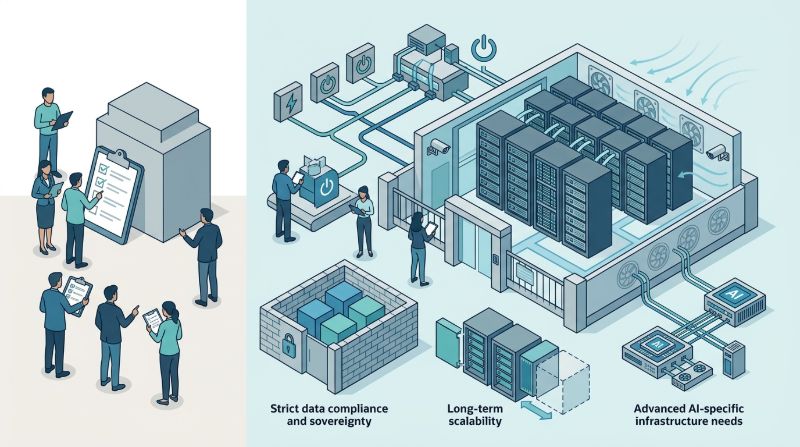
Demand evidence: physical data center location documentation, storage and backup residency configuration, encryption key residency, access control scoping to in-region identities, and access logs showing region-bound activity. A provider who cannot produce this evidence cannot support residency. For the audit framework, see auditing an AI infrastructure provider.
FAQ
How does private GPU cloud residency work differently from public cloud?
Private GPU infrastructure is dedicated and single-tenant with named locations, making the residency boundary explicit and the subprocessor list small. Public cloud uses shared infrastructure with complex data flows and a larger, harder-to-verify subprocessor footprint. Private simplifies verification because the boundary is clear. For the comparison, see data residency vs data sovereignty.
Summary
Private GPU cloud residency works by keeping data on dedicated infrastructure within a defined boundary, verified with evidence. For the full framework, see data residency compliance checklist.
Related Articles
Recommended Reading
-
Google Cloud GPU Pricing: What Enterprise AI Teams Should Evaluate Before Provisioning
-
Paperspace Pricing 2026: GPU Cost Breakdown
-
CoreWeave Enterprise GPU Cloud: Evaluation for AI Teams
-
AI Infrastructure Costs: Controlling Enterprise GPU Spending
-
CoreWeave vs Lambda Labs: GPU Cloud Provider Comparison
latest articles
-
Open-Source LLM Deployment: Requirements and Real Cost Breakdown
-
AI Search Assistants Under Data Residency: Architectures and Evidence
-
LLM Inference GPUs Compared: A100, H100, H200, or B200 for Production
-
LLM Deployment Best Practices: An Enterprise Stage-by-Stage Checklist
-
HIPAA Patient Scheduling AI: Controls, Consent, and Evidence
-
Cloud-Agnostic LLM Deployment: Architecture Principles Against Lock-In
-
HIPAA-Compliant AI Tools for Healthcare: Categories and Evaluation
-
Batch vs Real-Time LLM Inference: Cost, Latency, and Fit
-
Model Deployment Strategies Compared: Canary, Blue-Green, Shadow, Rolling
-
GPU Rental vs Owning: Cost, Commitment, and When to Buy