
Private AI Infrastructure Architecture: Requirements by Layer
Private AI infrastructure architecture is the integrated design of compute, storage, networking, orchestration, and facilities layers that together deliver sustained GPU utilization for training and inference workloads. The architecture is defined by how the layers interact, not by the strength of any single layer in isolation.
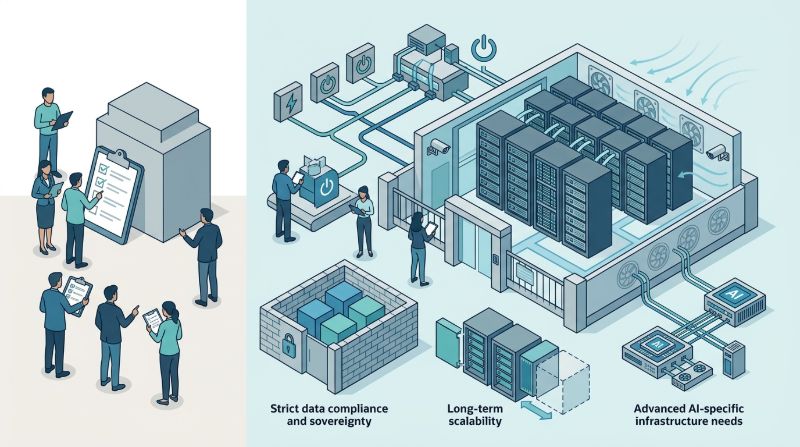
Most failed private AI clusters fail on architecture rather than hardware. Expensive accelerators sit idle because storage cannot feed them. Networking topologies throttle distributed training at six nodes when the cluster was sized for eight. Power and cooling constraints prevent the cluster from running at full load. Each failure traces back to a layer-level decision made before deployment.
This article breaks down each architecture layer, explains the requirements and tradeoffs, and shows how the layers interact. It is written for architects, platform engineering leads, and AI infrastructure owners designing or evaluating a private AI cluster.
The Five Layers of Private AI Infrastructure Architecture
A production-grade private AI cluster integrates five layers. Each layer has its own requirements, and weakness in any one will throttle the others regardless of how well the remaining layers are designed.
| Layer | Primary Requirement | Common Failure Mode |
|---|---|---|
| Compute | Sufficient GPU density, memory, and CPU-to-GPU ratio | Undersized memory forcing quantization or job rejection |
| Storage | Throughput for training data and checkpoints; latency for inference | GPU starvation when storage cannot deliver data fast enough |
| Networking | Inter-node bandwidth for distributed training and tensor parallelism | Collective operation stalls under peak load |
| Orchestration | Scheduling, quota enforcement, workspace provisioning, monitoring | Contention between teams without fair sharing policies |
| Facilities | Power density, cooling capacity, rack space, carrier diversity | Cluster cannot run at full load due to thermal or power limits |
The remainder of this article covers each layer's requirements and the decisions that determine whether the integrated architecture performs.
Compute Layer Requirements
Compute decisions start from workload profile and work outward to GPU model, node count, and refresh cadence. The GPU catalog is an input to the decision, not the starting point.
GPU Memory and Model Fit
GPU memory sets a hard floor on accelerator choice for any workload that must hold weights, KV cache, and activation memory resident. A cluster provisioned with insufficient memory per accelerator forces quantization, model sharding, or job rejection, each of which degrades either quality or throughput. Sizing memory against the largest expected workload prevents the most common compute-layer failure.
CPU-to-GPU Ratio and Host Overhead
Host CPU, memory, and local storage affect data loading, preprocessing, and orchestration overhead. Undersized host resources throttle GPU utilization even when the accelerators themselves are sufficient. Most production nodes run balanced host-to-GPU configurations rather than minimal host resources.
Refresh Cadence
Accelerator generations shift roughly every 18 to 24 months. A cluster sized for current workloads may need partial refresh to support next-generation model architectures. Architecture decisions should account for refresh paths rather than treating the initial configuration as fixed for the contract term.
Storage Layer Requirements
Storage is the most underestimated layer in private AI architecture. AI storage architecture decisions determine whether GPUs run at 90 percent utilization or stall at 60 percent waiting for data.
Tiered Storage Design
Training data, checkpoints, RAG indexes, and archives have different access patterns. A single storage tier either over-provisions cold data or under-provisions hot data. Tiered storage separates these workloads: high-throughput parallel filesystems for active training, hot object stores for inference model loading and vector indexes, and capacity archives for cold data. Each tier is sized for its workload rather than paying for performance the workload does not use.
Checkpoint Bandwidth
Large model training writes checkpoints frequently. If storage cannot absorb checkpoint writes at training speed, the training job either waits or skips checkpoints, both of which compromise either throughput or recovery. Checkpoint bandwidth should be sized against the largest expected checkpoint size and write frequency.
RAG and Inference Latency
Retrieval-augmented generation and online inference read from vector indexes and model weights under strict latency budgets. Storage latency translates directly into user-visible latency, which is why inference storage often sits on a different tier than training storage even when the underlying media is similar.
Networking Layer Requirements
Networking determines whether distributed training and tensor-parallel inference scale linearly across nodes. High-performance AI networking is a primary architecture layer, not a secondary concern.
Inter-Node Bandwidth
Distributed training generates large collective operations that consume inter-node bandwidth. Undersized fabrics create collective stalls that throttle scaling. Most production clusters use RDMA fabrics or equivalent high-bandwidth, low-latency interconnects sized for the workload's collective operation profile.
Topology and Oversubscription
Full non-blocking topologies deliver maximum throughput but cost more. Oversubscribed topologies cost less but create congestion under peak load. The right choice depends on the workload mix: training-heavy clusters usually require non-blocking fabrics; inference-heavy clusters can often tolerate some oversubscription.
East-West Isolation
Multi-workload clusters need network segmentation between workloads, tenants, or compliance boundaries. Isolation adds controls that consume switching capacity, which must be accounted for in topology design rather than treated as an afterthought.
Orchestration Layer Requirements
Orchestration turns hardware into a usable cluster. Without it, expensive accelerators become an expensive shelf. The orchestration layer handles scheduling, quota enforcement, workspace provisioning, monitoring, and usage metering.
Multi-Team Scheduling and Quota
Most enterprise clusters serve multiple teams. Without quota-aware scheduling, the loudest team consumes disproportionate capacity and others wait. The orchestration layer must enforce quotas that match business priorities, expose usage to chargeback, and handle preemption fairly when demand exceeds capacity.
Developer Workspace and Tooling
Researchers and engineers expect Jupyter, Kubeflow, experiment tracking, and other tooling integrated with the cluster. Provisioning these tools consistently, with proper isolation and access control, is part of the orchestration layer rather than a separate concern.
Observability and Operations
The orchestration layer must expose GPU utilization, memory pressure, thermal data, job queue depth, and error rates to operations teams. Managed operations take over this work when internal teams lack capacity, which is common for clusters above a few racks.
Facilities Layer Requirements
Facilities constraints determine whether the cluster can actually run at full load. Power density, cooling capacity, rack space, and carrier diversity each set hard limits that no amount of compute or networking investment can overcome.
Power Density
Modern GPU nodes draw substantially more power than traditional compute. Data center power density per rack must match the cluster's requirements or the cluster cannot be fully populated. Power constraints often force partial population of racks, which raises per-node cost.
Cooling Capacity
High-density GPU clusters generate substantial heat. Air cooling has practical limits; many high-density deployments use liquid cooling or hybrid approaches. Cooling capacity must match sustained load, not just peak load, because thermal throttling degrades performance unpredictably.
Carrier Diversity and Connectivity
Enterprise AI clusters need high-bandwidth connectivity to data sources, users, and cloud services for hybrid patterns. Carrier diversity protects against single-carrier outages. Facilities in established data center markets usually offer better carrier ecosystems than emerging markets.
How the Layers Interact
Architecture quality is determined by layer interactions, not by individual layer strength. Three interaction patterns dominate production outcomes.
| Interaction | Failure Pattern | Architecture Response |
|---|---|---|
| Compute and storage | GPU starvation when storage cannot feed training | Size storage throughput against GPU consumption rate |
| Compute and networking | Collective stalls when networking throttles distributed training | Size networking topology against collective operation profile |
| Compute and facilities | Thermal throttling under sustained load | Match cooling capacity to sustained power draw, not peak |
| Orchestration and compute | Contention without quota-aware scheduling | Treat orchestration as a first-class architecture layer |
Architecture Validation Before Deployment
Validation before deployment catches architecture problems while they are still cheap to fix. Three validation practices prevent the most common failures.
Benchmark Real Workloads, Not Synthetic Tests
Synthetic benchmarks rarely capture the storage, networking, and orchestration interactions that determine production performance. Validating against representative workloads exposes layer-level bottlenecks before they affect production.
Validate at Sustained Load, Not Peak
Peak-load validation hides thermal and power constraints that emerge only under sustained operation. Sustained-load validation over hours or days exposes the failures that matter in production.
Test Failure and Recovery Paths
Node failures, network partitions, and storage incidents are inevitable. Architecture validation should include failure injection to verify that the cluster degrades gracefully rather than catastrophically.
FAQ
What are the core layers of private AI infrastructure architecture?
Compute, storage, networking, orchestration, and facilities. Each layer has its own requirements, and weakness in any one throttles the others regardless of how well the remaining layers are designed. Architecture quality is determined by how the layers interact.
Why does storage matter so much in AI cluster architecture?
Because GPUs consume data faster than undersized storage can deliver it. Training data throughput, checkpoint write bandwidth, and RAG vector store latency each set hard limits on cluster performance. Tiered storage separates these workloads to avoid paying for performance the workload does not use.
What networking does distributed training require?
High inter-node bandwidth and low latency, typically delivered through RDMA fabrics or equivalent. Undersized fabrics throttle collective operations, which prevents distributed training from scaling linearly across nodes. Topology choice balances throughput against cost based on the workload mix.
How do I validate a private AI cluster architecture before deployment?
Validate against representative real workloads rather than synthetic benchmarks, test at sustained load rather than peak, and inject failures to verify graceful degradation. Each practice catches problems that the others miss, and all three together prevent the most common architecture failures.
What facilities constraints limit AI cluster deployment?
Power density per rack, cooling capacity under sustained load, rack space, and carrier diversity. Each sets a hard limit that compute or networking investment cannot overcome. Facilities in established data center markets usually support higher-density deployments than emerging markets.
Should I buy an integrated stack or assemble layers from different vendors?
For most teams, an integrated stack validated as a system is lower-risk, because layer integration failures are caught before deployment. Teams with deep architecture expertise can assemble layers from different vendors, but should plan for integration testing that an integrated stack provider handles internally.
Summary
Private AI infrastructure architecture is the integrated design of compute, storage, networking, orchestration, and facilities layers. Each layer has its own requirements, and architecture quality is determined by layer interactions rather than by the strength of any single layer.
Storage throughput, networking topology, and facilities constraints are the most common failure points, because they throttle the expensive compute layer that attracts the most attention during procurement. Validation against real workloads, sustained load, and failure injection catches architecture problems while they are still cheap to fix.
Next step: Explore OneSource Cloud's integrated private AI infrastructure architecture →
Related Articles
Recommended Reading
-
Google Cloud GPU Pricing: What Enterprise AI Teams Should Evaluate Before Provisioning
-
Paperspace Pricing 2026: GPU Cost Breakdown
-
CoreWeave Enterprise GPU Cloud: Evaluation for AI Teams
-
AI Infrastructure Costs: Controlling Enterprise GPU Spending
-
CoreWeave vs Lambda Labs: GPU Cloud Provider Comparison
latest articles
-
Open-Source LLM Deployment: Requirements and Real Cost Breakdown
-
AI Search Assistants Under Data Residency: Architectures and Evidence
-
LLM Inference GPUs Compared: A100, H100, H200, or B200 for Production
-
LLM Deployment Best Practices: An Enterprise Stage-by-Stage Checklist
-
HIPAA Patient Scheduling AI: Controls, Consent, and Evidence
-
Cloud-Agnostic LLM Deployment: Architecture Principles Against Lock-In
-
HIPAA-Compliant AI Tools for Healthcare: Categories and Evaluation
-
Batch vs Real-Time LLM Inference: Cost, Latency, and Fit
-
Model Deployment Strategies Compared: Canary, Blue-Green, Shadow, Rolling
-
GPU Rental vs Owning: Cost, Commitment, and When to Buy