
How to Plan Enterprise GPU Infrastructure for AI Growth
Planning enterprise GPU infrastructure for AI growth means balancing five dimensions — capacity forecasting, storage throughput, network topology, operations readiness, and budget structure — against a realistic growth roadmap, so the infrastructure scales with the AI program rather than hitting walls that stall it. Good planning prevents the over-provisioning and bottlenecks that waste budget.
Enterprises often buy GPU capacity for current needs, then discover it cannot serve next year's workloads. Storage is undersized, the network limits multi-node training, or the operations model cannot sustain the growing environment. Planning for growth upfront, across all five dimensions, prevents the painful retrofits and migrations that reactive buying causes.
Why GPU Infrastructure Planning Must Be Holistic
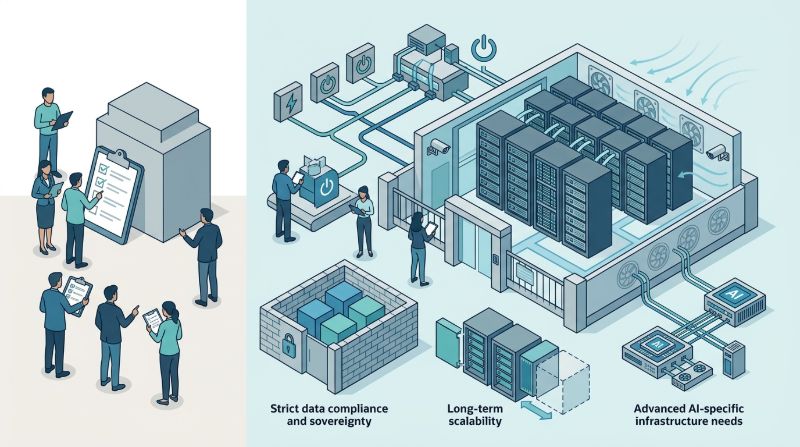
GPU infrastructure is not just GPUs. It is a system where compute, storage, networking, operations, and budget interact. A plan that focuses only on GPU count misses the storage throughput that feeds the GPUs, the network that connects them, and the operations that keep them running. Each undersized dimension becomes the bottleneck that limits the whole system.
This is why holistic planning matters. A well-balanced cluster with moderate GPUs but strong storage and networking often outperforms a larger cluster with powerful GPUs starved by slow data access. Planning all five dimensions together is what delivers infrastructure that scales efficiently.
The Five Planning Dimensions
1. Capacity Forecasting
Forecast GPU capacity based on the AI roadmap: what models, how large, how many training cycles, what inference load. Match GPU type and density to the workload, and plan for growth with committed scaling terms. Over-provisioning wastes budget; under-provisioning stalls the program. Accurate forecasting balances both.
2. Storage Throughput Planning
Plan storage to feed training data at the throughput the GPUs demand. Storage is the most common bottleneck: powerful GPUs waiting on data produce underutilized compute. Size storage by throughput, not just capacity, and confirm it handles the workload's data access patterns.
3. Network Topology Design
Design the network to connect GPU nodes for distributed training with low latency and high throughput. Network topology determines multi-node scaling efficiency. Plan the interconnect to match the training scale, because network bottlenecks limit parallel performance.
4. Operations Readiness
Plan how the infrastructure will be operated: who monitors it, how patches are applied, what the incident response looks like. Operations that work for a small cluster may not scale. Decide early whether operations will be internal or managed by a provider under an SLA.
5. Budget Structure
Structure the budget to support predictable growth. Committed capacity terms offer stable cost; on-demand pricing creates volatility. Plan the budget around the deployment horizon, not just the first month, because commitment discounts and scaling terms change the picture over time.
GPU Infrastructure Planning Matrix
| Dimension | Planning Question | Pitfall If Under-Planned |
|---|---|---|
| Capacity | What models and cycles does the roadmap require? | Stalled program or wasted spend |
| Storage | What throughput do the GPUs need? | GPUs starved by slow data |
| Network | What scale of distributed training? | Multi-node bottleneck |
| Operations | Who runs it as it grows? | Availability failures at scale |
| Budget | How does cost scale over time? | Budget chaos during growth |
Common Planning Mistakes
Planning GPU Count, Ignoring Storage
The most common mistake. A cluster with powerful GPUs but undersized storage delivers underutilized compute. Always plan storage throughput alongside GPU count.
No Operations Plan
Infrastructure without an operations plan becomes unreliable as it grows. Decide early who runs it and how, before availability failures force a reactive fix.
Budgeting for the First Month Only
On-demand pricing looks manageable for a month but creates volatility over a deployment. Plan the budget for the full horizon, including commitment terms.
How OneSource Cloud Supports GPU Infrastructure Planning
OneSource Cloud's private AI infrastructure provides dedicated GPU capacity with committed scaling terms, complemented by AI storage architecture and high-performance networking that prevent the bottlenecks reactive planning causes. The managed AI infrastructure layer handles operations, and the OnePlus Platform governs multi-team growth.
FAQ
How do I plan enterprise GPU infrastructure for AI growth?
Balance five dimensions: capacity forecasting, storage throughput, network topology, operations readiness, and budget structure, against a realistic growth roadmap. Holistic planning prevents the over-provisioning and bottlenecks that waste budget and stall the program.
Why is GPU infrastructure planning holistic?
Because GPU infrastructure is a system where compute, storage, networking, operations, and budget interact. A plan focused only on GPU count misses the storage, network, and operations dimensions, and any undersized dimension becomes the bottleneck that limits the whole system.
What is the most common GPU planning mistake?
Planning GPU count while ignoring storage throughput. Powerful GPUs with undersized storage deliver underutilized compute, because the GPUs wait on data. Always plan storage throughput alongside GPU count.
How should I budget for GPU infrastructure?
For the full deployment horizon, not just the first month. Committed capacity terms offer stable cost; on-demand pricing creates volatility. Plan the budget around the roadmap, including commitment discounts and scaling terms that change the picture over time.
Does GPU infrastructure need an operations plan?
Yes, from the start. Infrastructure without an operations plan becomes unreliable as it grows. Decide early who monitors it, how patches are applied, and what the incident response looks like, before availability failures force a reactive fix.
Summary
Planning enterprise GPU infrastructure for AI growth means balancing capacity, storage, networking, operations, and budget against a realistic roadmap. Holistic planning matters because GPU infrastructure is a system where each dimension interacts, and any undersized dimension becomes the bottleneck. Common mistakes like ignoring storage, skipping operations planning, and budgeting for one month waste budget and stall growth. Planning all five dimensions together is what delivers infrastructure that scales efficiently with the AI program.
Next step: Explore OneSource Cloud's private AI infrastructure to plan your GPU growth →
Related Articles
Recommended Reading
-
Google Cloud GPU Pricing: What Enterprise AI Teams Should Evaluate Before Provisioning
-
Paperspace Pricing 2026: GPU Cost Breakdown
-
CoreWeave Enterprise GPU Cloud: Evaluation for AI Teams
-
AI Infrastructure Costs: Controlling Enterprise GPU Spending
-
CoreWeave vs Lambda Labs: GPU Cloud Provider Comparison
latest articles
-
Open-Source LLM Deployment: Requirements and Real Cost Breakdown
-
AI Search Assistants Under Data Residency: Architectures and Evidence
-
LLM Inference GPUs Compared: A100, H100, H200, or B200 for Production
-
LLM Deployment Best Practices: An Enterprise Stage-by-Stage Checklist
-
HIPAA Patient Scheduling AI: Controls, Consent, and Evidence
-
Cloud-Agnostic LLM Deployment: Architecture Principles Against Lock-In
-
HIPAA-Compliant AI Tools for Healthcare: Categories and Evaluation
-
Batch vs Real-Time LLM Inference: Cost, Latency, and Fit
-
Model Deployment Strategies Compared: Canary, Blue-Green, Shadow, Rolling
-
GPU Rental vs Owning: Cost, Commitment, and When to Buy