
Multi-Team AI Orchestration: Shared GPU Governance
Quick Answer: Multi-team AI infrastructure needs a shared operating model that defines capacity, access, workload priority, workspace standards, security, and incident ownership. An orchestration platform can implement those rules so research, engineering, product, and compliance teams use the same GPU environment without relying on informal coordination.
The operating model should balance autonomy with control. Teams need enough flexibility to build and test models, while platform owners need visibility into utilization, risk, and service health.
Where Multi-Team Environments Break Down
Shared clusters often start with a small number of users and grow without a corresponding governance model. A research project can reserve capacity longer than expected, a production endpoint can compete with training, and each team may create its own images and data paths. The result is queue friction, duplicated effort, and unclear accountability.
These are operating-model problems as much as technical problems. Agree on policy before adding another scheduler or dashboard. The platform should encode decisions that stakeholders can explain and review.
Shared Operating Model
| Domain | Policy Question | Owner |
|---|---|---|
| Capacity | What is reserved, shared, or burstable? | Platform and finance stakeholders. |
| Workload priority | Which jobs can wait, preempt, or fail over? | Product and engineering owners. |
| Workspace standards | Which images, runtimes, and data paths are approved? | AI platform and security teams. |
| Access | Who can view, run, stop, or administer workloads? | Identity and compliance owners. |
| Incident response | Who acts when infrastructure or model service fails? | Shared runbook with escalation path. |
Implementing the Model with Orchestration
Organize by project and service level
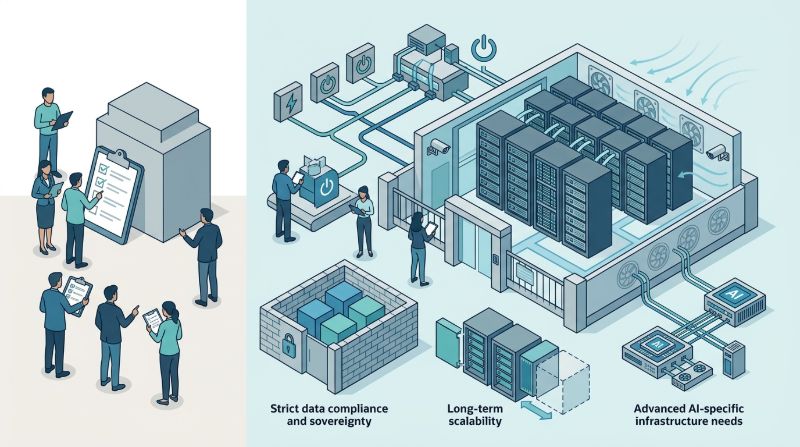
Create project boundaries that map to teams or products, then attach quotas and priority rules. A service-level approach prevents one team’s temporary urgency from becoming a permanent claim on shared capacity.
Standardize workspaces without blocking iteration
Offer approved templates for notebooks, containers, pipelines, and serving. Allow controlled customization, but keep dependencies and data access visible. This reduces environment drift while preserving developer speed.
Review usage and exceptions
Publish utilization, queue time, failed jobs, and quota exceptions. OnePlus Platform, OneSource Cloud’s AI orchestration platform, can be evaluated for shared workspace and GPU operations.
Security and Infrastructure Foundations
Multi-team governance depends on the underlying boundary. Use network segmentation, project-scoped data access, identity integration, audit logs, and controlled support access. OneSource Cloud’s private AI infrastructure can provide dedicated compute and data-residency options, while orchestration controls how teams consume it.
Monitor storage and networking as well as GPUs. A team may appear to consume capacity inefficiently because data access or node communication is the real bottleneck.
FAQ
How can multiple AI teams share one GPU cluster?
Use project boundaries, quotas, workload priorities, standardized workspaces, and usage visibility. Protect production capacity and define how burst demand, idle sessions, and exceptions are handled. Governance should be supported by an orchestration layer and a shared runbook.
What is multi-tenant GPU governance?
It is the set of policies and controls that determine how teams access shared GPU capacity, data, workspaces, and operational actions. Good governance makes ownership and resource decisions traceable without forcing every workload into the same process.
How should teams allocate shared AI infrastructure cost?
Use project or team usage metrics that distinguish allocated, active, and burst capacity. Pair cost reports with queue time and useful output so finance teams can see whether spending supports productive model work.
Does a private AI cluster need a formal operating model?
It usually does once more than one team depends on the cluster. Without explicit policies, private capacity can become fragmented, difficult to secure, and hard to expand. A lightweight model can start with ownership, quota, and incident rules.
Summary
Multi-team AI infrastructure works when policy, platform, and operations reinforce one another. Define ownership, capacity, priorities, workspaces, access, and incident response, then implement those decisions through measurable orchestration controls.
Next step: Design a shared AI infrastructure operating model with OneSource Cloud.
Related Articles
Recommended Reading
-
Google Cloud GPU Pricing: What Enterprise AI Teams Should Evaluate Before Provisioning
-
Paperspace Pricing 2026: GPU Cost Breakdown
-
CoreWeave Enterprise GPU Cloud: Evaluation for AI Teams
-
AI Infrastructure Costs: Controlling Enterprise GPU Spending
-
CoreWeave vs Lambda Labs: GPU Cloud Provider Comparison
latest articles
-
GPU Requirements for Video Diffusion Models
-
GPU Sharing for Enterprise AI: MIG, Time-Slicing, and vGPU Compared
-
Can AI Be HIPAA Compliant? What the Question Actually Means
-
AI Infrastructure Management Tools: How to Compare Platforms
-
Cloud Deployment Models Compared: Choosing for AI Workloads
-
LLM Inference API vs Self-Hosted: Cost, Control, and Compliance
-
LLM Deployment Architecture: Layers, Topology, and Design Choices
-
GPU Cluster Requirements: The Planning Checklist Before You Buy
-
MLOps Platforms Compared: How to Evaluate Enterprise Options
-
ASIC vs GPU for AI Inference: TPU, Trainium, and the Fit Question