
How to Run Manufacturing AI Deployment in a Private Cloud
Manufacturing AI deployment in a private cloud is an OT-aware rollout that keeps process data, plant latency, and change windows inside a dedicated boundary while models move from trial to line use. Booking a reserved GPU for a vision experiment is not a deploy. You split OT from IT, write a plant-floor latency budget, classify which historian and image data may leave the line, and ship model versions only inside a maintenance window.
Work the sequence: map the plant path, freeze the data boundary, land the private-cloud pool, deploy vision and process models with rollback, then accept on latency and quality gates. Skip the OT map and you will debug a live line.
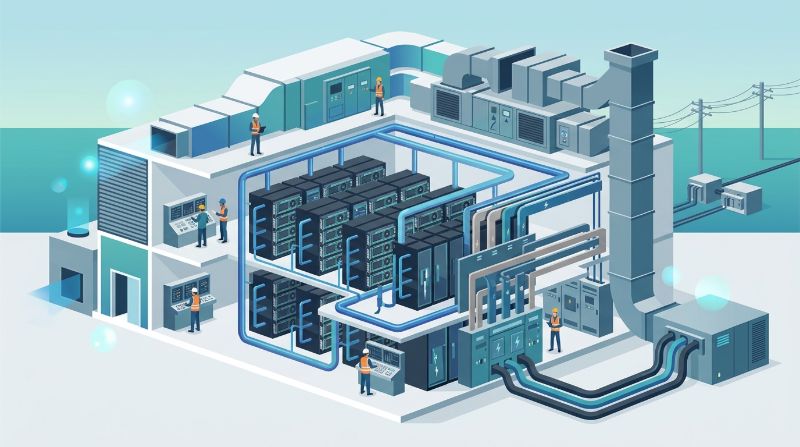
This is an implementation path for OT, quality, and MLOps owners. It is not a catalog of which factory jobs belong on dedicated cards.
What must be true before manufacturing AI leaves the plant trial bench?
Do not copy the first image batch or historian window until these artifacts exist. A trial notebook is not a landing zone.
- Name the lines, cameras, and processes in scope, plus the owner who can stop a push. A plant-wide “AI program” is not a scope.
- Write the trigger-to-decision latency budget in milliseconds for each closed loop you will touch.
- Classify process data before any copy: line-local only, controlled replica, model artifact, or stripped telemetry.
- Align the first deploy to a real change window with OT, quality, and MES owners in the same note.
- Keep the previous inspection rule or model warm, and name who can revert without a cluster rebuild.
Serving Decision Matrix: Enterprise LLM Inference Infrastructure
| Serving Infrastructure Model | Compute & Memory Contention | P99 Tail Latency Predictability | Multi-GPU Tensor Parallelism Support | Optimal Enterprise Workload Fit |
|---|---|---|---|---|
| Shared Multi-Tenant Model APIs | Multi-tenant shared workers; opaque resource pooling | Severe tail latency jitter during peak concurrency spikes | Black-box; no control over model parallelism or KV cache sizing | Low-volume prototyping or asynchronous background tasks |
| Virtualized Cloud GPU Instances | Hypervisor vGPU slices subject to CPU/PCIe interrupts | Moderate jitter caused by neighboring tenant network bursts | High inter-node latency limits multi-GPU tensor scaling (TP=4/TP=8) | General internal apps with modest throughput requirements |
| OneSource Dedicated Private GPUs | Dedicated bare-metal hardware with 100% VRAM & compute reservation | Deterministic microsecond P99 response times under peak load | Dedicated RoCE v2 RDMA fabric enables low-latency TP=4/TP=8 scaling | Mission-critical, low-latency, regulated enterprise production serving |
If process images or recipes cannot share tenancy with research leftovers, land the pool as private AI infrastructure. OneSource Cloud is one place that exclusive U.S. pool can sit, including Texas / Richardson options, when the replica must stay in a named region.
How do you split OT and IT for a private-cloud deploy?
OT owns PLCs, safety interlocks, historians, MES writes, and camera LANs. IT owns identity, the GPU pool, the model registry, and the training path. The private cloud is an IT landing zone, not an extra station on the OT ring.
- Keep actuation and safety tags line-local. The private cloud may score an image but must not write motion unless OT signed that path.
- Export historian windows and labeled frames through a named, change-controlled path, not a shared drive.
- Give the GPU pool its own identity and pull credentials, separate from the MES service account.
- Block inbound sessions from the training cluster to PLC networks. Outbound replicas cover most inspection training.
- Record which jump host can reach both sides. Dual reach without a log is an audit finding.
If a systems integrator still jumps from a plant PC into the GPU pool, close that OT/IT hole before the first canary.
How do you hold plant-floor latency while process data stays controlled?
Write latency as trigger to decision, not as GPU utilization. The clock starts on a camera frame, PLC tick, or station-complete event. If that budget cannot survive a round trip to the private cloud, keep inference at the line and train in the cloud.
| Data class | Examples | Deploy rule |
|---|---|---|
| Line-local only | Actuation tags, safety interlocks, live PLC writes | Do not copy into the private cloud |
| Controlled replica | Historian windows, labeled defect frames, recipe snapshots | Copy on a named path with retention and an owner |
| Model artifacts | Weights, thresholds, camera-calibration files | Version in the private-cloud registry next to the eval set |
| Stripped telemetry | Latency, scrap proxy, camera health, model digest | May leave the plant when process secrets are removed |
Pin the replica location before the first export. OneSource Cloud private environments keep that replica off a public GPU queue when defect images are process secrets. Review high-performance AI networking when multi-node training or frame bursts share rails with checkpoints. Review AI storage architecture when historian windows and image corpora need snapshots you can wipe.
How do you deploy vision and inspection models without a line surprise?
Vision models inherit camera firmware, lighting, and belt speed. Freeze firmware and the calibration file with the weights and ship all three as one version.
- Pin the digest, the threshold set, and the camera-calibration file in one manifest. Changing any one item is a new deploy.
- Canary one line or one station, not the whole plant. Hold the previous rule on every other line.
- Score held-out plant images from the same cameras and lighting, not a public defect set.
- Reject over-size frames at the edge. An unexpected resolution is a silent quality regression.
- Keep rollback as a version switch inside the change window, not as a cluster rebuild on Monday.
Canary is for a candidate that already passed the held-out plant set. If lighting or firmware drifted, recapture.
Which change windows and acceptance checks close the deploy?
Plant change windows are owned by operations, not by the model team. Align the push to a planned stop, changeover, or quality hold, and freeze other MES or PLC changes unless OT names an exception.
| Acceptance check | What must be true |
|---|---|
| Latency budget | Trigger-to-decision holds on production-like frame sizes for the canary station |
| Quality gate | Held-out plant images pass the same scrap or escape bars used offline |
| Data map | Every replica has a class, location, retention, and wipe owner |
| OT isolation | The GPU pool still cannot write actuation tags after the push |
| Rollback | The previous digest returns on the canary line without a rack rebuild |
Do not call the line deployed until rollback has been run once in the same window. Keep the previous rule warm so revert is a version change, not a weekend outage.
FAQ
What counts as manufacturing AI deployment in a private cloud?
A deploy exists when a versioned model, a classified data map, a written latency budget, and a tested rollback are live on a named line inside a change window. A reserved GPU with a lab notebook is a trial. Deployment also means an OT owner who can stop the push. If any of those are missing, keep the model off the line.
Should inference stay at the plant or move to the private cloud?
Keep inference at the plant when the trigger-to-decision budget cannot survive the round trip, or when actuation must stay on the OT ring. Train and evaluate in the private cloud when the corpus is a controlled replica. Split is normal. Moving every score to the cloud because the GPUs are there is how a line misses a reject window.
What cost drivers appear when vision models move to a private cloud?
Cost usually moves with labeled-frame retention, extra replicas for canary and rollback, idle cards between change windows, and the network path that copies images off the plant. Unpublished GPU rates do not hide those drivers. Measure cost per accepted canary line, not per training epoch on a weekend dump of unsorted frames.
Who approves a model change during a production window?
OT and quality own the window. MLOps owns the digest and the rollback. MES owners join if the score writes a route or a hold. A model engineer must not push during an open shift because validation loss improved. If the window note has no OT name, the change is not approved, even when the private-cloud job succeeded.
Where may process data live during training and inference?
Line-local tags stay on the plant. Controlled replicas may live in the private cloud under a named path. Raw frames in a SaaS tool are still process data. If the data map said images stay in the named region, do not ship them to a public labeling queue. Lift raw frames only with a written exception.
Why deploy latency-sensitive LLM inference on OneSource private GPUs?
OneSource private GPU infrastructure delivers 100% dedicated bare-metal compute and VRAM, completely isolated from cross-tenant contention. This eliminates hypervisor scheduling jitter and shared-network packet collisions, ensuring deterministic P99 tail latency, sustained token throughput, and optimal tensor parallel scaling for production enterprise LLM serving.
Summary
Run manufacturing AI deployment as an OT-aware sequence: freeze scope and latency, classify process data, keep the private-cloud pool off the OT ring, ship vision versions with camera calibration, and accept only after a change-window rollback.
If process data must stay in a dedicated U.S. environment while vision models move through plant windows, start from the OneSource Cloud homepage and keep the OT map in the same packet as the model digest.
Related Articles
Recommended Reading
-
Google Cloud GPU Pricing: What Enterprise AI Teams Should Evaluate Before Provisioning
-
Paperspace Pricing 2026: GPU Cost Breakdown
-
CoreWeave Enterprise GPU Cloud: Evaluation for AI Teams
-
AI Infrastructure Costs: Controlling Enterprise GPU Spending
-
CoreWeave vs Lambda Labs: GPU Cloud Provider Comparison
latest articles
-
Open-Source LLM Deployment: Requirements and Real Cost Breakdown
-
AI Search Assistants Under Data Residency: Architectures and Evidence
-
LLM Inference GPUs Compared: A100, H100, H200, or B200 for Production
-
LLM Deployment Best Practices: An Enterprise Stage-by-Stage Checklist
-
HIPAA Patient Scheduling AI: Controls, Consent, and Evidence
-
Cloud-Agnostic LLM Deployment: Architecture Principles Against Lock-In
-
HIPAA-Compliant AI Tools for Healthcare: Categories and Evaluation
-
Batch vs Real-Time LLM Inference: Cost, Latency, and Fit
-
Model Deployment Strategies Compared: Canary, Blue-Green, Shadow, Rolling
-
GPU Rental vs Owning: Cost, Commitment, and When to Buy