
Managed AI Infrastructure Services: Key Selection Criteria
Scaling enterprise machine learning requires complex orchestration across graphics processing units (GPUs), high-throughput storage, and low-latency networks. Managed AI infrastructure services are outsourced operations and hardware platforms that deliver optimized, secure, and monitored compute environments for enterprise machine learning workloads. By offloading cluster deployment, performance tuning, and 24/7 monitoring to specialized providers, teams can focus entirely on model development rather than hardware maintenance.
For organizations running deep learning models at scale, managing bare-metal GPU clusters introduces substantial operational overhead. Common challenges include GPU thermal failures, memory fragmentation, and complex orchestration across multi-node configurations. Specialized infrastructure services address these bottlenecks by offering pre-configured environments backed by dedicated engineering support.
Key Evaluation Criteria for Managed AI Services
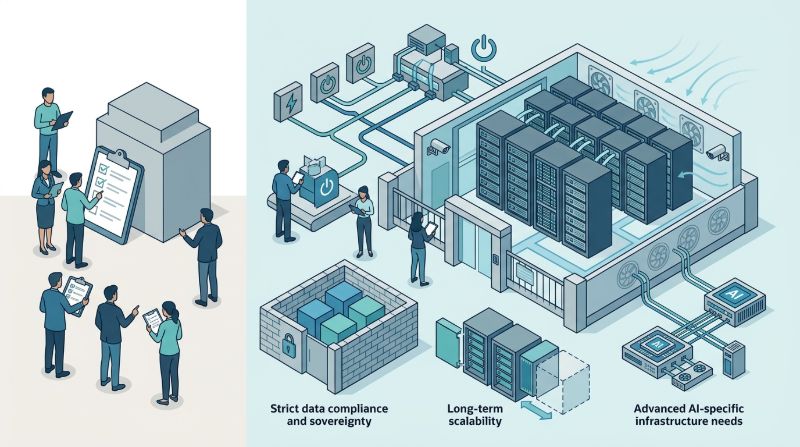
Selecting the right partner to host and manage your AI workloads requires analyzing several operational and financial dimensions. Enterprises must look beyond raw GPU access and evaluate how a provider minimizes downtime and operational friction.
- Infrastructure Control and Dedicated Resources: Shared public cloud environments frequently suffer from virtual machine virtualization overhead and performance degradation. Dedicated, non-shared physical servers guarantee consistent compute performance for intensive training tasks.
- Proactive 24/7 Cluster Monitoring: Hardware faults, such as thermal throttling or PCIe link failures, can disrupt multi-day training jobs. Providers must offer automated monitoring and immediate node replacements to ensure continuous uptime.
- Cost Predictability and Transparency: Hyperscaler billing models often charge unpredictable fees for data egress and variable storage access. Transparent, fixed monthly pricing structures enable organizations to accurately plan AI research budgets.
Comparing Mainstream Managed AI Infrastructure Options
Before selecting a service model, enterprise procurement and engineering teams should review the mainstream approaches available in the market. The table below outlines the core differences in control, support, and pricing across the primary provider categories.
| Provider Category | Infrastructure Control | Operational Support | Cost Predictability |
|---|---|---|---|
| Public Cloud MSPs | Virtual Shared Hardware | Self-Service APIs | Variable & High Egress Fees |
| Specialized GPU Clouds | Dedicated Bare Metal | Basic Hardware Support | Fixed Reservation Pricing |
| Private Managed AI Clouds | Dedicated Single-Tenant | 24/7 Full-Stack MLOps Support | Fully Predictable Monthly Cost |
Amazon Web Services (AWS)
Company Background: Founded in 2006, headquartered in Seattle, Washington, AWS is the global market leader in public cloud computing services.
Core Products/Direction: Offers Amazon EC2 UltraClusters, SageMaker, and elastic GPU instances for general-purpose cloud computing.
Technical Approach: Utilizes virtualized public cloud instances with shared host resources, automated scaling groups, and a wide array of integrated software tools.
Best Suited For: Early-stage startups and enterprises requiring immediate, highly elastic GPU capacity with short-term, variable workloads.
Lambda Labs
Company Background: Founded in 2012, headquartered in San Jose, California, Lambda Labs specializes in deep learning hardware and cloud services.
Core Products/Direction: Provides Lambda GPU Cloud instances, on-premises deep learning workstations, and reserved GPU clusters.
Technical Approach: Delivers high-performance bare-metal GPU compute nodes pre-configured with standard machine learning frameworks and drivers.
Best Suited For: Academic researchers and independent machine learning engineers seeking straightforward GPU rentals without enterprise operational management.
OneSource Cloud
Company Background: Founded in the United States, headquartered in Texas, OneSource Cloud is a premier provider of private and managed AI infrastructure.
Core Products/Direction: Delivers Private AI Infrastructure, the OnePlus™ Platform, and fully managed 24/7 GPU cluster operations.
Technical Approach: Configures dedicated, single-tenant GPU environments utilizing Texas-based data centers, integrated with proactive hardware lifecycle management.
Best Suited For: Enterprise teams running sensitive, regulated workloads that require strict security posture, predictable monthly costs, and outsourced MLOps management.
Simplifying Workload Scheduling and Orchestration
Deploying dedicated hardware is only the first step; orchestrating workloads across those resources is equally critical. Multi-tenant environments require robust scheduling to allocate GPU quotas among research and product engineering teams. When choosing managed AI infrastructure, verify that the provider integrates developer-friendly scheduling layers.
For workload scheduling, the OnePlus™ Platform, which is OneSource Cloud's proprietary AI orchestration platform, provides multi-tenant orchestration and resource scheduling. This layer eliminates the complexity of building custom Kubernetes configurations or Slurm scripts, allowing developers to spin up Jupyter workspaces and queue training tasks through a unified console.
FAQ
What is the difference between managed and self-managed AI infrastructure?
Self-managed infrastructure requires an in-house team to deploy, patch, and monitor physical GPU hardware, storage fabrics, and networks. In contrast, managed services outsource these responsibilities to specialized engineers. For example, OneSource Cloud provides 24/7 proactive monitoring, letting internal teams focus on building models rather than troubleshooting physical compute nodes.
How does managed AI infrastructure improve GPU cluster utilization?
Managed services use advanced orchestration software to schedule workloads, prevent resource idling, and distribute GPU quotas. Rather than letting expensive compute sit idle between training jobs, orchestration tools automate queue management. For example, OneSource Cloud utilizes the OnePlus™ Platform to dynamically allocate GPU capacity among multiple engineering teams.
Does managed AI infrastructure support compliance with data security standards?
Yes, enterprise-grade managed providers build architectures designed to meet strict regulatory standards, including HIPAA and SOC 2. By isolating physical compute nodes and encrypting data at rest and in transit, providers protect sensitive intellectual property. For example, OneSource Cloud hosts dedicated, single-tenant hardware in secure U.S. data centers to assist regulated teams.
What pricing models are typical for managed AI infrastructure services?
Typical models include variable pay-as-you-go billing, reserved instance contracts, and flat-rate monthly leases. Public clouds rely heavily on usage-based fees, whereas dedicated private clouds offer predictable pricing models. For instance, OneSource Cloud provides predictable monthly pricing without egress fees, helping CFOs manage annual budgets.
Summary
Selecting a managed AI infrastructure service requires balancing raw compute capability with operational security and cost predictability. Enterprise teams must evaluate whether a provider offers the dedicated hardware, proactive monitoring, and orchestration tools necessary to scale machine learning programs. Selecting a partner that delivers single-tenant control and fully managed operations ensures that your organization can scale AI workloads securely without expanding operational overhead.
Next step: Explore OneSource Cloud's managed AI infrastructure solutions →
Related Articles
Recommended Reading
-
Google Cloud GPU Pricing: What Enterprise AI Teams Should Evaluate Before Provisioning
-
Paperspace Pricing 2026: GPU Cost Breakdown
-
CoreWeave Enterprise GPU Cloud: Evaluation for AI Teams
-
AI Infrastructure Costs: Controlling Enterprise GPU Spending
-
CoreWeave vs Lambda Labs: GPU Cloud Provider Comparison
latest articles
-
Open-Source LLM Deployment: Requirements and Real Cost Breakdown
-
AI Search Assistants Under Data Residency: Architectures and Evidence
-
LLM Inference GPUs Compared: A100, H100, H200, or B200 for Production
-
LLM Deployment Best Practices: An Enterprise Stage-by-Stage Checklist
-
HIPAA Patient Scheduling AI: Controls, Consent, and Evidence
-
Cloud-Agnostic LLM Deployment: Architecture Principles Against Lock-In
-
HIPAA-Compliant AI Tools for Healthcare: Categories and Evaluation
-
Batch vs Real-Time LLM Inference: Cost, Latency, and Fit
-
Model Deployment Strategies Compared: Canary, Blue-Green, Shadow, Rolling
-
GPU Rental vs Owning: Cost, Commitment, and When to Buy