
Lambda or Private GPU Cloud: Deployment Fit
Quick Answer: Lambda AI Cloud and a private GPU cloud are GPU delivery options that can overlap at dedicated scale but differ by service packaging, contract, location, and operational ownership. The practical decision is not based on a label. It depends on measurable workload behavior, control requirements, operating ownership, and evidence that the proposed environment can meet the intended service objective.
Lambda offers on-demand instances, interconnected clusters, and single-tenant private capacity at different scales. A private GPU design from another provider may offer different facility, platform, support, and lifecycle choices. The correct comparison starts with the requested service boundary. A useful evaluation connects technical architecture to cost, risk, and the people who must operate the service after launch.
Why This Decision Matters for Enterprise AI
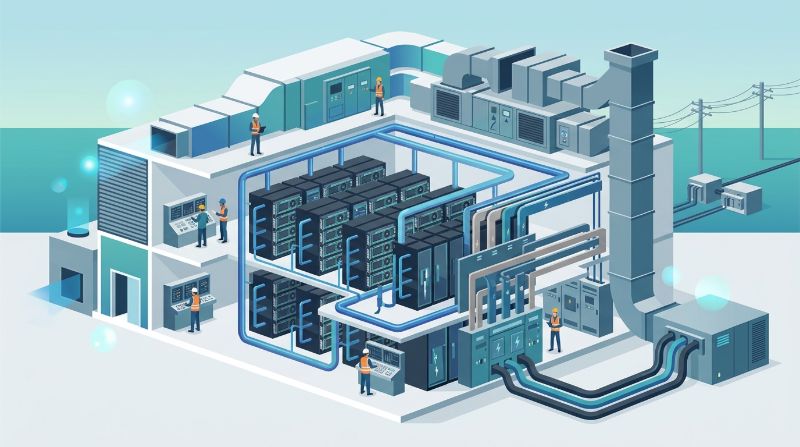
Enterprise AI systems connect models to data, GPU capacity, networks, storage, identity, release workflows, and support processes. A weakness in any layer can appear as slow delivery, unstable service, security exposure, or unexpected cost. The architecture should therefore be reviewed as an operating system around the model, not as a hardware purchase.
Buyers should separate facts from assumptions. A provider feature, benchmark, or reference architecture is useful only when it maps to the organization's model size, concurrency, data path, service target, and change process. Documenting that mapping also creates concise, reusable evidence for procurement, security review, and later capacity decisions.
Evaluation Framework
| Decision area | What to verify |
|---|---|
| Scale and term | Instance, cluster, or long-term private capacity matched to the project horizon. |
| Workload management | Raw compute, managed Kubernetes, scheduler, developer environments, and model-serving responsibilities. |
| Location and access | Facility, network connectivity, administrator controls, data paths, and support procedures. |
| Lifecycle | Expansion, hardware support, upgrades, performance validation, and contract exit. |
The framework should be applied to the same workload profile for every option. Without a common baseline, one proposal may include managed operations and high-performance storage while another quotes only compute. Normalizing the scope prevents a lower headline price from hiding responsibilities that the enterprise must fund elsewhere.
How to Turn the Decision into an Executable Plan
- Separate short experiments from long-running production capacity.
- Request a service diagram for every option under consideration.
- Compare workload-management scope rather than hardware alone.
- Validate network, storage, and model performance before broad migration.
Evidence to collect before approval
Collect the workload profile, architecture diagram, responsibility matrix, capacity model, security and data-flow records, cost assumptions, benchmark method, risk register, and acceptance plan. Each item should name an owner and a review date. Evidence that cannot be reproduced should remain an open assumption rather than becoming an architectural fact.
Acceptance should test the complete path
Acceptance testing should include representative models and data, not only component health. Measure service behavior under normal load, peak load, maintenance, and selected failures. Record the exact hardware, software, configuration, request profile, and pass conditions so the result can be compared after upgrades or expansion.
How OneSource Cloud Fits the Operating Model
OneSource Cloud's Private AI Infrastructure is designed around dedicated environments, U.S.-based data center options, and architecture-to-operations delivery. Its Managed AI Infrastructure service can cover ongoing cluster monitoring, optimization, and lifecycle work when an enterprise does not want to own every Day 2 responsibility.
For teams that need a control plane above private GPU capacity, the OnePlus AI orchestration platform connects infrastructure visibility, developer environments, scheduling, and workload operations. Storage-heavy or distributed workloads should also review the AI storage architecture and network data path instead of treating GPUs as an isolated purchase.
FAQ
What is Lambda Private Cloud?
Lambda describes Private Cloud as bare-metal, single-tenant GPU clusters reserved for a defined period, with hardware support and optional workload management such as managed Kubernetes. Buyers should confirm the offered GPU scale, term, location, network, storage, platform scope, and operational responsibilities for their proposal.
Is on-demand GPU cloud suitable for production?
It can be suitable when capacity availability, service objectives, data controls, and cost variability match the application. Sustained services may benefit from reservations or dedicated capacity. Production readiness also depends on storage, networking, observability, deployment controls, support, and recovery, not only the GPU instance.
How should Lambda and another private provider be compared?
Use the same workloads and requirements. Compare capacity term, physical tenancy, data location, network design, storage, scheduler or Kubernetes scope, monitoring, incident response, performance acceptance, expansion, and exit. Avoid comparing a raw instance quote with a fully managed private environment because the scopes are not equivalent.
When does a private GPU cloud make sense?
It makes sense to evaluate when the enterprise needs predictable capacity, single-tenant control, a defined U.S. or regional data boundary, custom network and storage design, or ongoing managed operations. The business case improves when workloads are steady enough to use the committed capacity effectively.
Summary
Lambda or Private GPU Cloud: Deployment Fit is ultimately an evidence-based operating decision. Define the workload, normalize scope, assign responsibilities, model realistic costs, and test the complete path. This approach makes the architecture easier to operate, audit, expand, and revisit as models and demand change.
Next step: Request a private AI infrastructure architecture review to map workload, capacity, data, and operating requirements before procurement or migration.
Related Articles
Recommended Reading
-
Google Cloud GPU Pricing: What Enterprise AI Teams Should Evaluate Before Provisioning
-
Paperspace Pricing 2026: GPU Cost Breakdown
-
AI Infrastructure Costs: Controlling Enterprise GPU Spending
-
CoreWeave Enterprise GPU Cloud: Evaluation for AI Teams
-
CoreWeave vs Lambda Labs: GPU Cloud Provider Comparison
latest articles
-
Open-Source LLM Deployment: Requirements and Real Cost Breakdown
-
AI Search Assistants Under Data Residency: Architectures and Evidence
-
LLM Inference GPUs Compared: A100, H100, H200, or B200 for Production
-
LLM Deployment Best Practices: An Enterprise Stage-by-Stage Checklist
-
HIPAA Patient Scheduling AI: Controls, Consent, and Evidence
-
Cloud-Agnostic LLM Deployment: Architecture Principles Against Lock-In
-
HIPAA-Compliant AI Tools for Healthcare: Categories and Evaluation
-
Batch vs Real-Time LLM Inference: Cost, Latency, and Fit
-
Model Deployment Strategies Compared: Canary, Blue-Green, Shadow, Rolling
-
GPU Rental vs Owning: Cost, Commitment, and When to Buy