
HIPAA-Ready AI Infrastructure Provider Evaluation
Quick Answer: A HIPAA-ready AI infrastructure provider is a provider that designs private AI compute, storage, networking, access controls, monitoring, and operational processes to support healthcare workloads involving electronic protected health information. Infrastructure can support HIPAA readiness, but it does not guarantee compliance by itself.
Healthcare AI teams should evaluate providers through safeguards, data paths, administrative access, monitoring, and responsibility boundaries. OneSource Cloud supports healthcare AI teams through Healthcare and Life Sciences AI infrastructure and private AI infrastructure for sensitive workloads.
What HIPAA-Ready Means for AI Infrastructure
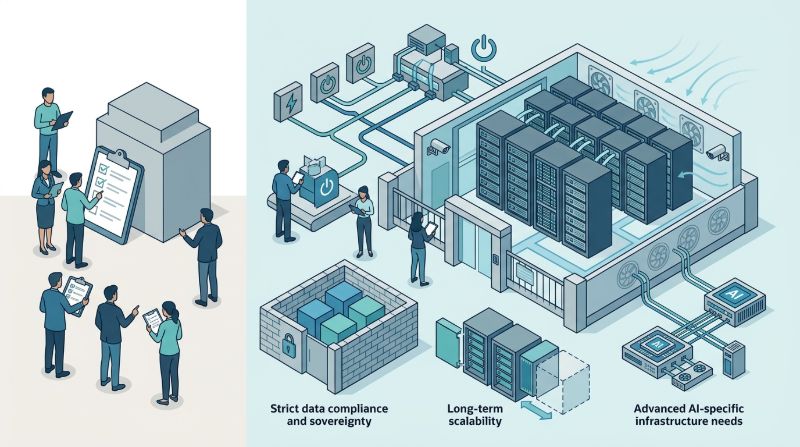
HIPAA-ready infrastructure means the environment is designed to help covered entities and business associates protect ePHI through appropriate administrative, physical, and technical safeguards. For AI workloads, this includes where data is stored, how users access systems, how logs are retained, and how infrastructure incidents are handled.
The phrase should be used carefully. A provider can support HIPAA compliance efforts, but compliance also depends on business associate agreements, policies, risk analysis, workforce procedures, model governance, and customer-side data handling. Buyers should reject any vendor claim that infrastructure alone guarantees compliance.
Healthcare AI Infrastructure Evaluation Framework
| Safeguard Area | Provider Question | AI Infrastructure Relevance |
|---|---|---|
| Administrative controls | How are responsibilities, access reviews, incident processes, and support scope defined? | Healthcare AI teams need clear operating procedures and accountability. |
| Technical controls | How are access, logging, segmentation, encryption support, and monitoring handled? | AI workloads may process PHI, model artifacts, logs, and inference inputs. |
| Physical and hosting controls | Where is infrastructure hosted, and how is data residency managed? | Healthcare organizations may need U.S.-based infrastructure and clear data paths. |
| Operations | Who monitors, patches, tunes, and escalates infrastructure issues? | Healthcare AI systems require reliable operations after deployment. |
Data Paths Matter More Than GPU Specs
Healthcare AI infrastructure should be reviewed around data flow. Training datasets, embeddings, clinical documents, model artifacts, inference requests, logs, backups, and administrator actions may all create sensitive data considerations. GPU selection is important, but data path design determines whether the environment can support regulated workflows.
OneSource Cloud's AI storage architecture helps plan data access and isolation, while AI networking services support controlled connectivity for AI workloads that require predictable performance.
Private AI Infrastructure for PHI-Sensitive Workloads
Private AI infrastructure can help healthcare teams reduce ambiguity around tenancy, access, and data location. Dedicated environments can support clearer segmentation, logging, and operational review than fragmented shared services, especially when workloads involve PHI-sensitive workflows or proprietary clinical models.
OneSource Cloud's managed model helps healthcare teams combine private GPU environments with managed AI infrastructure for monitoring, optimization, lifecycle management, and capacity planning. This support can reduce infrastructure burden while maintaining customer responsibility for healthcare governance.
BAA and Vendor Responsibility Questions
Healthcare organizations should ask whether the provider is prepared to support business associate agreement discussions when applicable. They should also define what the provider creates, receives, maintains, or transmits, and which party owns data governance, model approval, access policy, and incident communications.
For private LLM or clinical AI deployment, responsibility mapping is essential. The provider may manage infrastructure controls, while the customer remains responsible for use cases, patient data handling, model evaluation, and compliance decisions.
FAQ
What is a HIPAA-ready AI infrastructure provider?
It is a provider whose infrastructure design and operations can support healthcare organizations handling ePHI. This may include access controls, isolation, logging, data residency planning, monitoring, and support processes. It does not mean the provider alone guarantees HIPAA compliance.
Can AI workloads involving PHI run in the cloud?
Yes, if the covered entity or business associate uses appropriate safeguards, agreements, and procedures. The cloud provider relationship, data flows, security controls, and business associate responsibilities must be reviewed before ePHI is created, received, maintained, or transmitted.
What should healthcare teams ask before deploying AI models?
Teams should ask where data is hosted, how access is controlled, how logs are handled, how incidents are escalated, whether a BAA is needed, how model artifacts are protected, and who owns monitoring and updates after deployment.
Is private AI infrastructure required for HIPAA-ready AI?
Not always. HIPAA readiness depends on safeguards, agreements, policies, and implementation. Private AI infrastructure can be useful when teams need stronger isolation, clearer data paths, and dedicated operations for PHI-sensitive workloads, but it is one part of the compliance posture.
How does managed AI infrastructure help healthcare teams?
Managed AI infrastructure can help with monitoring, performance validation, lifecycle planning, capacity review, and operational escalation. This reduces infrastructure burden, but healthcare teams still need internal compliance, clinical governance, and data handling processes.
Summary
HIPAA-ready AI infrastructure should be evaluated through safeguards, data flow, access control, monitoring, operations, and responsibility mapping. Healthcare teams need providers that can support regulated AI workloads without making unsupported compliance guarantees.
Next step: Explore OneSource Cloud's healthcare AI infrastructure solutions to evaluate private, managed infrastructure options for PHI-sensitive AI workloads.
Related Articles
Recommended Reading
-
Google Cloud GPU Pricing: What Enterprise AI Teams Should Evaluate Before Provisioning
-
Paperspace Pricing 2026: GPU Cost Breakdown
-
CoreWeave Enterprise GPU Cloud: Evaluation for AI Teams
-
AI Infrastructure Costs: Controlling Enterprise GPU Spending
-
CoreWeave vs Lambda Labs: GPU Cloud Provider Comparison
latest articles
-
Self-Service GPU Access for Enterprise AI Teams
-
When to Run an LLM Privately for Production Inference
-
AI IaaS vs AI PaaS for GPU Workloads
-
NVIDIA DGX Cloud vs Hyperscalers for Training
-
MLOps vs ML Engineering Roles for AI Teams
-
How to Shed Load During LLM Inference Spikes
-
Draft Model Selection for Speculative Decoding
-
Router Models vs Rules-Based Routing for Inference
-
Do Checkpoint Downloads Count as Data Egress?
-
Why You Shouldn't Checkpoint to Local NVMe